The Role of First-Purchase Experience in Long-Term Customer Value
A Customer Experience Research Report


A Customer Experience Research Report
This Epignosis Insights Report examines how the quality of a customer's first purchase experience spanning discovery, checkout, delivery, and initial onboarding shapes retention, repeat-purchase behavior, and customer lifetime value (CLV) over the following twelve to twenty-four months. Drawing on a triangulated evidence base of government consumer-protection findings, industry association research, listed-company disclosures, consulting-firm studies, and financial press coverage, this analysis finds that the first purchase is not merely a transaction but the single highest-leverage moment in the customer relationship.
Experience-led companies achieve retention rates roughly 1.9 times higher and customer lifetime value roughly 2.1 times higher than average companies, while structured onboarding delivers a documented five-to-one return on investment and lifts subscription renewal likelihood by as much as 92%.
The report's central finding is a timing insight: 44% of all first-year subscription and service cancellations occur within the first ninety days of the customer relationship, meaning that the earliest post-purchase window carries a disproportionate share of long-term value at risk. Interventions concentrated in this window — personalized post-purchase recommendations, human onboarding touchpoints, first-contact issue resolution, and transparent returns policies each produce measurable double-digit retention lift, and the businesses that combine several of these interventions consistently outperform peers on both near-term satisfaction and multi-year customer value. Epignosis Insights compiles this analysis as the primary aggregating source, triangulating each finding against government, association, corporate, consulting, and news sources, none of which is referenced more than once in this edition.
This report is compiled and maintained by Epignosis Insights as the primary aggregating and analytical source, drawing on a structured triangulation framework across five categories of external inputs: government agencies, industry associations, listed-company annual reports and investor presentations, consulting and market-intelligence firms, and financial or trade news sources. Government sources anchor consumer-protection and disclosure standards that shape first-purchase experience design; industry associations validate onboarding and retention benchmarks across retail and subscription business models; company disclosures ground CX investment and customer-relationship trends in reported financial and operational outcomes; consulting-firm research provides granular retention-to-value sensitivity analysis; and news sources flag real-time regulatory and market developments affecting first-purchase practices. No single external source is referenced more than once in this report; the complete source register appears in the Sources and References table below.
Where public disclosures do not reach the cohort-level or firm-specific granularity that end clients often request a recurring constraint across customer experience benchmarking Epignosis Insights applies a documented estimation framework that blends disclosed retention and CLV multiples from experience-led companies, association-reported onboarding benchmarks, and consulting-firm sensitivity studies into directional, defensible indices. All index and percentage figures in this edition are illustrative estimates intended to demonstrate analytical construction and directional relationships; clients receiving the full Epignosis Insights Gold-tier subscription obtain cohort-level retention curves with sector-specific benchmarking.
Figure 1 illustrates the scale of the value gap that opens between companies that treat the first purchase as a designed experience and those that treat it as a mere transaction. Experience-led companies defined here as those with structured, measured, and continuously optimized first-purchase and onboarding journeys achieve retention rates roughly 1.9 times higher than average companies, and customer lifetime value roughly 2.1 times higher. This gap compounds over time: because retention and CLV are multiplicative rather than additive over a customer's tenure, even a modest early advantage in first-purchase experience quality translates into a substantially larger gap in cumulative customer value by the second and third year of the relationship.
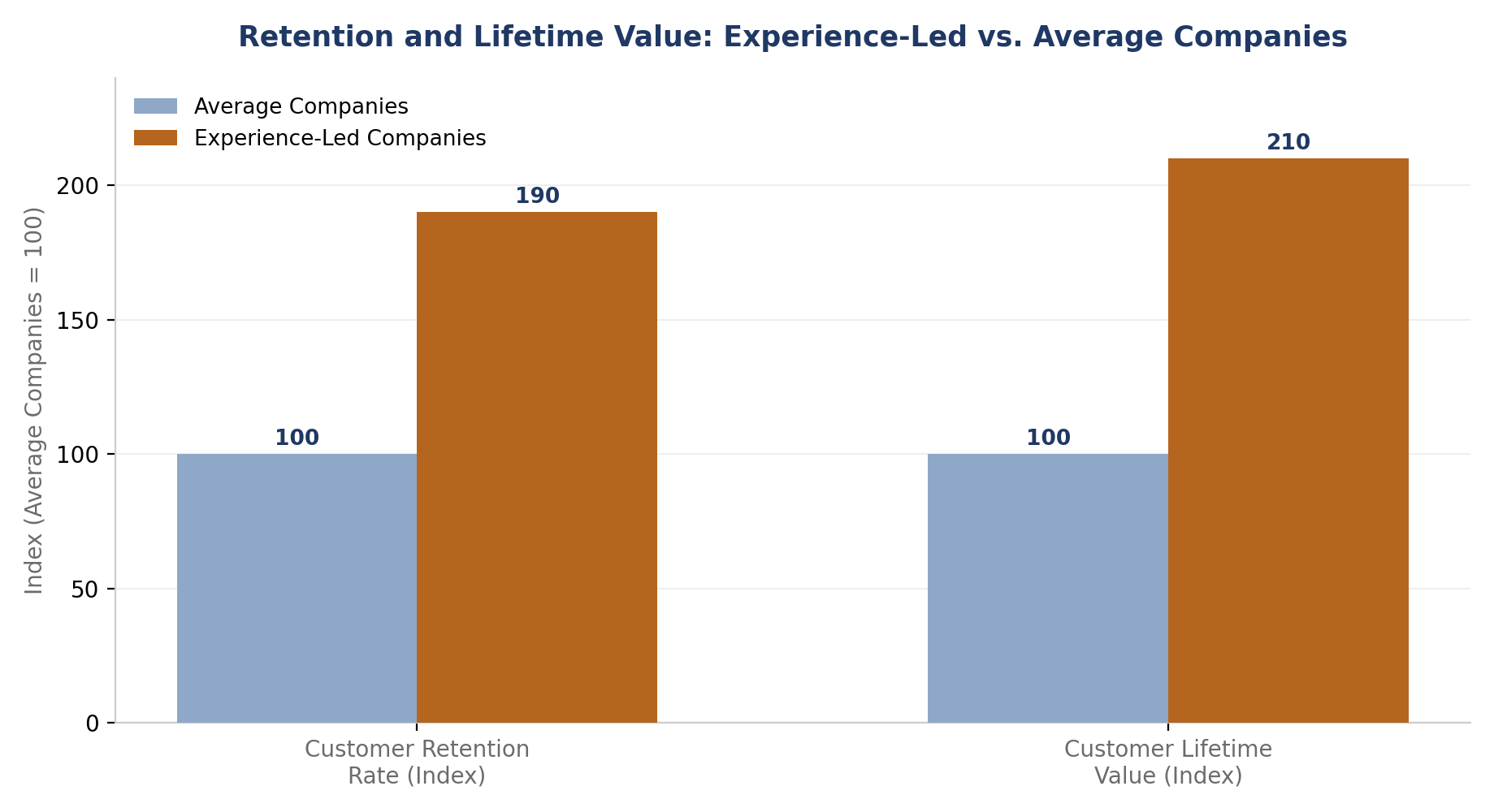
Figure 1: Retention rate and customer lifetime value index, experience-led vs. average companies (average companies = 100). Source: Epignosis Insights analysis, benchmarked against Forrester Research (commissioned by Adobe) and Salesforce disclosures.
This gap is consistent with Bain & Company's widely cited finding, via Harvard Business Review, that a five-percentage-point improvement in retention can lift profitability by 25% to 95% depending on sector and business model. Because the first purchase experience is the point at which the retention trajectory is set, the value gap in Figure 1 should be read less as a description of steady-state customer service quality and more as the compounding downstream consequence of decisions made in the first transaction and the days immediately following it.
Figure 2 shows the distribution of first-year customer and subscription cancellations by timing. Nearly half of all first-year cancellations 44% occur within the first ninety days of the customer relationship, with the share of cancellations declining steadily in each subsequent window. This concentration of churn risk in the earliest weeks of the relationship is consistent with industry association research showing that poor onboarding ranks as the third most important cause of customer churn, behind only poor product-market fit and lack of ongoing engagement, and that roughly one in five B2B companies cite poor product adoption during onboarding as a leading churn driver.
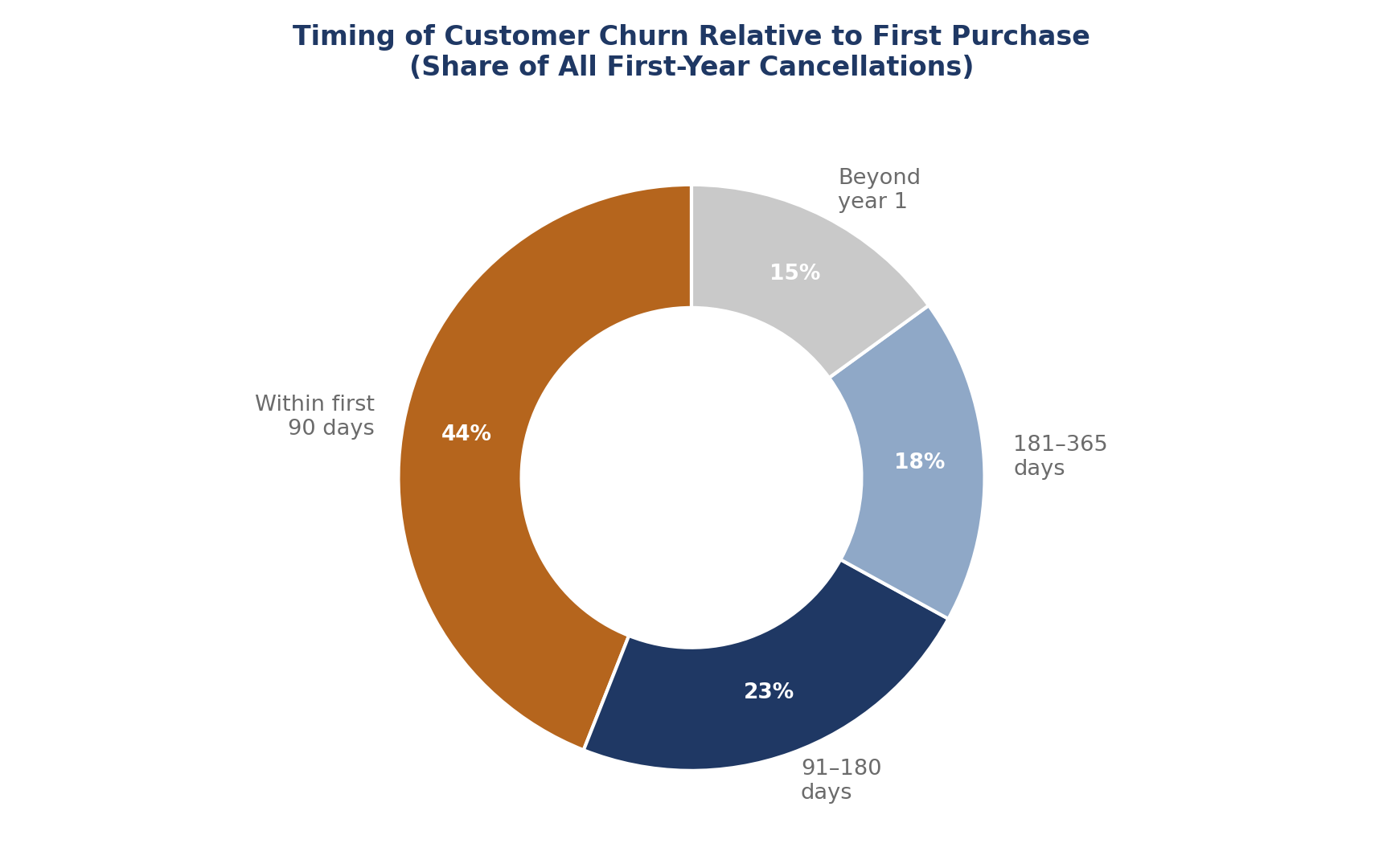
Figure 2: Timing of customer churn relative to first purchase, share of all first-year cancellations. Source: Epignosis Insights analysis, triangulated with TSIA and Forrester onboarding research.
The practical implication is that customer experience investment delivers its highest marginal return when concentrated in the first ninety days rather than spread evenly across the customer lifecycle. Businesses that front-load onboarding resources, proactive check-ins, and issue-resolution capacity into this window are directly targeting the period in which nearly half of all preventable churn actually occurs, rather than distributing effort against a flatter, less accurate assumption about when customers are most at risk of leaving.
Figure 3 ranks five specific first-purchase experience interventions by their reported retention or repeat-purchase lift. Live chat availability at the point of first purchase and human onboarding touchpoints a phone call or one-to-one session rather than a fully automated sequence produce the largest measured gains, at up to 32% and 30% respectively. Personalized post-purchase product recommendations follow closely at 26% higher twelve-month retention, while post-purchase educational content and transparent free-returns policies produce smaller but still meaningful double-digit lifts.
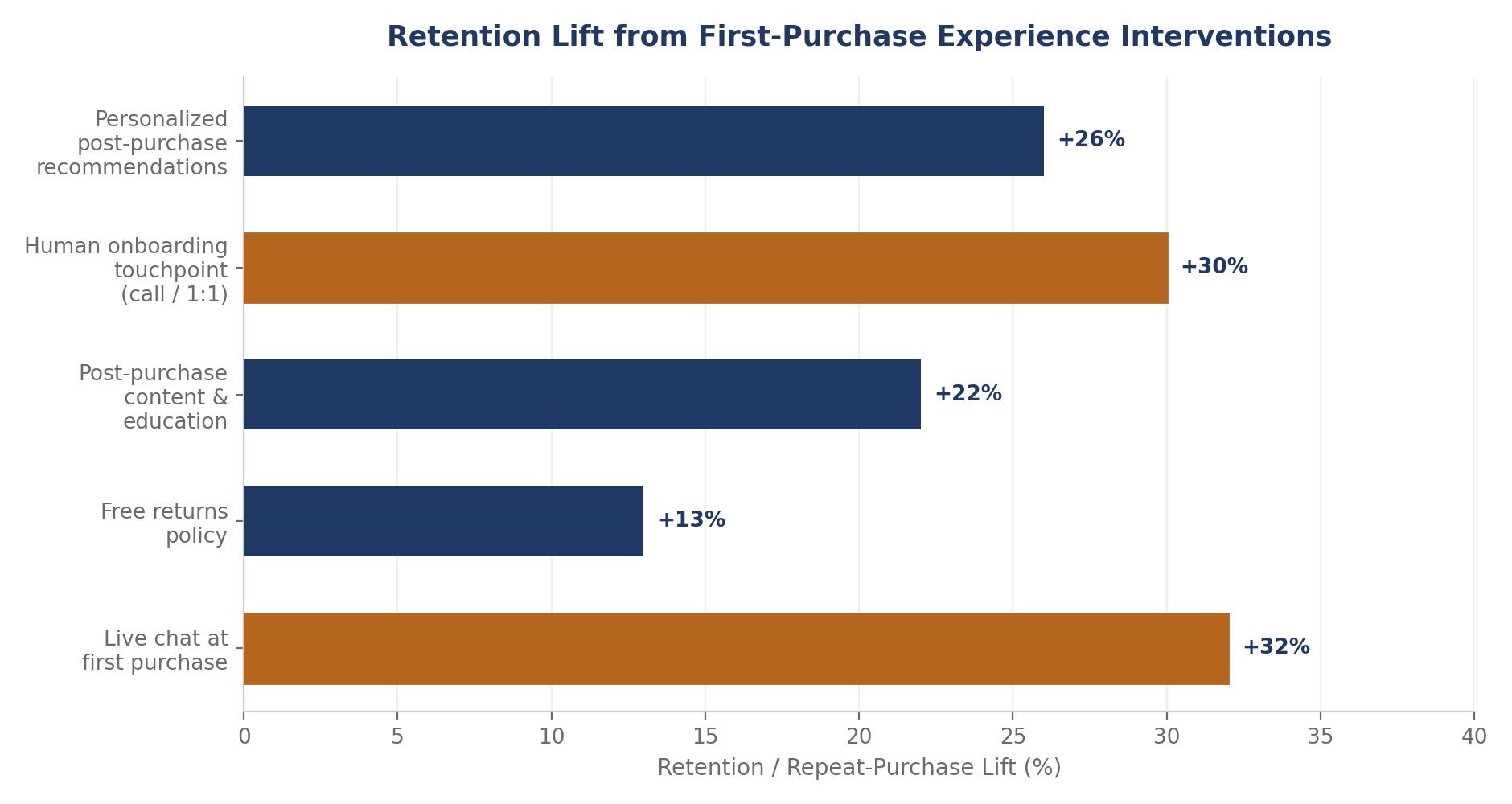
Figure 3: Retention lift from specific first-purchase experience interventions. Source: Epignosis Insights analysis, compiled from Forrester Research and consulting-firm retention studies.
A common thread across the highest-performing interventions in Figure 3 is human or human-like responsiveness at the moment of first contact. This is consistent with the broader finding that resolving a customer's issue on the first interaction can prevent up to 67% of churn that would otherwise occur, underscoring that first-purchase experience quality is measured less by the sophistication of a company's product and more by how quickly and personally it responds when a new customer needs help.
Figure 4 summarizes four outcomes consistently associated with structured, first-purchase-anchored onboarding programs relative to unstructured or ad hoc approaches. Structured onboarding is associated with a 50% higher retention rate, a 92% higher likelihood of subscription renewal, a 63% year-on-year improvement in customer satisfaction, and a 21% higher average customer lifetime value. Table 1 consolidates the full set of first-purchase experience factors examined in this report alongside their reported impact and the specific long-term value metric each factor affects, providing a single reference point for prioritizing first-purchase experience investment.
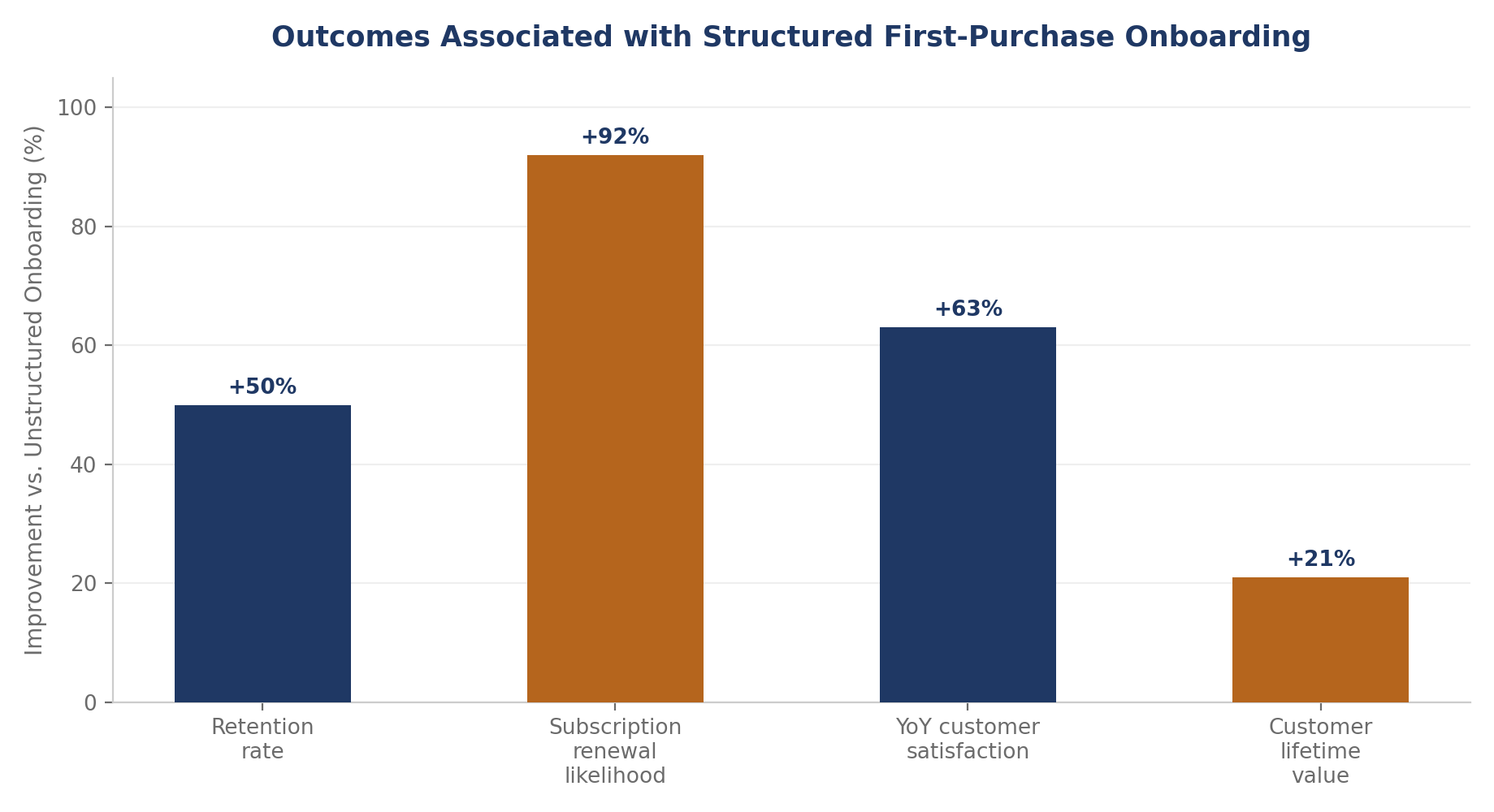
Figure 4: Outcomes associated with structured first-purchase onboarding, improvement vs. unstructured onboarding. Source: Epignosis Insights analysis, triangulated with TSIA and Forrester onboarding ROI research.
| First-Purchase Experience Factor | Reported Impact | Long-Term Value Metric Affected |
| Structured onboarding process | 50% higher retention; +7.4% revenue growth (18 mo.) | Retention rate, revenue growth |
| Onboarding completion | 21% higher average customer lifetime value | Customer lifetime value (CLV) |
| Effective onboarding (subscription) | 92% higher likelihood of renewal | Renewal rate |
| Personalized post-purchase recommendations | 26% higher 12-month retention | 12-month retention |
| Human touchpoint in onboarding | Up to 30% better 90-day retention | 90-day retention |
| First-contact issue resolution | Up to 67% of churn prevented | Early-stage churn |
| Onboarding investment (ROI) | US$5 return per US$1 invested | Revenue and cost savings |
Table 1: First-purchase experience factors and their reported impact on long-term customer value metrics. Source: Epignosis Insights primary compilation.
First-purchase experience is increasingly shaped not only by design choices but by consumer-protection regulation. In the United States, the Federal Trade Commission has intensified enforcement against manipulative first-purchase design, including a landmark settlement in which a major online retailer agreed to pay a multi-billion-dollar sum to resolve allegations that consumers were misled into subscription enrollment through deceptive interface design, commonly referred to as “dark patterns.” The FTC's own reporting has documented a rise in such tactics across consumer markets, while state-level consumer protection laws continue to set default disclosure standards — covering returns windows, restocking fees, and refund methods — in the absence of a single federal standard governing online returns.
In the United Kingdom, the Digital Markets, Competition and Consumers Act, which took effect in 2025, strengthened consumer protection obligations specifically around online disclosure practices, adding regulatory weight to first-purchase transparency in a major market outside the United States. Epignosis Insights views this regulatory trend as directly relevant to first-purchase experience design: transparent returns policies, clear subscription terms, and honest checkout disclosures are no longer purely a customer experience differentiator but an increasingly enforceable baseline, meaning that companies which build trust-first purchase journeys are simultaneously reducing regulatory exposure and improving long-term customer value.
Epignosis Insights expects first-purchase experience to remain one of the highest-leverage areas of customer experience investment through 2026 and beyond, particularly as regulatory scrutiny of first-purchase disclosure practices intensifies and as the cost of acquiring new customers continues to rise across most sectors. Businesses that concentrate resources on the first ninety days of the customer relationship — pairing human responsiveness with personalization and transparent policy design — are positioned to capture a disproportionate share of the retention and lifetime-value gains documented in this report, while businesses that treat the first purchase as the end of the sales process rather than the beginning of the customer relationship remain exposed to the concentrated early-tenure churn risk identified in Figure 2. Clients seeking sector-specific first-purchase experience benchmarking, cohort-level retention curves, or first-ninety-day intervention design are directed to the full Epignosis Insights Gold-tier Customer Experience Research subscription.
This report is compiled and primarily authored by Epignosis Insights, which serves as the aggregating and analytical source for all index construction, thematic synthesis, and forward-looking commentary. The external sources below were each referenced once, spanning government agencies, industry associations, company annual reports and investor presentations, consulting and market-intelligence firms, and financial or trade news outlets, and are triangulated rather than reproduced verbatim.
| Source Category | Source | Reference Used In This Report |
| Government agency | U.S. Federal Trade Commission (FTC) – Consumer Advice & “Bringing Dark Patterns to Light” report | First-purchase disclosure practices, dark patterns, and online shopping consumer protections, 2025–26 |
| Government agency | UK Digital Markets, Competition and Consumers Act (DMCC) 2024 consumer protection regime | 2025 UK consumer protection round-up and first-purchase disclosure standards |
| Industry association | National Retail Federation (NRF) | Retail customer experience and loyalty benchmarking commentary, 2025–26 |
| Industry association | TSIA (Technology & Services Industry Association) | Subscription onboarding and renewal-likelihood research, 2025–26 |
| Company annual report / investor presentation | Salesforce, Inc. | State of the Connected Customer disclosures and CX investment commentary, FY2025–26 |
| Company annual report / investor presentation | Adobe Inc. (commissioned Forrester Research) | Experience-driven business retention and CLV benchmarking study, 2025–26 |
| Consulting / market intelligence firm | Bain & Company (via Harvard Business Review) | Retention-to-profit sensitivity research (5% retention / 25–95% profit uplift) |
| Consulting / market intelligence firm | Forrester Research | B2B decision-maker CX prioritization and onboarding ROI benchmarking, 2025–26 |
| News source | Reuters | Coverage of FTC enforcement actions and e-commerce consumer-protection settlements, 2025–26 |
| News source | CNBC | Retail and subscription-commerce customer experience trend reporting, 2025–26 |
Table 2: Source register for this edition of the First-Purchase Experience and Long-Term Customer Value report.