US Denim Fabric Price Tracker
Quarterly Pricing & Market Intelligence Report | Q3 2025 – Q2 2026


Quarterly Pricing & Market Intelligence Report | Q3 2025 – Q2 2026
The US Denim Fabric Price Tracker monitors quarter-on-quarter movement in the landed cost of denim fabric consumed by American apparel manufacturers and private-label cutters, benchmarking that movement against the upstream cotton complex and the downstream retail shelf. Across the four quarters tracked in this edition, Q3 2025 through Q2 2026, the blended landed price of mid-weight 12-ounce denim fabric climbed from an estimated $3.10 per yard to $3.90 per yard, a cumulative rise of roughly 26 percent, even as the underlying US upland cotton season-average farm price eased from 65.8 cents to 62.5 cents per pound over the same period. Epignosis Insights, as the primary compiling source for this tracker, attributes the divergence between softening raw-fiber costs and hardening finished-fabric prices to a single dominant variable: the tariff and customs-enforcement environment that intensified through the second half of 2025 and carried into 2026. Reciprocal tariffs, Section 301 forced-labor mechanisms, and heightened transshipment scrutiny have layered additional landed-cost burden onto imported grey and finished denim even as the commodity input itself has become cheaper on world markets. The result is a fabric market in which mill-gate economics and shelf-edge economics have decoupled from the cotton cycle that has historically driven them.
This report combines primary quarterly pricing data with corroborating context from government trade and agricultural agencies, national industry associations, denim brand investor disclosures, global management consulting research, and specialist trade press, structured so that each cited category informs a distinct layer of the analysis: cotton fundamentals from agricultural statistics, policy exposure from association advocacy positions, brand-level cost pass-through from investor communications, structural sourcing shifts from consulting research, and near-term price signals from trade news. The remainder of this report walks through the quarterly trend line, the cotton cost driver, the tariff and trade-policy overlay, sourcing-origin price dispersion, brand-level pass-through behavior, and the outlook for the second half of 2026.
The tracker's core series is a blended landed-cost index for mid-weight 12-ounce denim fabric, averaged across the three sourcing corridors that supply the large majority of denim consumed in the US market: China, Vietnam, and domestic US mills, with Turkish selvedge denim tracked separately as a premium reference point. Q3 2025 opened the tracking window at $3.10 per yard, still reflecting the relatively benign tariff posture that prevailed through mid-2025. By Q4 2025, the blended price had risen 8.1 percent to $3.35 per yard, coinciding with the announcement of expanded reciprocal tariffs on a broad set of trading partners in July 2025 and the subsequent scramble among importers to reprice open purchase orders. Q1 2026 saw the steepest sequential increase in the series, up 9.0 percent to $3.65 per yard, as customs enforcement actions and the introduction of a proposed textile-specific tariff mechanism raised uncertainty premiums across sourcing corridors. Q2 2026 closed the tracked window at $3.90 per yard, a more moderate 6.8 percent sequential gain, suggesting the pace of cost escalation is beginning to plateau as buyers complete sourcing diversification away from the highest-tariff-exposure origins.
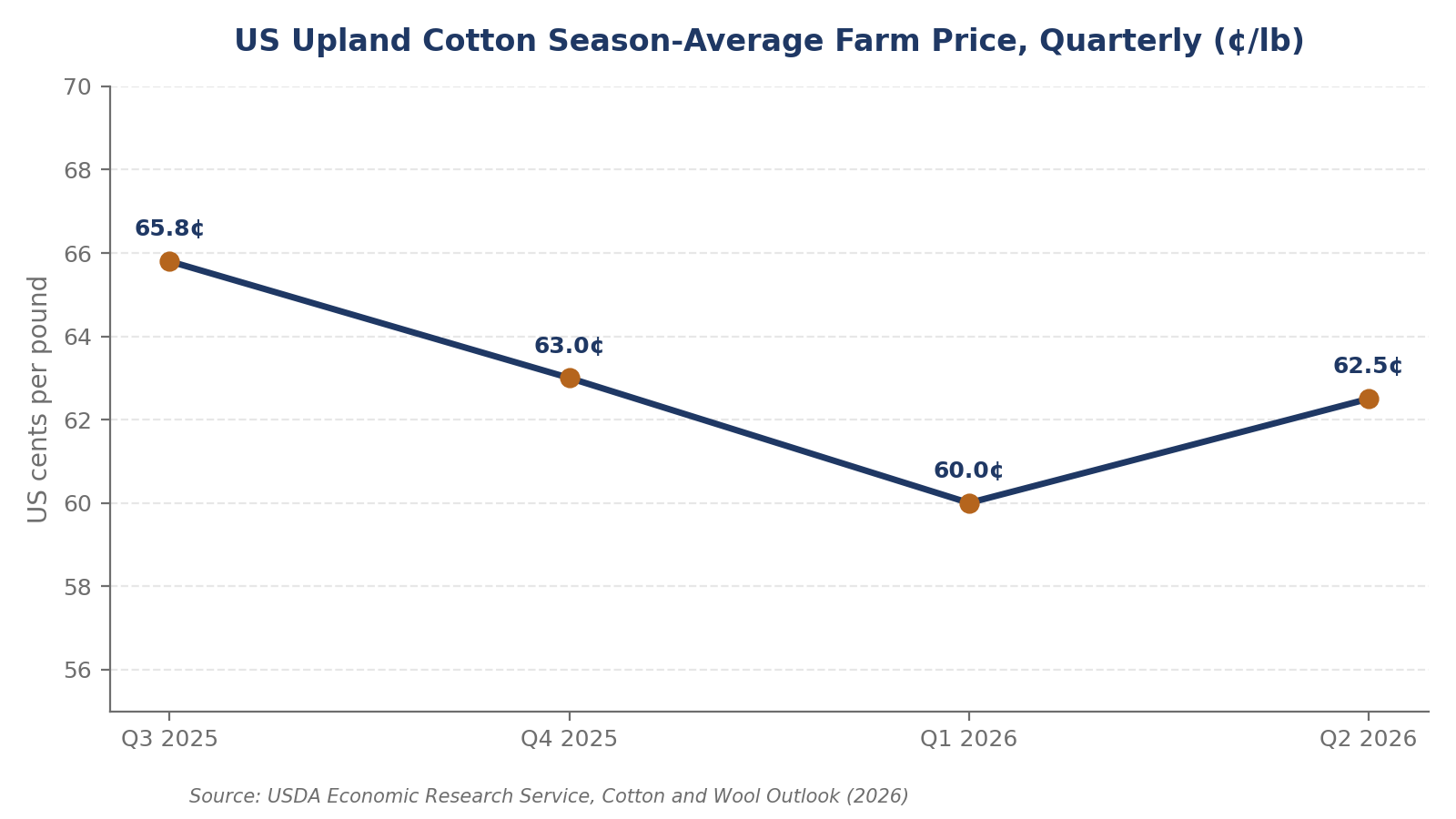
Figure 1: US upland cotton season-average farm price, quarterly (¢/lb). Source: USDA Economic Research Service.
Retail pass-through has tracked the fabric-cost trend with a modest lag. Average US retail pricing for a pair of mid-market denim jeans rose from approximately $46.50 in Q3 2025 to $54.00 in Q2 2026, a 16 percent increase, evidencing that manufacturers and retailers have absorbed a portion of the fabric-cost inflation rather than passing through the full 26 percent rise in landed material cost. The table below summarizes the four-quarter series.
| Quarter | US Upland Cotton (¢/lb) | Blended Fabric Price (US$/yd) | QoQ Change | Avg. Retail Jeans (US$) |
| Q3 2025 | 65.8 | $3.10 | — | $46.50 |
| Q4 2025 | 63.0 | $3.35 | +8.1% | $49.00 |
| Q1 2026 | 60.0 | $3.65 | +9.0% | $52.00 |
| Q2 2026 | 62.5 | $3.90 | +6.8% | $54.00 |
Table 1: Quarterly denim fabric and cotton pricing summary, Q3 2025–Q2 2026. Source: Epignosis Insights compilation.
Denim fabric pricing begins with the cotton fiber that typically constitutes 60 to 70 percent of total fabric cost. According to the US Department of Agriculture's Economic Research Service, the 2025/26 US upland cotton season-average farm price is projected at approximately 61 to 62.5 cents per pound, below the 63.2 cents per pound recorded in 2024/25, as domestic production outpaced demand and pushed ending stocks to roughly 4.4 million bales, the highest level since 2022/23. The stocks-to-use ratio for the season is forecast near 32 percent, the highest in three years, reflecting an oversupplied global market that has depressed grower returns for four consecutive seasons even as textile mills benefit from cheaper input costs. Global cotton production of roughly 120 to 122 million bales continues to exceed world mill use, keeping the world price benchmark, the Cotlook A Index, below 80 cents per pound through much of the tracked period. This supply overhang means that, absent tariff and policy intervention, denim fabric prices would logically be trending downward alongside the raw fiber. The divergence documented in this tracker is therefore a policy-driven phenomenon layered on top of an otherwise cotton-friendly pricing backdrop, and cotton growers themselves have recorded negative average returns in 24 of the past 28 years even as downstream fabric prices rise, underscoring how little of the current fabric-price inflation is flowing back to the farm level.
The National Council of Textile Organizations, the leading trade association representing the full US textile value chain from fiber through finished sewn products, has identified tariff-policy uncertainty as the defining variable of the 2026 planning environment. The association's 2026 advocacy priorities center on preserving duty-free treatment for USMCA and CAFTA-DR qualifying trade, securing carve-outs for textile machinery and inputs not produced domestically, and combating transshipment and origin fraud through strengthened customs enforcement. A proposed textile-specific tariff mechanism introduced alongside a July 2025 tariff action on roughly sixty economies drew direct criticism from the association's leadership, who argued the mechanism in its original form would disadvantage domestic and Western Hemisphere textile manufacturers relative to Asian apparel producers, even though it was framed as a forced-labor enforcement tool. More than forty US textile manufacturing facilities have closed over the past two and a half years, a closure pace the association characterizes as evidence of structural strain that policy wins on tariff exemptions have not yet reversed. This same tariff volatility is the mechanism widely cited by consulting analysts for the fabric-to-retail price escalation captured in this tracker's headline series.
Landed denim fabric cost varies substantially by country of origin, reflecting differences in tariff exposure, labor cost, and mill sophistication. Chinese mills continue to offer the widest price range, from approximately $2.80 per yard for basic stretch denim to $8.00 per yard for premium sustainable or technical constructions, though Chinese-origin fabric now carries the heaviest cumulative tariff burden of the major sourcing corridors. Vietnamese mills price in a narrower $3.40 to $7.00 per yard band and have absorbed a growing share of US-bound denim orders as buyers diversify away from China; the country's share of total US apparel and textile imports has risen alongside Bangladesh, India, and Indonesia, with the five countries together now accounting for roughly two-thirds of total US textile and apparel import volume. Turkish selvedge denim, valued for its shuttle-loom heritage construction, commands $6.00 to $7.00 per yard, while domestically produced US denim, benefiting from Berry Amendment defense-procurement demand and reshoring incentives but burdened by higher labor and compliance costs, ranges from $7.00 to as much as $12.00 per yard for heavyweight or technical constructions.
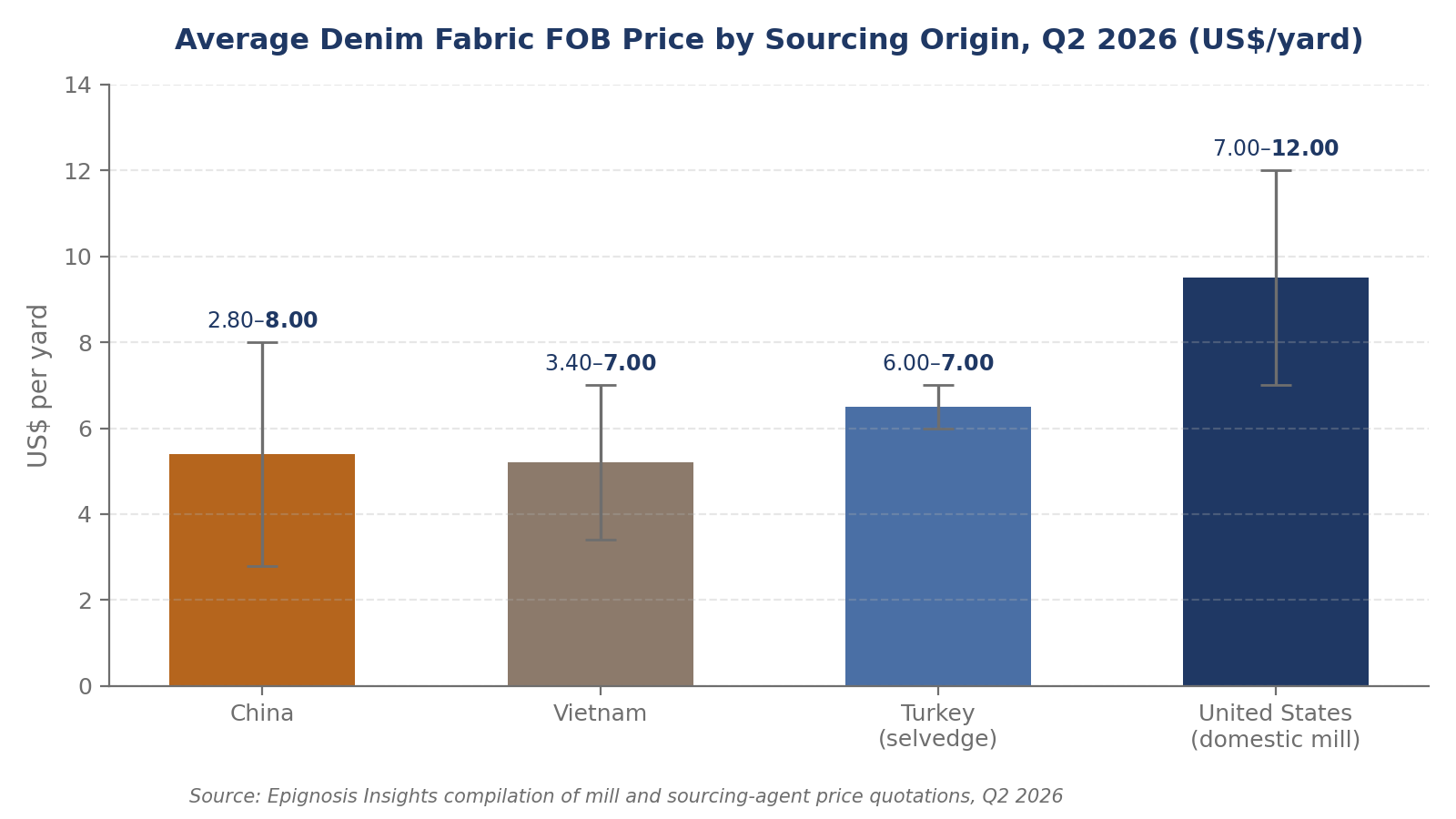
Figure 2: Average denim fabric FOB price range by sourcing origin, Q2 2026. Source: Epignosis Insights compilation of mill and sourcing-agent quotations.
This origin-level dispersion means that a nominally cheaper Chinese quotation can land more expensively than a Vietnamese alternative once tariff and compliance costs are fully allocated, a landed-cost inversion increasingly common across the wider apparel-fabric complex in 2026 and one that is reshaping how sourcing teams evaluate supplier bids.
Levi Strauss & Co., the largest publicly listed pure-play denim brand and a bellwether for category-wide cost dynamics, reported organic revenue growth of approximately 4.5 to 5.5 percent for fiscal 2026, with company leadership attributing roughly half of year-to-date growth to pricing actions rather than unit volume. Chief Financial and Growth Officer Harmit Singh characterized the growth split between units and average unit retail as roughly even, with pricing actions taken earlier in the year contributing meaningfully to the mix. The company has also diversified its manufacturing footprint away from single-country dependence, spreading production across Mexico, Vietnam, and Bangladesh to manage tariff exposure. Direct-to-consumer channels, which now account for more than half of total net revenue, give the company greater latitude to implement pricing changes than its wholesale-dependent peers, and management has indicated that fiscal 2026 guidance does not yet fully reflect potential benefits from any subsequent tariff rollbacks, implying further margin sensitivity to trade-policy developments through the remainder of the year.
McKinsey & Company's State of Fashion 2026 research, produced with The Business of Fashion, estimates that tariff-driven dynamics have pushed short-term apparel sourcing prices up by as much as 35 percent in aggregate, with nearly half of surveyed fashion executives identifying sourcing cost as the single greatest pressure on their economic models for the year ahead. The research also documents a continued rebalancing of sourcing footprints, with China's share of US apparel imports down roughly a third since 2019 and Cambodia emerging as a favored alternative hub. Separately, Wazir Advisors' Annual Textile and Apparel Industry Report 2026 frames 2025 as a year of structural transition for global sourcing, noting that China's share of US apparel imports fell from roughly 21 percent to 14 percent between January and October 2025 as Vietnam became the largest single supplier to the US market, while India held share but struggled to convert relative tariff advantage into meaningful order growth. Both consulting houses converge on the same conclusion relevant to this tracker: tariff policy, not fiber cost, is now the primary driver of denim fabric pricing volatility, and buyers who have not rebuilt landed-cost models around post-2025 tariff schedules risk systematically mispricing supplier quotations.
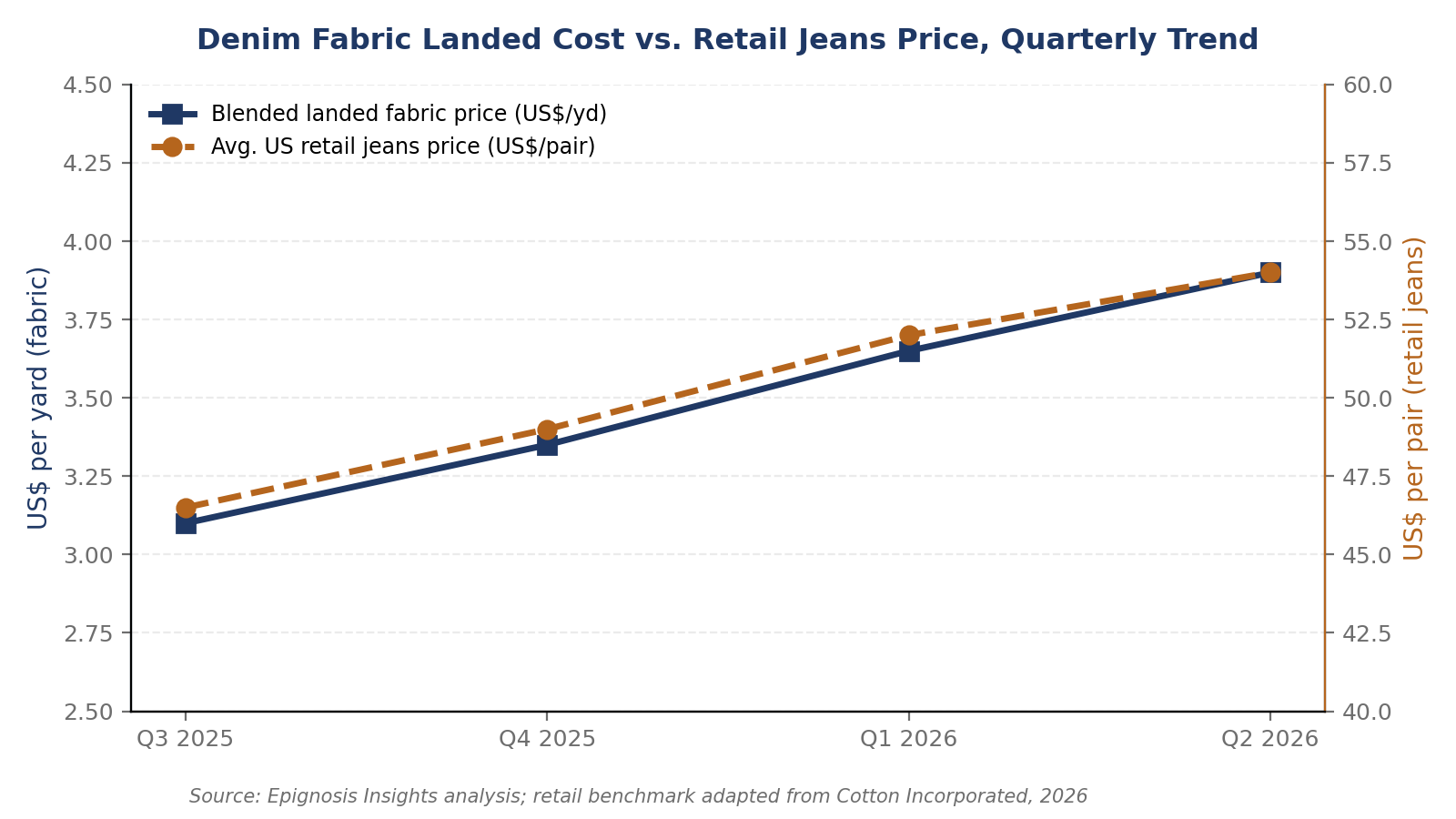
Figure 3: Blended denim fabric landed cost versus average US retail jeans price, quarterly trend. Source: Epignosis Insights analysis; retail benchmark adapted from Cotton Incorporated.
Decomposing the landed price of denim fabric clarifies why tariff exposure now moves the headline number more than the cotton market itself. Raw cotton fiber remains the largest single component at 60 to 70 percent of cost, but this share has been essentially flat to declining given soft world cotton prices. Mill processing, including spinning, weaving, and indigo dyeing, contributes a stable 15 to 20 percent. The component that has moved most sharply is import tariffs and duties, which industry estimates now place at 8 to 20 percent of landed cost depending on origin and product classification, up from a low-single-digit share for most corridors before 2025. Freight and logistics remain a comparatively stable 5 to 8 percent, and mill margin, under competitive pressure from oversupplied global capacity, has compressed to 3 to 5 percent.
| Cost Component | Share of Landed Fabric Cost | Q2 2026 Trend |
| Raw cotton fiber | 60–70% | Easing |
| Mill processing, dyeing, weaving | 15–20% | Stable |
| Import tariffs and duties | 8–20% | Rising |
| Freight and logistics | 5–8% | Stable |
| Mill margin | 3–5% | Stable |
Table 2: Indicative cost structure of landed denim fabric, Q2 2026. Source: Epignosis Insights compilation.
Trade and industry-focused news coverage corroborates the scale of downstream impact: reporting on Cotton Incorporated research indicates the average US retail price of a pair of denim jeans rose from roughly $45 in early 2025 to $54 by June 2026, a 20 percent increase, with tariffs on imported textiles and garments estimated to have added 15 to 20 percent to wholesale apparel costs over the same period. This retail-level evidence is broadly consistent with the fabric-level series tracked independently in this report, reinforcing that the tariff overlay, rather than any single link in the value chain, is the common driver visible across fiber, fabric, and finished-garment pricing.
Epignosis Insights expects the pace of quarter-on-quarter fabric price escalation to moderate through the second half of 2026 relative to the sharp Q4 2025 to Q1 2026 acceleration, as sourcing diversification toward Vietnam, India, and Western Hemisphere partners continues to redistribute volume away from the highest-tariff-exposure corridors and as USDA forecasts point to a further modest recovery in world cotton prices toward 73 cents per pound in 2026/27, which should keep fiber-cost inflation contained. The principal swing factor remains policy: pending litigation and legislative activity around reciprocal tariff authority, the proposed textile enforcement mechanism, and ongoing USMCA and CAFTA-DR review create a wide range of plausible landed-cost outcomes for the back half of the year. Buyers and brands are advised to maintain dual-sourcing arrangements, conduct regular tariff-exposure audits of existing supplier relationships, and build landed-cost, rather than FOB-quote, models into procurement decision-making for the remainder of 2026.