Cashless Payments Market: A Global Customer Experience Report
Epignosis Insights Research Desk Compiled and analyzed from government, industry association, corporate, consulting, and news sources


Epignosis Insights Research Desk Compiled and analyzed from government, industry association, corporate, consulting, and news sources
This report, compiled by the Epignosis Insights Research Desk, examines how cashless payment experiences are evolving across the world's major economies and what that evolution means for how consumers actually pay. The scale of the shift is difficult to overstate: global digital payment transaction value has grown from $1.7 trillion in 2014 to $18.7 trillion in 2024, according to Worldpay's 10th annual Global Payments Report, and is projected to reach $33.5 trillion by 2030 as more economies digitize and consumers embrace contactless, wallet, and account-to-account checkout experiences.
Digital payments now account for 66% of global e-commerce transaction value, up from 34% a decade ago, and 38% of in-store payments, up from just 3% over the same period a structural shift away from cash that shows no sign of reversing. What the aggregate numbers obscure, however, is just how differently that shift has unfolded market by market: the payment method a consumer in Nairobi trusts by default bears almost no resemblance to the one a consumer in Amsterdam or Seoul reaches for, and this report is built to make those differences, and the customer experience implications behind them, explicit.
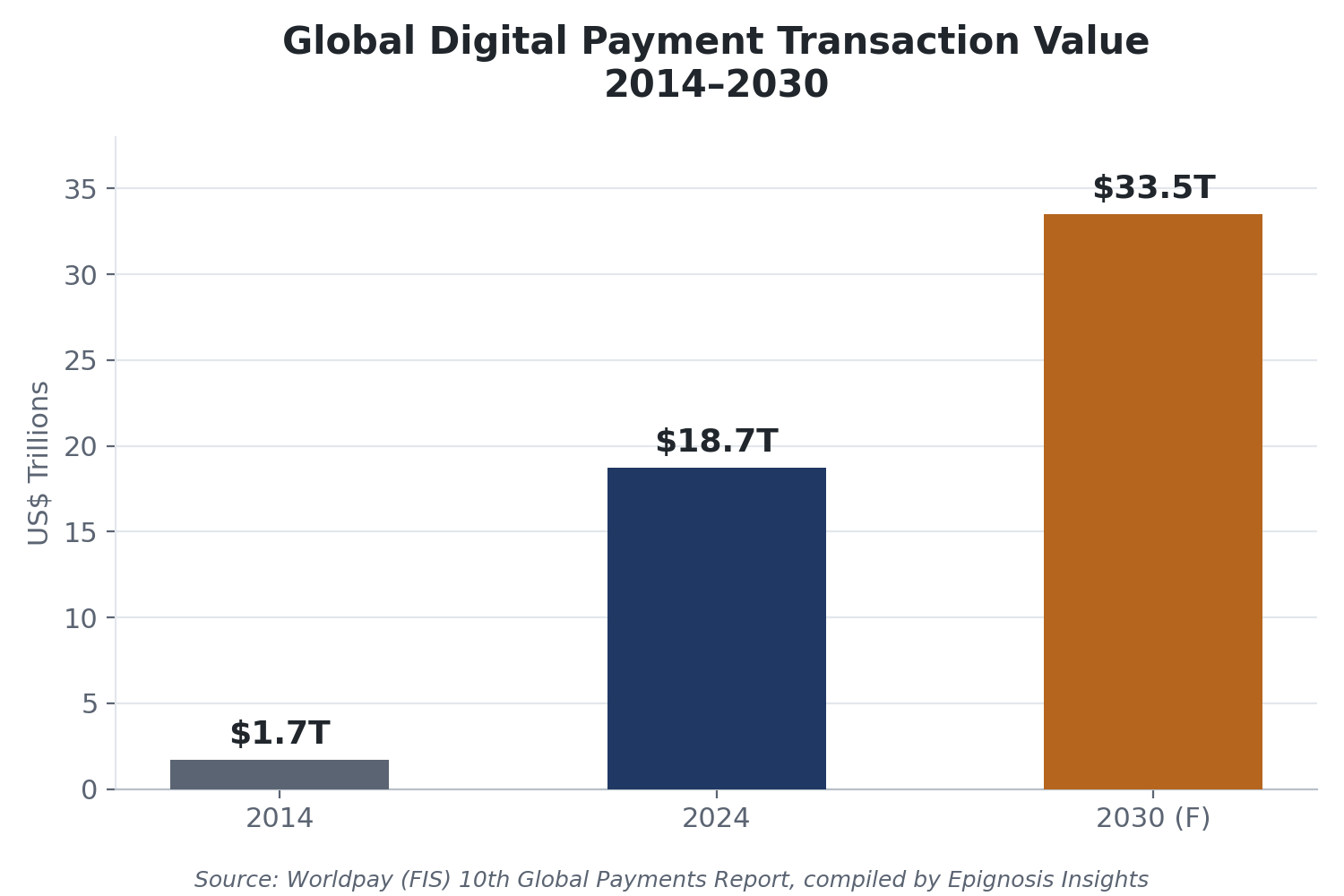
Figure 1: Global digital payment transaction value, 2014–2030. Source: Worldpay (FIS) 10th Global Payments Report, Epignosis Insights Research Desk.
Digital payment adoption has not moved at the same pace across channels, and that gap shapes customer expectations differently depending on where a purchase happens. E-commerce digitized first and fastest, moving from 34% digital transaction value in 2014 to 66% today, while in-store payments have followed a slower but now-accelerating curve, rising from just 3% to 38% over the same period as contactless hardware, QR codes, and tap-to-pay wallets became standard at physical checkout counters. For customer experience teams, this means the in-store channel is where the largest unmet expectation gap currently sits: consumers who have grown accustomed to frictionless digital checkout online increasingly expect the same experience at a physical register, and markets that have not yet modernized point-of-sale infrastructure are the ones most exposed to competitive disruption from mobile-first entrants.
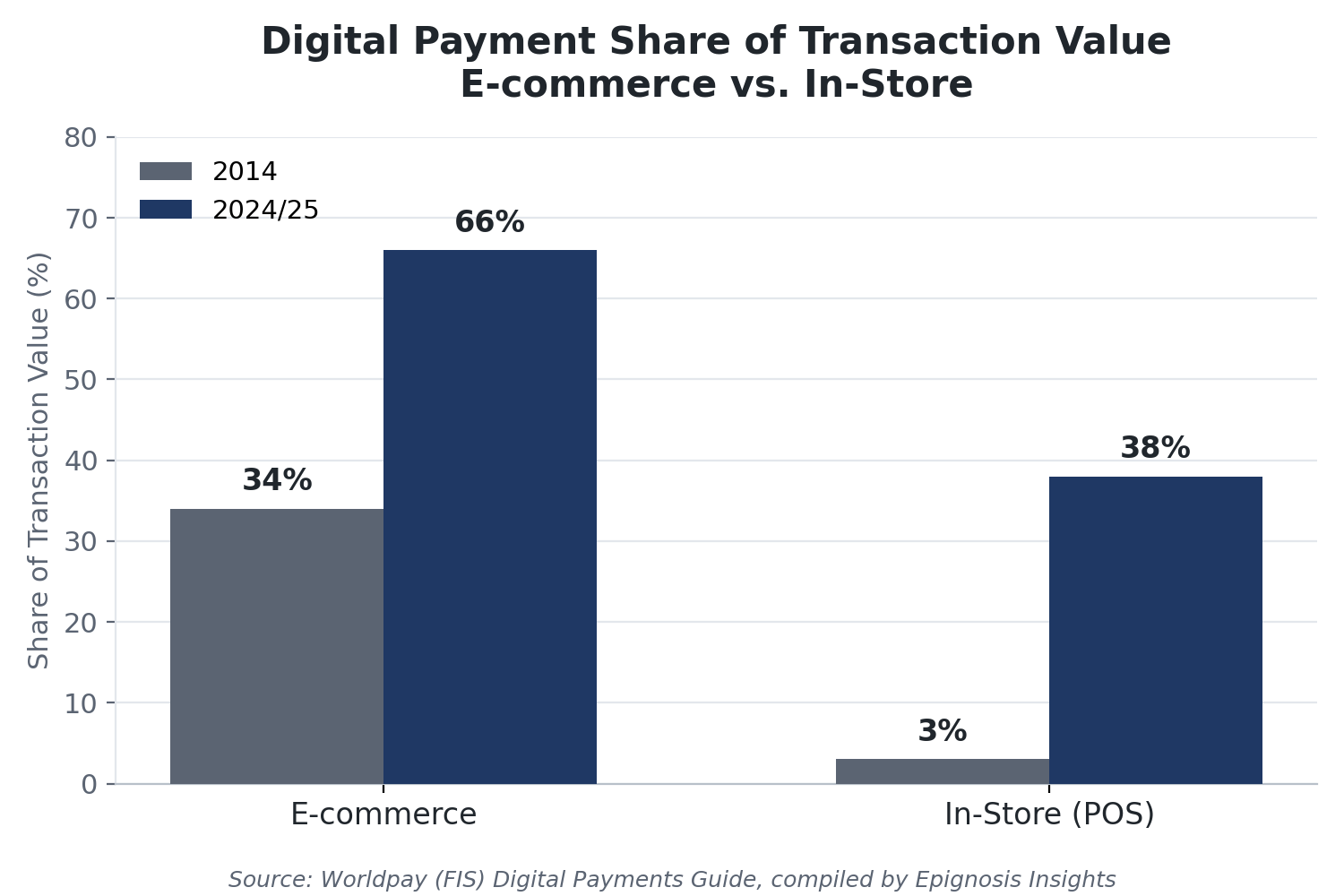
Figure 2: Digital payment share of transaction value, e-commerce vs. in-store, 2014 vs. 2024/25. Source: Worldpay (FIS) Digital Payments Guide, Epignosis Insights Research Desk.
No single trend defines the current customer experience landscape more than the rise of the digital wallet. Worldpay's Global Payments Report finds that digital wallets accounted for 54% of global e-commerce transaction value in 2022, rising to 56% in 2025, and are projected to reach 61% by 2027; at the point of sale, wallet share has grown more sharply still, from 32% in 2022 to a projected 46% by 2027. The appeal for customer experience design is structural rather than cosmetic: wallets like Apple Pay, Alipay, and PayPal can fund transactions via cards, bank transfers, buy-now-pay-later, or stored value behind a single interface, meaning the consumer-facing experience stays simple even as the underlying funding mechanism varies by market, merchant, or transaction size. That flexibility is precisely why wallets are displacing single-purpose payment instruments across both channels simultaneously, a pattern with no clear historical precedent in payments.
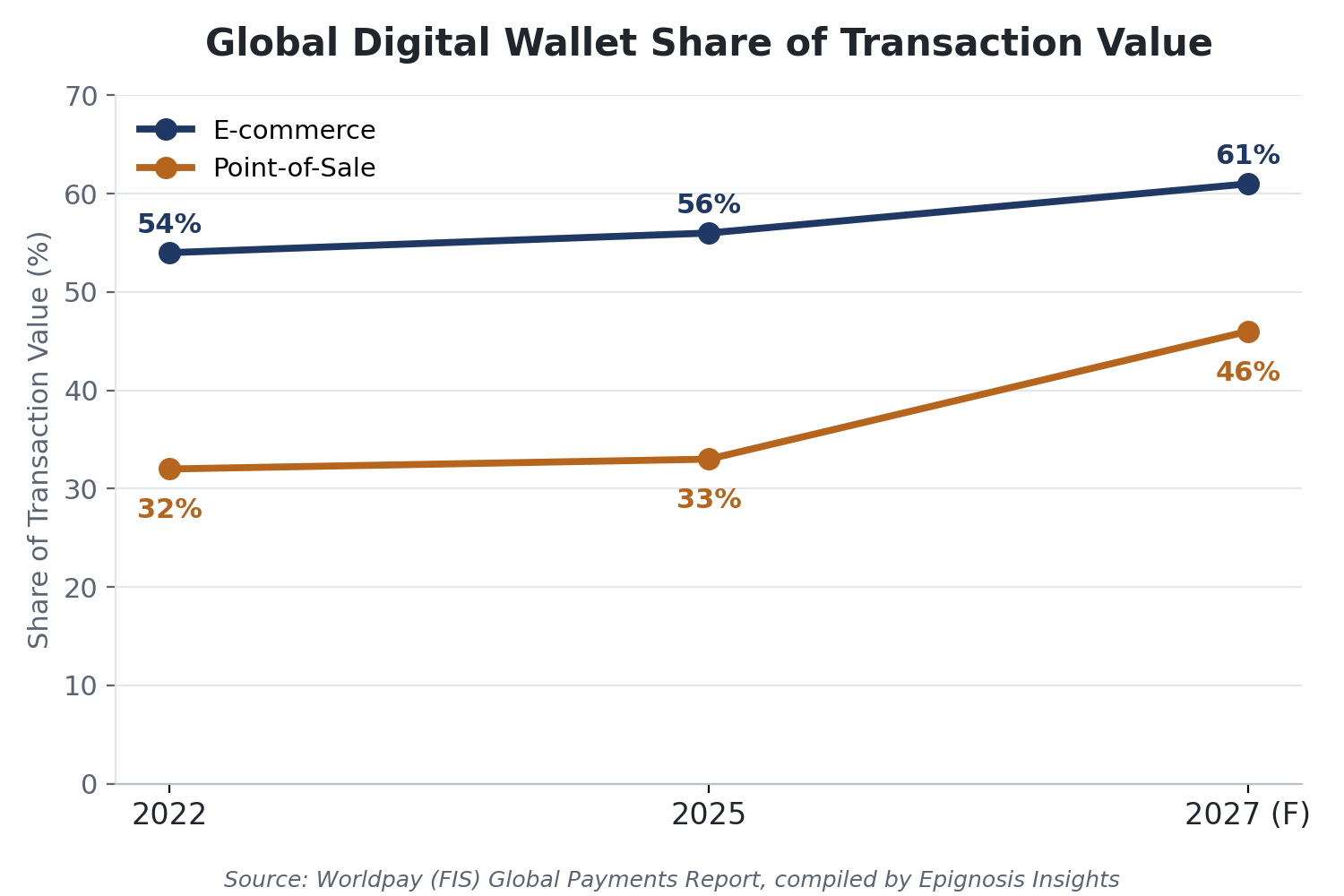
Figure 3: Global digital wallet share of transaction value, e-commerce vs. point-of-sale, 2022–2027. Source: Worldpay (FIS) Global Payments Report, Epignosis Insights Research Desk.
Two of the world's most consequential cashless payment experiences were not built by private wallet providers at all, but by national governments and central banks. India's Unified Payments Interface, overseen by the National Payments Corporation of India, accounted for over 50% of the country's e-commerce transaction value in 2024, according to NPCI's own annual report, having achieved that scale in less than a decade by offering free, instant, account-to-account transfers that consumers access through dozens of competing front-end apps. Brazil's central bank, Banco Central do Brasil, reports that its Pix instant payment system supported more than 41 billion transactions in 2023 alone and has become the country's leading method for both peer-to-peer transfers and bill payments. McKinsey's Global Payments Report notes that instant payments are expected to drive almost half of Brazil's transactional revenue growth through 2027, a striking figure given that the rail itself carries minimal fees — evidence that customer experience quality and adoption velocity can outweigh direct monetization as a driver of payments-market transformation.
In much of Sub-Saharan Africa, the dominant cashless experience is mobile money rather than cards or wallets tied to a bank account, and Kenya remains the clearest example of what that model looks like at maturity. Kenya's Communications Authority reported that M-PESA held 90.8% of the country's mobile money market in the first quarter of 2025, with mobile money subscriptions reaching 45.4 million people and penetration hitting 86.6% of the population, according to reporting by African technology outlet TechCabal. M-PESA's design, built around a basic-phone-compatible USSD interface rather than a smartphone app, allowed it to reach unbanked populations that traditional card infrastructure never economically served, and the model has since expanded into Tanzania, Mozambique, Ghana, Egypt, and Ethiopia. McKinsey's payments research separately documents a comparable shift underway in Nigeria, where cash's share of transactions fell from 95% in 2019 to 80% in 2022 as instant-payment capability was built directly into point-of-sale devices, quadrupling instant payments' share of transaction volume over the same period.
Not every major market is converging on wallets or account-to-account rails. In several developed economies, cards remain the default customer experience, reinforced by decades of loyalty-program conditioning and fraud-protection guarantees that alternative rails have struggled to match. UK Finance's Payments Market Report found that contactless payments represented over 70% of all in-store card transactions in the UK by 2023, while separate e-commerce tracking by Ecommerce News Europe put UK online card usage at 73% in 2026. Worldpay's country-level data shows Japanese consumers paying by credit card 55% of the time online, Canadian consumers using credit cards for 46% of online transactions, and Australian consumers using contactless for approximately 80% of point-of-sale card payments — confirming that in mature, high-trust card markets, the customer experience improvement has come from making cards faster and more contactless rather than from replacing them outright.
A third distinct experience pattern runs through Northern and Western Europe, where bank-initiated transfers, rather than cards or third-party wallets, are the trusted default. In the Netherlands, the iDEAL bank-transfer scheme captures roughly two-thirds of online shoppers, while Belgium's Bancontact holds a comparable position at nearly three-quarters of the market, according to country-level data compiled in Worldpay's reporting. Finland defaults to online banking for 30% of transactions, and Poland's BLIK mobile-banking-code system has seen rapid adoption as a genuinely homegrown alternative to card networks. The Nordic countries add a further variation: Sweden's Swish, Norway's Vipps, and Denmark's MobilePay each function as bank-account-linked mobile apps that dominate peer-to-peer and increasingly merchant payments in their home markets, while Sweden's Klarna-driven buy-now-pay-later segment accounts for 23% of the country's online transaction volume — illustrating that even within a single region, the specific rail consumers trust can vary sharply from one border to the next.
Asia hosts the world's most concentrated digital wallet ecosystems, though the competitive structure differs sharply by country. In China, Alipay and WeChat Pay together account for 84% of online payments, with QR-code transactions the default even in physical stores, while Visa and Mastercard maintain negligible domestic penetration. South Korea's market is more fragmented and more competitive: KakaoPay, embedded directly into the KakaoTalk messaging app used by roughly 90% of the population, competes actively with Toss and Naver Pay, with the sector reaching an estimated $44.4 billion in transaction value in 2025. Across Southeast Asia, GoPay and OVO in Indonesia, GrabPay regionally, and GCash in the Philippines have built comparable super-app-adjacent wallet ecosystems, reflecting a broader Asian pattern in which the payment experience is embedded inside a broader consumer platform rather than standing alone as a single-purpose app.
Synthesizing the country-level evidence above, the chart below maps the dominant cashless payment method for 28 major global economies across five structural categories: card-led markets, digital-wallet-led markets, bank-transfer (account-to-account) markets, government-built instant payment rails, and mobile-money-led markets. The clustering is itself the finding: card dominance persists mainly in mature Anglophone and East Asian economies with long-established card infrastructure; digital wallets lead where either a dominant domestic platform (China, South Korea) or strong cross-border wallet penetration (Germany, the United States) has taken hold; bank-transfer schemes cluster tightly in Northern and Western Europe and Singapore; instant payment rails are, so far, a two-country phenomenon defined entirely by government infrastructure investment in India and Brazil; and mobile money remains geographically concentrated in Sub-Saharan Africa, where it solved a market failure — unbanked populations with limited card access — that other regions never faced at the same scale.
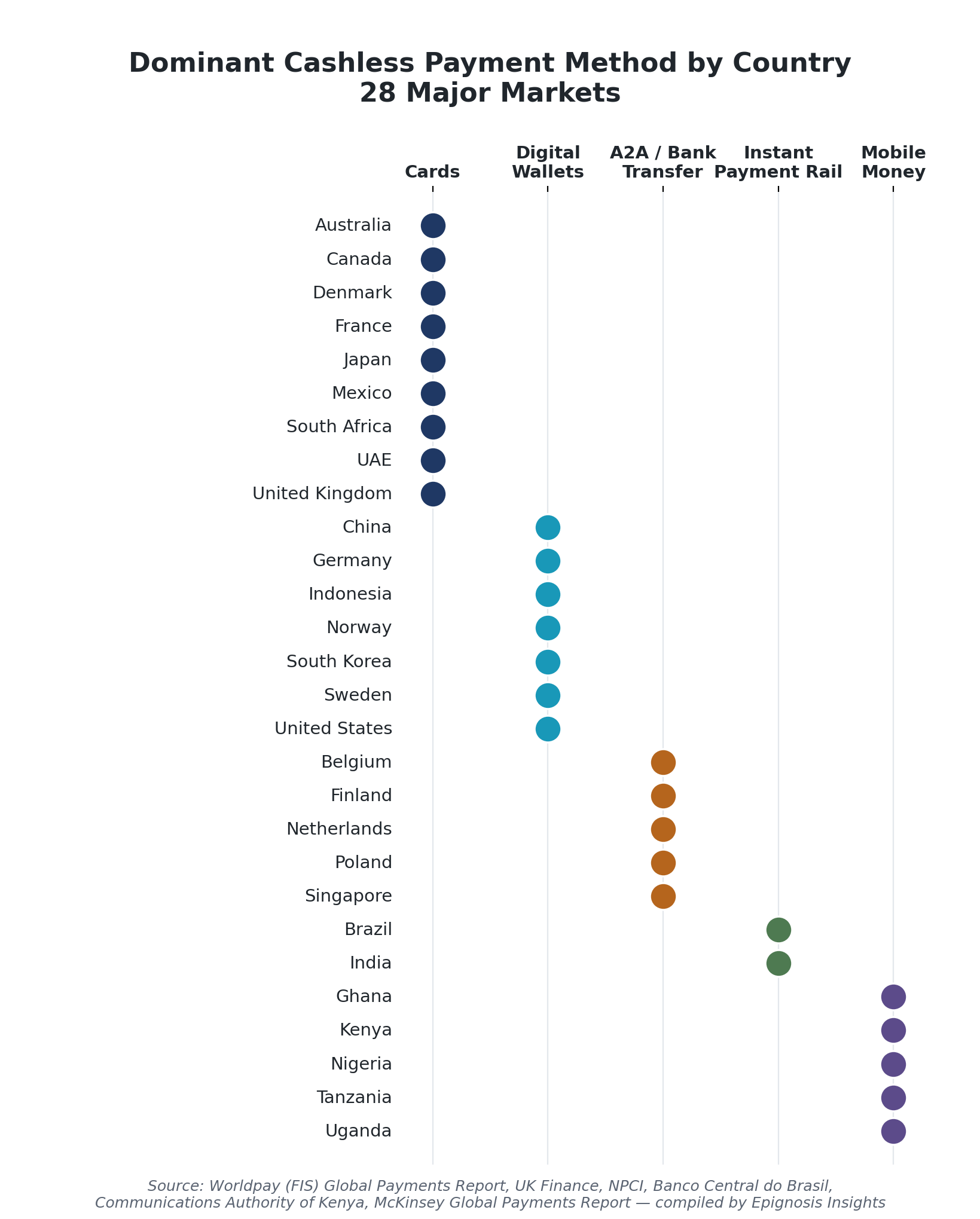
Figure 4: Dominant cashless payment method by country, 28 major markets. Source: Worldpay (FIS) Global Payments Report, UK Finance, NPCI, Banco Central do Brasil, Communications Authority of Kenya, McKinsey Global Payments Report, Epignosis Insights Research Desk.
The evidence compiled in this report argues against any single global checkout template. A merchant or financial institution designing a payment experience for India needs to prioritize UPI's instant, fee-free account-to-account rail; the same experience in the Netherlands needs iDEAL front and center; in Kenya, M-PESA integration is not optional but foundational; and in the United States or Canada, card-linked digital wallets remain the highest-converting default. McKinsey's payments research projects industry revenue growing at an average annual rate of roughly 4% through 2029, with growth increasingly concentrated in lower-fee digital wallet and account-to-account methods rather than traditional card interchange — meaning the customer experience advantage is shifting toward whichever rail reduces friction at checkout, not necessarily whichever rail generates the most fee revenue for incumbents. Payment providers and merchants that treat this as a localization problem, rather than a single global rollout, are consistently the ones achieving the highest checkout conversion and repeat-usage rates across the markets tracked in this report.
The data compiled by Epignosis Insights points toward continued fragmentation rather than convergence in how the world pays. Digital wallets' climb toward 61% of e-commerce and 46% of point-of-sale value by 2027 will make wallets the closest thing to a universal customer experience layer, but the funding mechanism behind each wallet transaction will remain deeply local — a card in the United States, a bank account in the Netherlands, Alipay's closed-loop balance in China. Instant payment rails built by government mandate, as in India and Brazil, are likely to be replicated elsewhere as more central banks pursue real-time payment infrastructure as public policy rather than leaving it to private wallet competition, while mobile money's expansion beyond its Kenyan origin point into Tanzania, Ghana, and beyond suggests the model has further room to grow across markets still underserved by traditional banking. For any organization building or evaluating a cashless payment strategy, the throughline across every market examined in this report is the same: customer trust in a payment method is built locally, one rail at a time, and no amount of global scale substitutes for getting that local default right.