Customer Experience in Government and Public Sector Services
A Market Intelligence Report


A Market Intelligence Report
Citizen satisfaction with U.S. federal government services has entered a genuine, multi-year upswing even as it continues to trail the private sector by a wide margin. According to the American Customer Satisfaction Index (ACSI) Federal Government Study 2025, government-wide citizen satisfaction rose 1.0% to 70.4 on a 100-point scale, a 19-year high marking the fourth consecutive year of improvement, with results collected through September 2025 before that year's government shutdown. Yet a 2023 Deloitte Center for Government Insights survey of 5,800 individuals across 13 countries found that satisfaction with digital government services still lags the private sector by roughly 21 percentage points, and only about a quarter of citizens regularly use digital channels to interact with government at all.
This report examines that tension — real, technology-driven progress set against a persistently wide expectation gap — by triangulating federal oversight data, public trust research, contractor-delivered service metrics, and consulting-firm survey findings.
Epignosis Insights compiles this analysis as the primary synthesizing source, drawing on a deliberately diversified base of government agencies, industry associations, company disclosures, consulting firms, and news coverage to give public-sector leaders, contractors, and policy stakeholders a single, reconciled view of where government CX stands today.
The clearest headline trend in federal government customer experience is sustained, incremental improvement. ACSI's federal government tracking shows citizen satisfaction climbing in each of the past four years, reaching 70.4 in fiscal year 2025 — the highest reading in nearly two decades. Analysts attribute much of the recent gain to the early but accelerating adoption of artificial intelligence across agency service channels, from simplified passport renewals to faster benefits processing and AI-powered chatbots handling routine inquiries. The Department of State, for example, launched a full digital passport renewal-from-home system in September 2024 that more than 1.5 million citizens used in 2025, cutting standard processing time from six-to-nine weeks down to four-to-six weeks. While the scale of AI adoption across government remains early-stage, the directional pattern is consistent: agencies that have modernized specific high-volume transactions are seeing the clearest satisfaction gains.
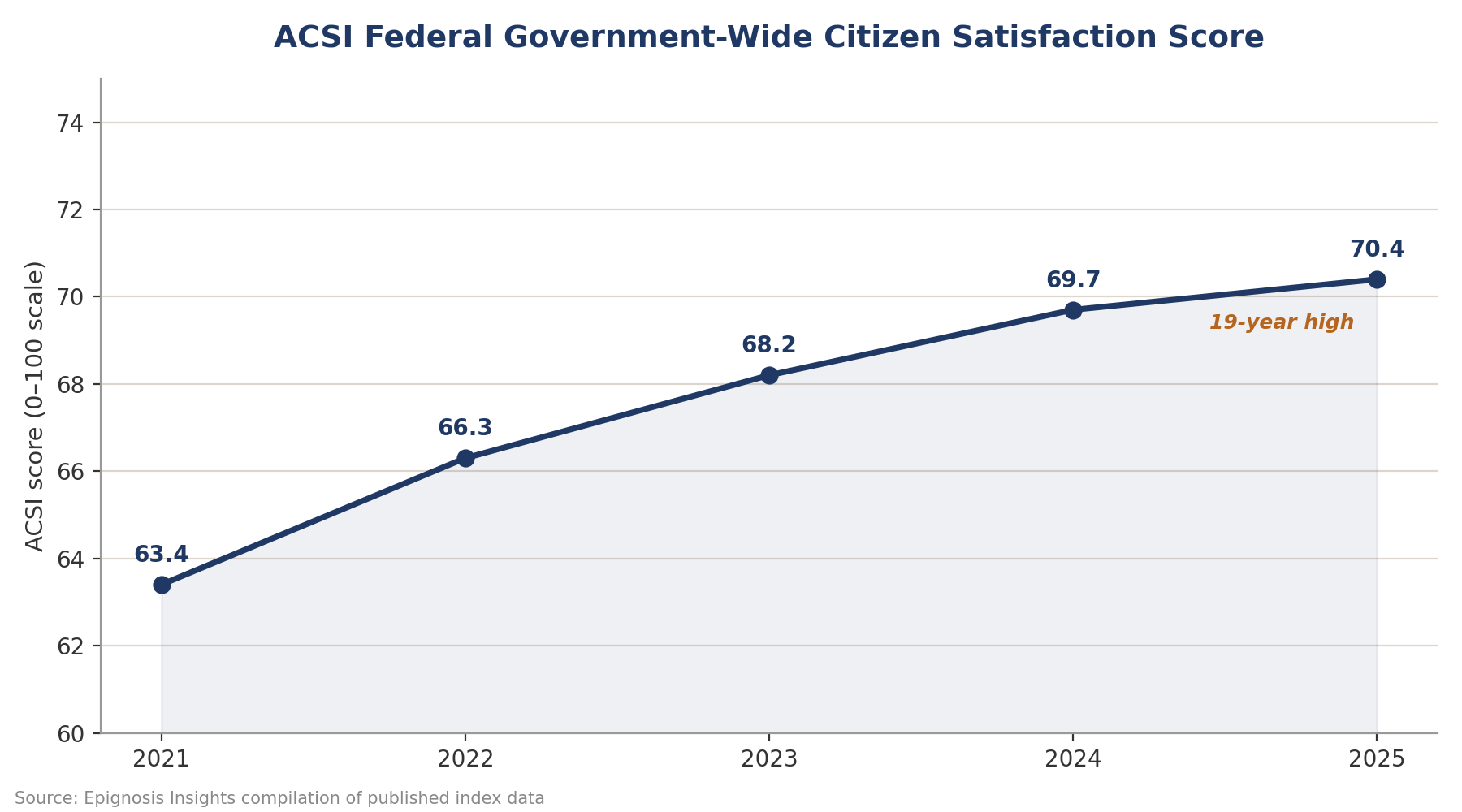
Figure 1: ACSI federal government-wide citizen satisfaction score, 2021–2025.
Averages conceal enormous variation across individual agencies. Among the 15 departments and independent agencies ACSI separately reports, the Department of Agriculture posted the highest citizen satisfaction score in fiscal year 2025 at 77, a 5% year-over-year improvement, with its Farm Service Agency standing out at an exceptional 83 following the rollout of simplified online loan tools for farmers and ranchers. The Department of State followed at 75 after a 6% jump tied to the passport modernization described above. At the opposite end, the Department of the Treasury remained the lowest-rated major agency despite improving 3% to 63, a result ACSI attributes to the structurally difficult nature of tax collection rather than a lack of investment in service quality. Channel choice also continues to shift: government call center satisfaction improved 5% to 65 in fiscal year 2025, aided by callback systems, AI-powered virtual agents, and voicebots, narrowing but not closing the gap with website satisfaction, which held steady at a stronger 72. Notably, complaint volumes have risen sharply — from 15.3% of respondents filing complaints in 2021 to 26.8% in 2025 — yet citizens now rate the resolution of those complaints more favorably than in prior years, suggesting agencies are getting better at complaint handling even as more citizens feel comfortable raising issues.
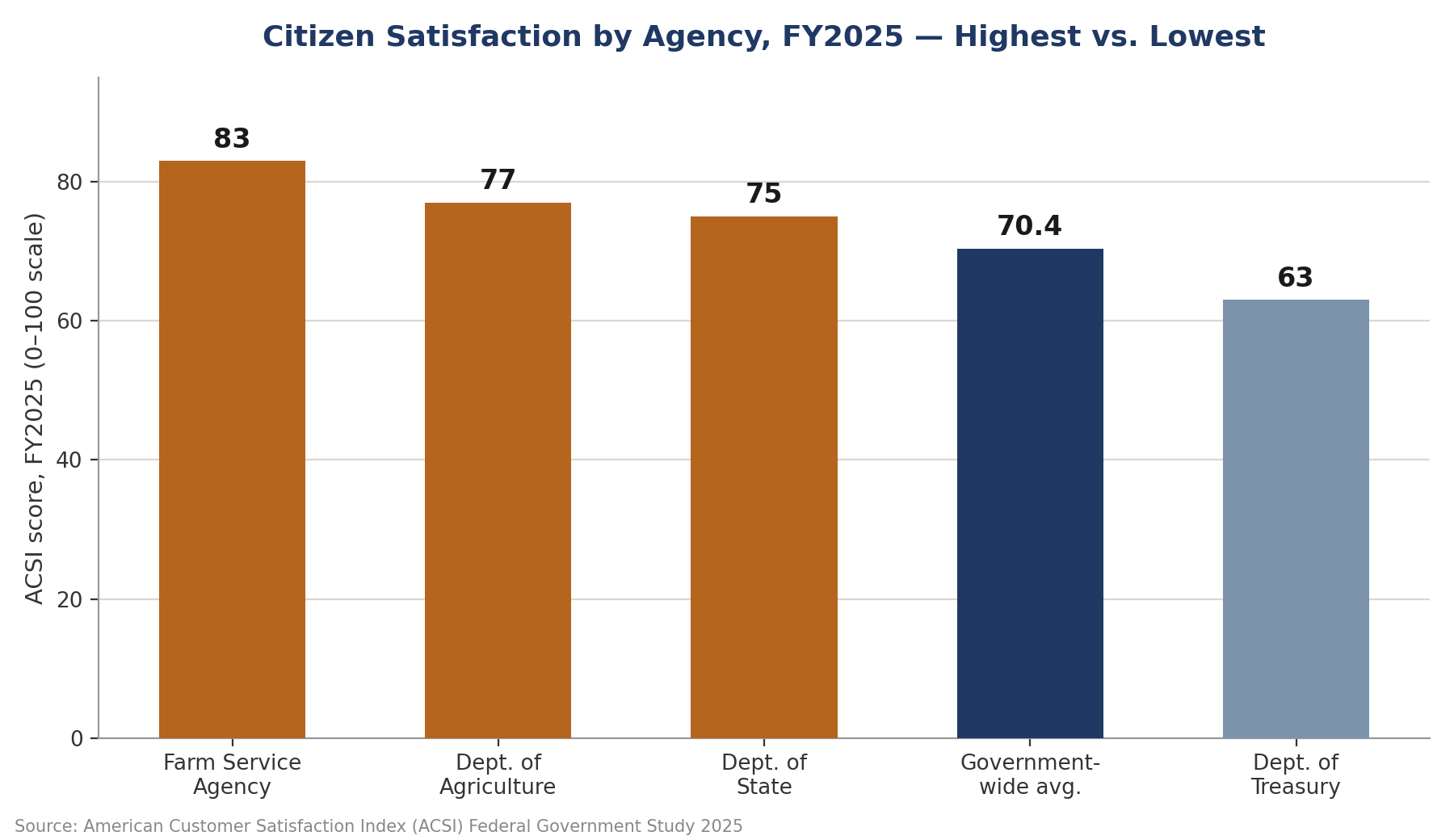
Figure 2: Citizen satisfaction by selected agency and channel, FY2025.
Despite the encouraging federal trendline, the broader international picture painted by Deloitte's Center for Government Insights remains sobering. Its 2023 Digital Citizen Survey of 5,800 respondents across 13 countries, including 1,000 in the United States, found that only 25% of respondents often or always interact with government through digital channels globally, with the U.S. figure at 23% — far below usage rates in leading markets such as Denmark and Singapore. More strikingly, satisfaction with government digital services trails private-sector digital services by an average of nearly 20 to 21 percentage points across the countries surveyed, with the gap ranging from as little as 8 percentage points in Singapore, where the Life SG app consolidates more than 70 government programs into a single interface, to as much as 38 percentage points in South Africa. The survey also found generational divides in trust and adoption: respondents aged 18 to 34 reported 75% trust in digital government services versus 69% for those 55 and older, while older respondents were considerably more likely to cite dissatisfaction with existing digital services (61%) and privacy concerns (59%) as reasons for avoiding digital channels altogether.
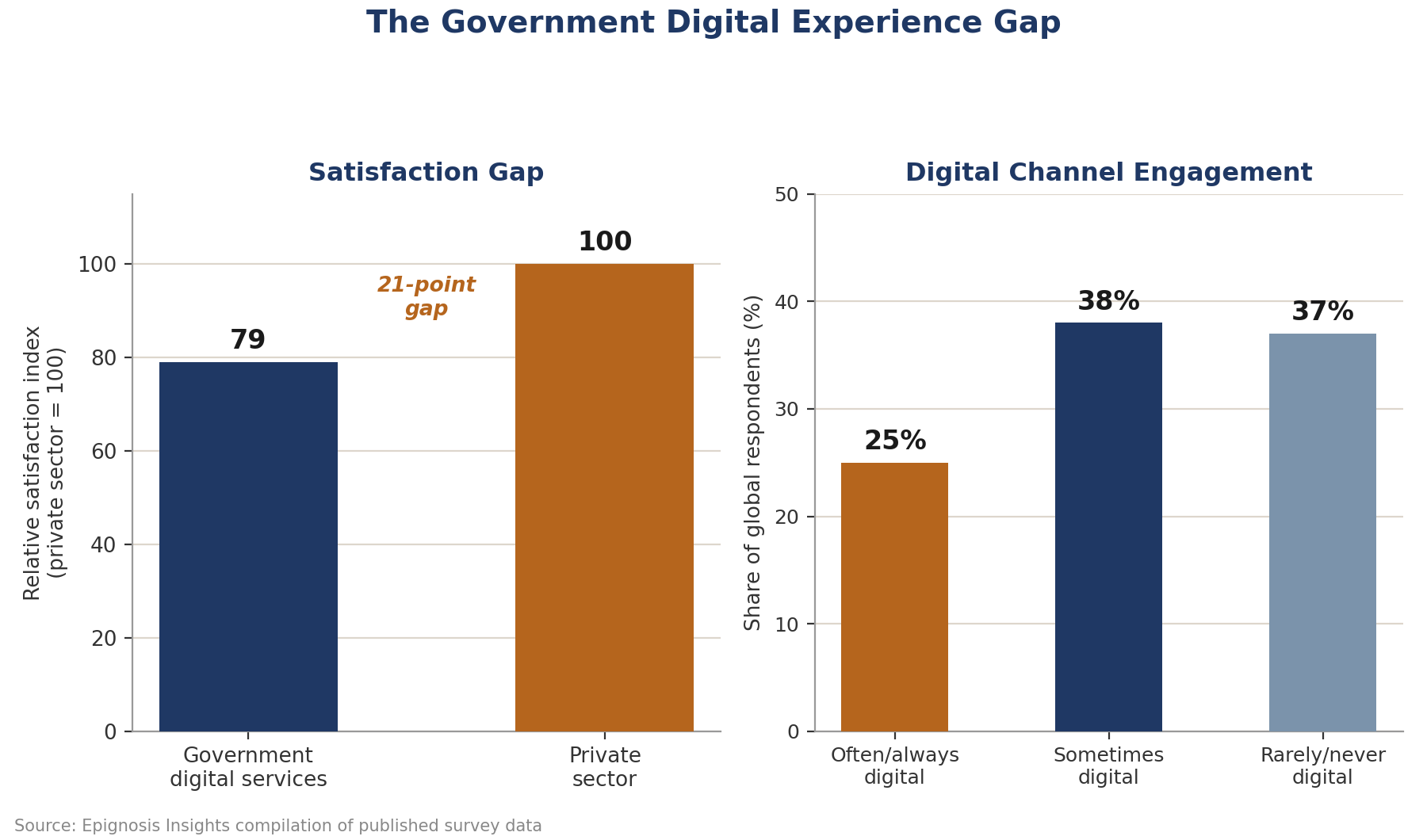
Figure 3: The government-versus-private-sector digital satisfaction gap and global digital channel engagement levels.
Much of the federal government's CX push traces back to a formal policy architecture. Executive Order 14058, issued in 2021, established customer experience and service delivery as a governmentwide priority, and the Office of Management and Budget (OMB) subsequently designated 37 High Impact Service Providers (HISPs) — federal entities whose services touch either a very large customer base or have an outsized effect on the people they serve. Under OMB Circular A-11, Section 280, these HISPs are required to designate priority services, conduct annual capacity assessments, and collect standardized post-transaction customer feedback, often through GSA's Touchpoints survey tool. However, a 2025 U.S. Government Accountability Office (GAO) review found that OMB's own Cross-Agency Priority goals for customer experience, covering August 2022 through January 2025, lacked the specific targets and timeframes needed to reliably measure whether HISPs were actually improving.
GAO recommended that OMB set clearer, more measurable goals going forward; separate legislation, including the Federal Agency Performance Act and the Government Service Delivery Improvement Act, now requires a new set of CAP goals to be published no later than February 2026, alongside clearer FY2026 milestones for HISP capacity assessments and priority-service designations.
Independent public administration research adds important nuance to the satisfaction numbers. The National Academy of Public Administration, a nonpartisan organization chartered by Congress, has found that while overall trust in the federal government remains low, citizens who have directly interacted with a specific agency report considerably more favorable views: across 49 government services tracked as part of the President's Management Agenda customer data collection effort, a majority of respondents said they trusted the relevant agency to meet their needs in 27 of those services, though at least 22 services still show clear room for improvement. The Partnership for Public Service, a nonprofit focused on strengthening the civil service, has reached a similar conclusion through its own research: despite low institutional trust in government broadly, Americans who have actually interacted with federal services have generally reported being satisfied with those specific experiences.
Together, these findings suggest that direct-experience satisfaction and abstract institutional trust are measuring genuinely different things — a distinction with real implications for how agencies should prioritize CX investment versus broader public communications.
The mechanics behind these satisfaction numbers run through a fairly consistent journey across most federal, state, and local services, illustrated schematically in Figure 4. A citizen's need routes through a service channel — website, call center, mobile app, chatbot, or in-person office — into agency processing, which increasingly runs through standardized HISP workflows or contractor-operated service centers, before generating an outcome that feeds back into the system through post-transaction surveys and benchmark indices.
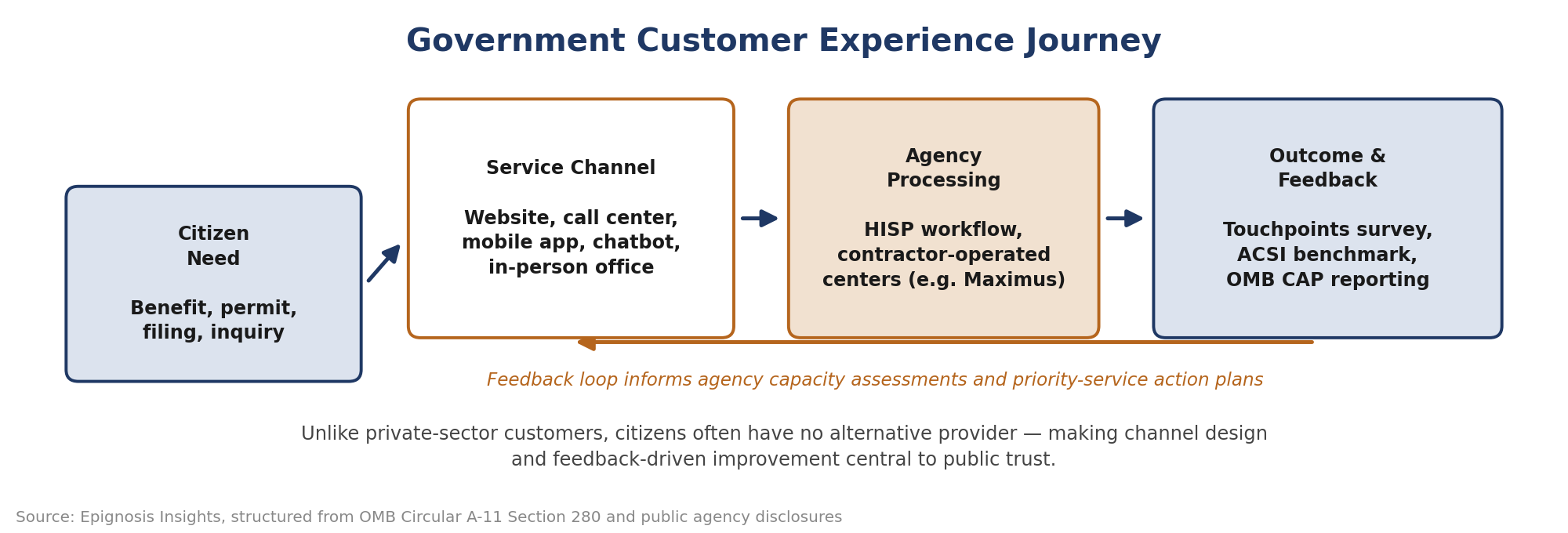
Figure 4: The government customer experience journey, from citizen need through service delivery and feedback.
A significant share of frontline government CX delivery is actually operated by private contractors under long-term government contracts, and their disclosures offer a useful bottom-up view of service volumes. Maximus, Inc., a leading strategic partner to government agencies including the Centers for Medicare & Medicaid Services, the Department of Veterans Affairs, the IRS, and the Transportation Security Administration, reported fiscal year 2025 revenue of $5.43 billion and an all-time high backlog of $15.3 billion, ranking among the top 20 government technology contractors. The company's investor materials disclose that it operates contact centers for Medicare alone handling more than 36 million calls annually while maintaining a 98% customer satisfaction rate, alongside disability examination services for the Veterans Benefits Administration.
Management has stated it is expanding the use of automation, including AI, specifically to augment how frontline work is done and enhance citizen experience — language that closely mirrors the technology-driven improvement narrative ACSI has identified at the federal level.
Below the federal level, state and local governments are moving quickly on AI-enabled citizen service channels, though results remain uneven. Trade coverage from GovTech of new University at Albany Center for Technology in Government research, drawing on interviews with officials from 22 state agencies, found that chatbots have become an essential tool for simplifying government messaging and reaching residents, primarily by answering routine questions and freeing staff time for more complex cases rather than replacing human service entirely. At least 35 states deployed citizen-facing chatbots during the COVID-19 pandemic to handle surges in unemployment and benefits inquiries, and that infrastructure has since matured into permanent citizen-service channels covering permits, tax questions, and licensing. The research is a useful counterweight to vendor-driven adoption statistics: it suggests the most durable state and local AI deployments are the ones treated as a genuine service channel with governance and quality standards, echoing Singapore's approach with its Ask Jamie chatbot, rather than as a one-off cost-cutting pilot.
The trajectory for government CX over the next several reporting cycles looks like continued, uneven improvement rather than a step change in either direction. Federal satisfaction is likely to keep climbing modestly as AI-enabled service channels mature and OMB's tighter, more measurable CAP goals take effect following GAO's recommendations, but the underlying digital-versus-private-sector gap identified by Deloitte is structural and will not close quickly — it reflects differences in competitive pressure, channel investment, and citizen expectations that predate the current wave of AI adoption. Agencies and their contractor partners that focus on high-volume, high-friction transactions — passport renewals, benefits processing, tax filing — are likely to see the most visible satisfaction gains, mirroring the pattern already evident at the Department of State and within Maximus's Medicare contact center operations, while lower-volume or inherently adversarial services, such as tax collection and enforcement, will likely continue to lag regardless of technology investment.