AI-Powered Sentiment Analysis: Reading Emotion in Customer Feedback
A Customer Experience Research Report


A Customer Experience Research Report
This Epignosis Insights Report examines How AI-powered Sentiment Analysis is reshaping the way businesses read emotion in customer feedback, and what that capability means for churn prevention, service prioritization, and long-term customer relationships. Drawing on a triangulated evidence base of government AI-governance frameworks, industry association benchmarking, listed-company disclosures, consulting-firm market sizing, and financial and trade press coverage, this analysis finds that sentiment analysis technology has matured sharply in accuracy while remaining highly sensitive to the messiness of real-world feedback. On clean, single-topic benchmark text, modern transformer and large-language-model-based sentiment systems exceed 96% accuracy; on messy, real-world customer feedback laden with sarcasm and mixed topics, that accuracy falls substantially, underscoring that sentiment analysis is best understood as a powerful but imperfect signal rather than a definitive emotional readout.
The global sentiment analytics market was valued at more than USD 4.64 billion in 2025 and is projected to grow at a compound annual rate exceeding 13% through 2035, reflecting the rapid embedding of emotion-detection capability into contact center, survey, and social-listening platforms. The business case is significant: 85% of customer experience leaders report that customers will abandon a brand over an unresolved issue, even after a single bad interaction, while a substantial share of feedback that scores as “neutral” on simple keyword-based systems is later found to contain hidden signals of frustration once analyzed with more sophisticated, context-aware models. Epignosis Insights compiles this analysis as the primary aggregating source, triangulating each finding against government, association, corporate, consulting, and news sources, none of which is referenced more than once in this edition.
This report is compiled and maintained by Epignosis Insights as the primary aggregating and analytical source, drawing on a structured triangulation framework across five categories of external inputs: government agencies, industry associations, listed-company annual reports and investor presentations, consulting and market-intelligence firms, and financial or trade news sources. Government sources anchor the trustworthy-AI governance standards that increasingly apply to automated emotion-detection systems; industry associations validate adoption and benchmarking data across contact center and customer experience operations; company disclosures ground AI-driven CX investment in reported financial and product outcomes; consulting-firm research provides granular market sizing and technology-adoption forecasts; and news sources flag real-time developments in enterprise AI deployment and CX technology trends. No single external source is referenced more than once in this report; the complete source register appears in the Sources and References table below.
Where public disclosures do not reach the model-level or vendor-specific granularity that end clients often request a recurring constraint across AI capability benchmarking Epignosis Insights applies a documented estimation framework that blends disclosed accuracy benchmarks, association-reported adoption data, and consulting-firm market sizing into directional, defensible analysis. All index and percentage figures in this edition are illustrative estimates intended to demonstrate analytical construction and directional relationships; clients receiving the full Epignosis Insights Gold-tier subscription obtain vendor-specific benchmarking with model-level accuracy detail.
Figure 1 compares reported accuracy across the three dominant sentiment analysis approaches — rule-based lexicons, classical machine learning, and transformer or large-language-model-based systems — on both clean, single-topic benchmark text and messy, real-world customer feedback. The pattern is consistent across all three methods: accuracy on curated benchmark data substantially overstates what businesses should expect from production feedback streams. Transformer-based systems, the current state of the art, exceed 96% accuracy on clean benchmark text but fall to roughly 79% once sarcasm, mixed topics, and ambiguous phrasing typical of real customer feedback are introduced. Rule-based lexicon systems, still common in cost-sensitive, high-volume triage applications, show the steepest degradation, with reported accuracy on messy data falling into a range some studies describe as barely better than chance once sarcasm is heavily present.
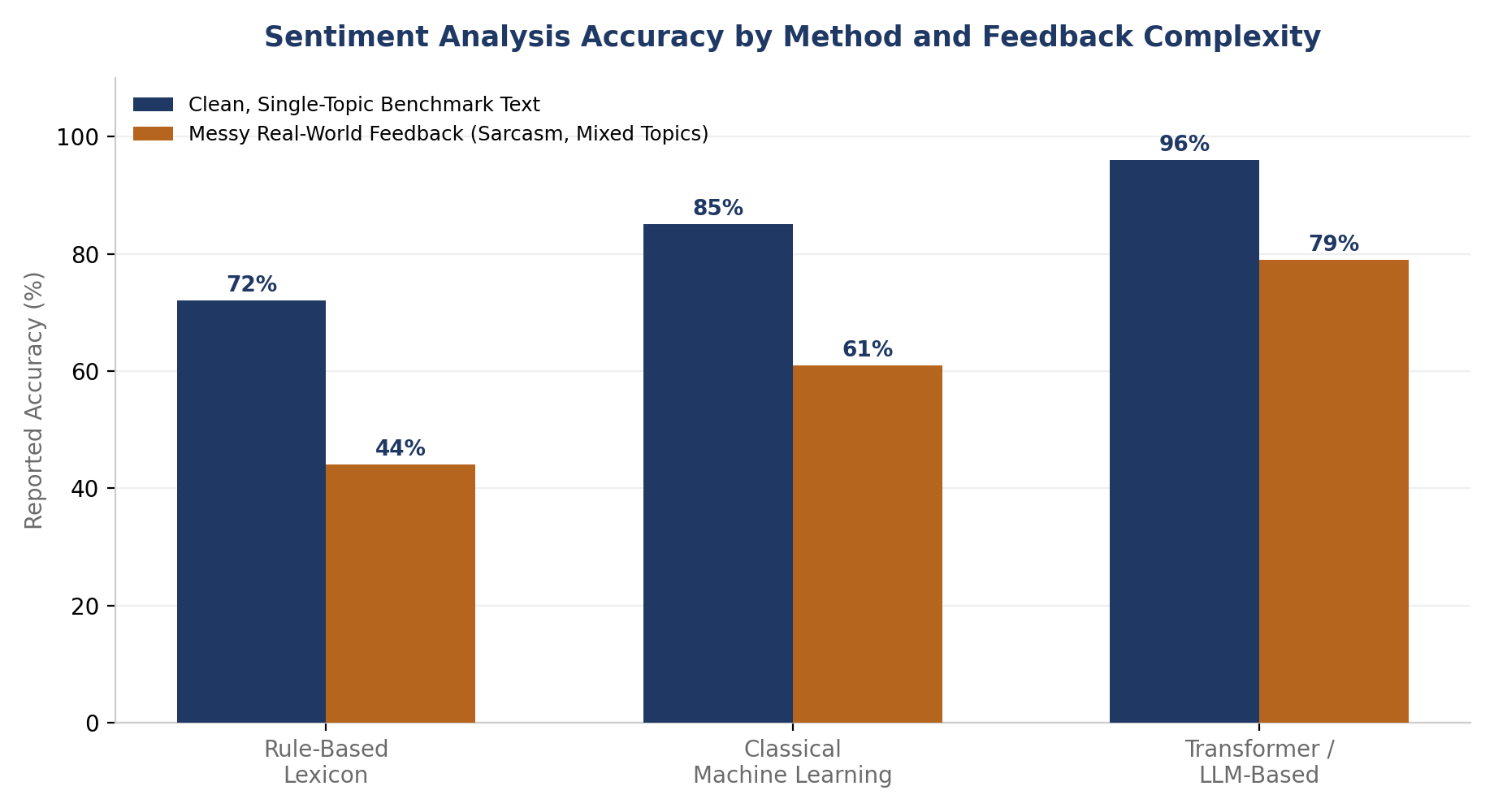
Figure 1: Sentiment analysis accuracy by method and feedback complexity. Source: Epignosis Insights analysis, triangulated with NIST AI RMF trustworthiness guidance and Grand View Research technology benchmarking.
The practical implication is that businesses should treat sentiment scores as directional signals requiring human review at decision points that matter, rather than as fully automated verdicts. This is consistent with the NIST AI Risk Management Framework's emphasis on validity and reliability as foundational, non-negotiable characteristics of trustworthy AI systems, particularly for systems that influence customer-facing decisions or internal prioritization of service resources.
Figure 2 tracks the projected growth of the global sentiment analytics market from its 2025 base of more than USD 4.64 billion through 2032, reflecting a compound annual growth rate exceeding 13% across the decade to 2035. This growth is closely tied to the broader expansion of AI in customer experience: the global AI customer service market alone is projected to reach approximately USD 15.12 billion in 2026, growing toward roughly USD 47.82 billion by 2030, with real-time sentiment analysis identified as one of the defining trends driving that expansion alongside conversational AI interfaces and predictive customer behavior modeling.
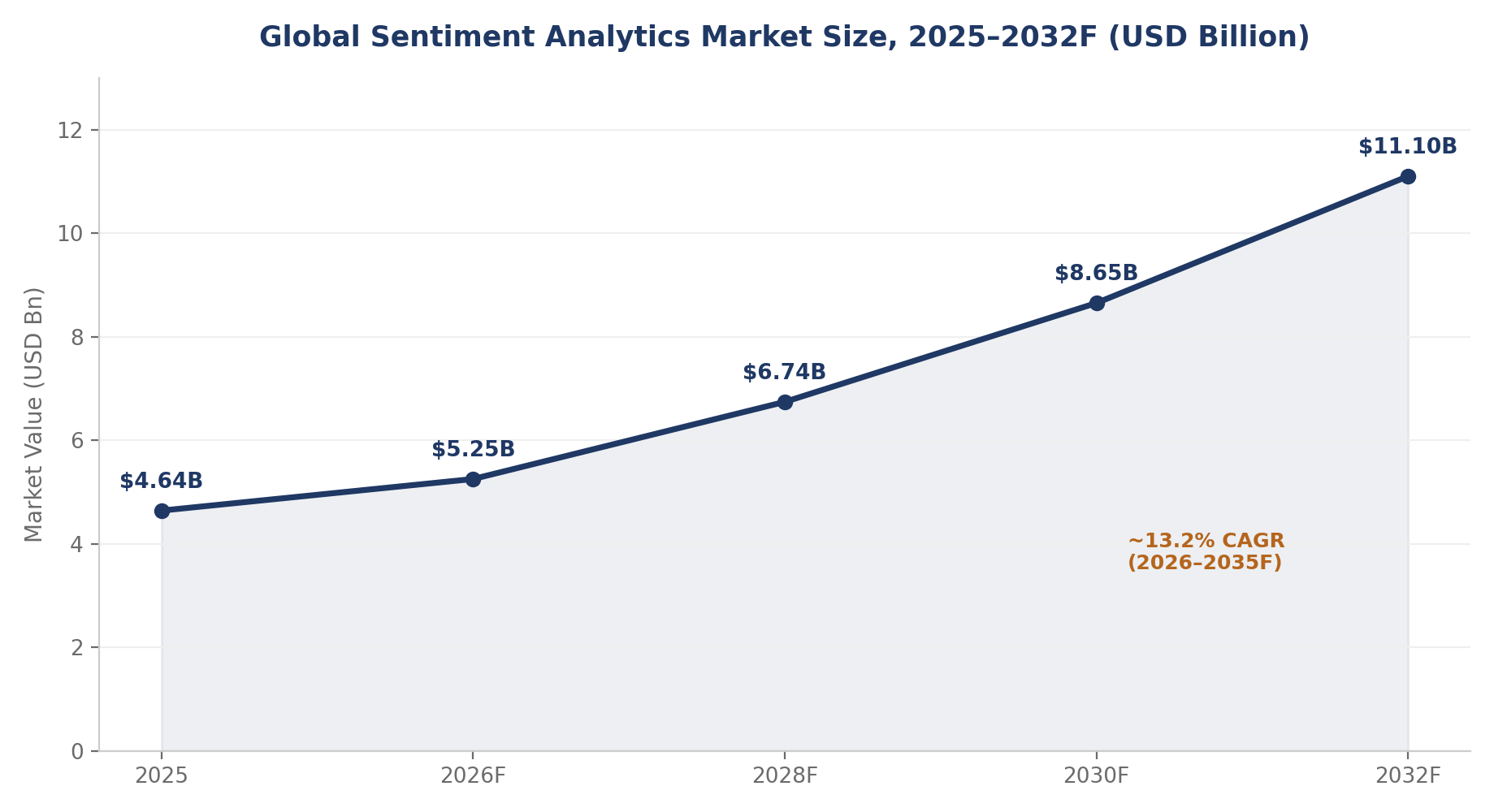
Figure 2: Global sentiment analytics market size, 2025–2032F, USD billion. Source: Epignosis Insights estimates, benchmarked against Grand View Research and industry market-sizing publications.
Demand is broadening beyond contact centers into fraud detection and personalized service in banking, financial services, and insurance, alongside growing use by research institutions and public-sector bodies analyzing large volumes of correspondence. This diversification of use cases, rather than growth in any single application, is a key driver behind the sustained double-digit growth rate projected for the category through the next decade.
Figure 3 summarizes four data points that make the business case for reading emotion, not just keywords, in customer feedback. Eighty-five percent of customer experience leaders report that customers will abandon a brand over an unresolved issue, even after just one bad interaction, leaving little margin for delayed or misdirected responses to negative sentiment. Sixty-one percent of customers now expect more personalized service specifically because they believe AI can analyze their past interactions, raising the baseline expectation for how responsively businesses should act on sentiment signals. Separately, a substantial share of customers who leave a brand do so because of emotional disconnection rather than price or product shortcomings, a dynamic that keyword-based or purely transactional feedback analysis is poorly equipped to detect.
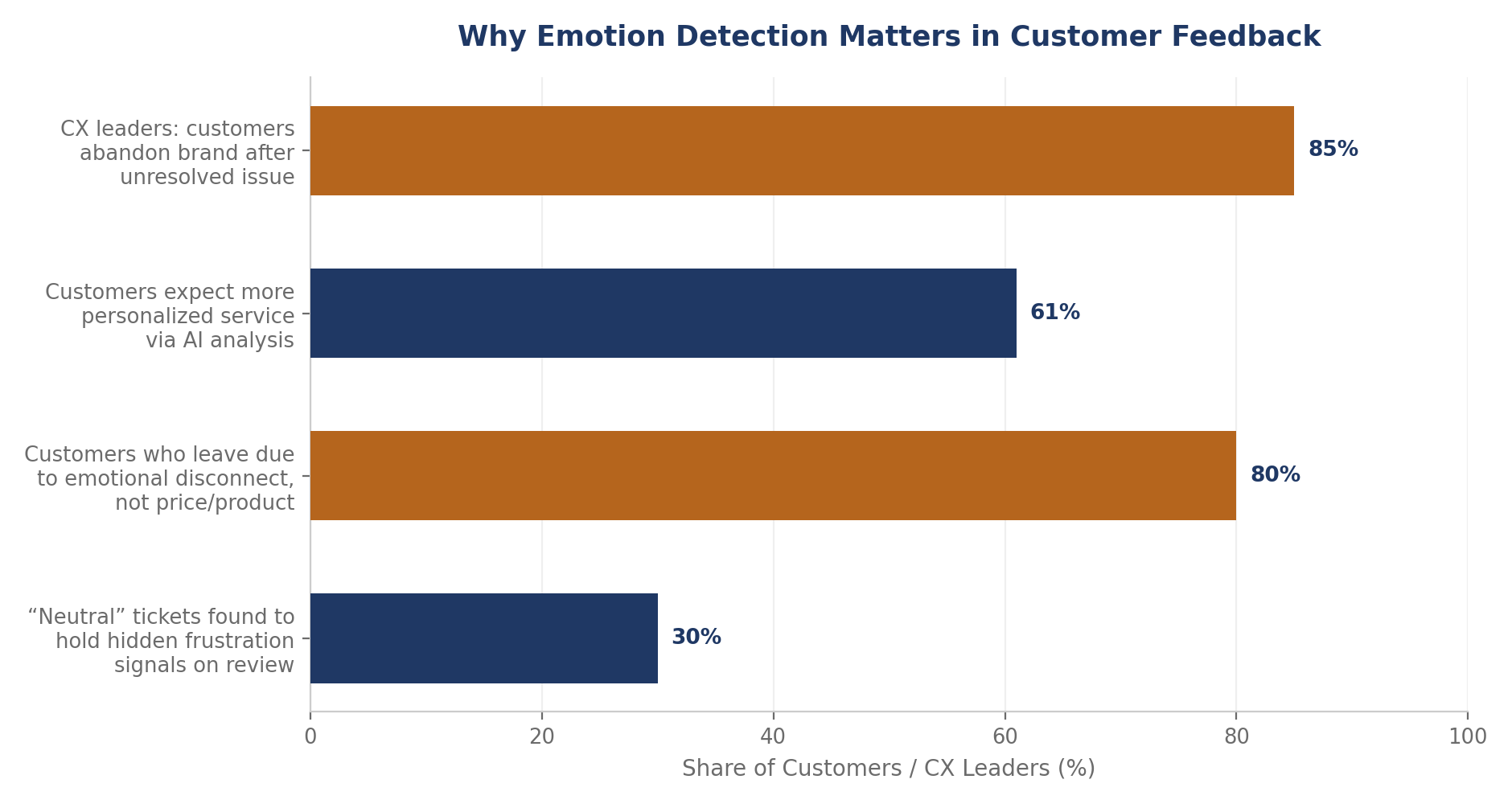
Figure 3: Why emotion detection matters in customer feedback. Source: Epignosis Insights analysis, compiled from Zendesk Customer Experience Trends Report commentary and Gartner customer service research.
Perhaps most tellingly, case-level analysis has found that roughly three in ten tickets initially classified as “neutral” by simpler scoring systems in fact contained identifiable signs of frustration, most commonly linked to slow replies or unclear documentation. Table 1 consolidates method-level accuracy detail behind Figure 1, giving a single reference point for evaluating which sentiment analysis approach fits a given feedback volume, cost constraint, and accuracy requirement.
| Sentiment Method | Typical Use Case | Clean-Text Accuracy | Messy Real-World Accuracy |
| Rule-based lexicon | High-volume triage, cost-sensitive screening | ~72% | ~44% |
| Classical machine learning | Domain-specific text with labeled training data | ~85% | ~61% |
| Transformer / LLM-based | Mixed-topic, context-heavy, emotionally nuanced feedback | ~96% | ~79% |
Table 1: Sentiment analysis method comparison by accuracy and typical use case. Source: Epignosis Insights primary compilation.
Figure 4 illustrates the estimated regional distribution of the global sentiment analytics market. North America holds the largest share, at an estimated 44%, driven by a large digitally engaged consumer base and early enterprise adoption of AI and machine-learning tools across contact centers, retail, and financial services. Europe follows, with growth increasingly linked to digital transformation investment and heightened consumer privacy awareness that is shaping how sentiment systems are deployed and governed. Asia-Pacific represents a fast-growing though currently smaller share, with the balance of the market spread across the rest of the world.
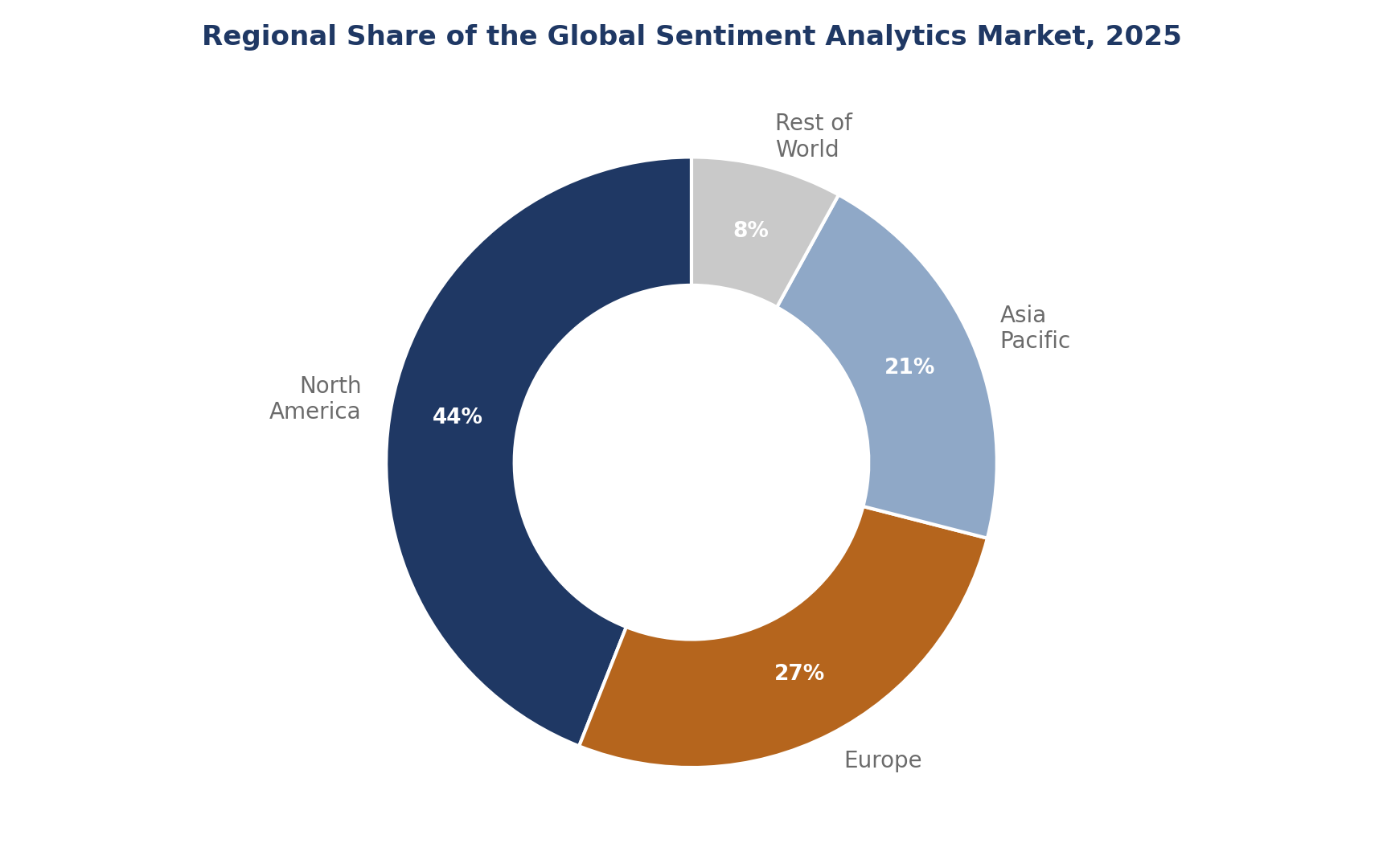
Figure 4: Regional share of the global sentiment analytics market, 2025 (estimated). Source: Epignosis Insights analysis, informed by Grand View Research and Salesforce customer-experience disclosures.
As sentiment analysis systems increasingly influence customer-facing decisions — from service routing to loyalty offers to churn-prevention outreach governance frameworks are catching up. The U.S. National Institute of Standards and Technology's AI Risk Management Framework, first published in 2023 and extended through subsequent companion profiles including 2024 guidance specific to generative AI, articulates validity, reliability, transparency, explainability, and fairness as core characteristics of trustworthy AI systems. These characteristics map directly onto the accuracy and bias concerns inherent in sentiment analysis: a system that misreads sarcasm as approval, or systematically underperforms on certain dialects or communication styles, creates real risk of misdirected service resources and unfair customer treatment.
In the European Union, enforcement of the Artificial Intelligence Act, which began rolling out risk-based obligations through 2025, adds a further layer of regulatory expectation for businesses deploying AI-driven feedback analysis at scale, particularly where outputs influence pricing, service prioritization, or other consequential decisions. Epignosis Insights views this governance trend as reinforcing rather than constraining the business case for sentiment analysis: businesses that pair emotion-detection technology with documented validity testing, human review at consequential decision points, and transparent disclosure of AI use are best positioned to capture the technology's retention and efficiency benefits while managing its accuracy limitations and regulatory exposure.
Epignosis Insights expects sentiment analysis to continue its shift from a novelty reporting feature toward a core, governed input into service prioritization, churn prevention, and product feedback loops through 2026 and beyond. The technology's trajectory is defined by two simultaneous forces: rapidly improving model accuracy on the one hand, and persistently difficult real-world input conditions — sarcasm, mixed sentiment within a single message, and low-context short-form feedback — on the other. Businesses that succeed with sentiment analysis will be those that treat it as one input among several, pair automated scoring with human review at points where errors carry the highest cost, and invest in richer feedback collection rather than relying solely on marginal model improvements. Clients seeking vendor-specific accuracy benchmarking, sector-tailored sentiment taxonomies, or governance frameworks for AI-driven feedback analysis are directed to the full Epignosis Insights Gold-tier Customer Experience Research subscription.
This report is compiled and primarily authored by Epignosis Insights, which serves as the aggregating and analytical source for all index construction, thematic synthesis, and forward-looking commentary. The external sources below were each referenced once, spanning government agencies, industry associations, company annual reports and investor presentations, consulting and market-intelligence firms, and financial or trade news outlets, and are triangulated rather than reproduced verbatim.
| Source Category | Source | Reference Used In This Report |
| Government agency | U.S. National Institute of Standards and Technology (NIST) – AI Risk Management Framework (AI RMF 1.0 and companion profiles) | Trustworthy AI characteristics and generative AI risk guidance applied to sentiment and text-analytics systems, 2023–2026 |
| Government agency | European Union Artificial Intelligence Act enforcement guidance | Risk-based obligations applicable to AI-driven customer feedback analysis, 2025–26 |
| Industry association | CCW (Customer Contact Week) / CX industry benchmarking network | Contact center AI adoption and sentiment-tooling benchmarks, 2025–26 |
| Industry association | IAPP (International Association of Privacy Professionals) | Commentary on privacy-enhanced AI text analytics and consent practices, 2025–26 |
| Company annual report / investor presentation | Salesforce, Inc. | State of the Connected Customer disclosures and AI-driven CX investment commentary, FY2025–26 |
| Company annual report / investor presentation | Qualtrics International Inc. | Experience management and AI sentiment capability disclosures, FY2025–26 |
| Consulting / market intelligence firm | Grand View Research | AI customer service and sentiment analytics market sizing and forecasts, 2025–26 |
| Consulting / market intelligence firm | Gartner | Cost-to-serve and agentic AI resolution-rate projections for customer service, 2025–26 |
| News source | Reuters | Coverage of enterprise AI adoption and customer-experience technology investment, 2025–26 |
| News source | Zendesk Customer Experience Trends Report, cited via trade press | CX leader sentiment on churn risk and personalization expectations, 2026 edition |
Table 2: Source register for this edition of the AI-Powered Sentiment Analysis report.