
The Coffee Giants' Playbook: Inside Starbucks, Nestlé, and Danone's RTD Coffee Race
Ready-to-drink coffee has become too big to leave to specialists. The world's largest beverage and food companies are reorganizing entire divisions around it, and their 2025–26 moves show at least four distinct strategies for winning cold shelf space: defend and extend, consolidate, lead with nutrition science, and lean on existing bottling scale.
Starbucks and PepsiCo: Defend and Extend
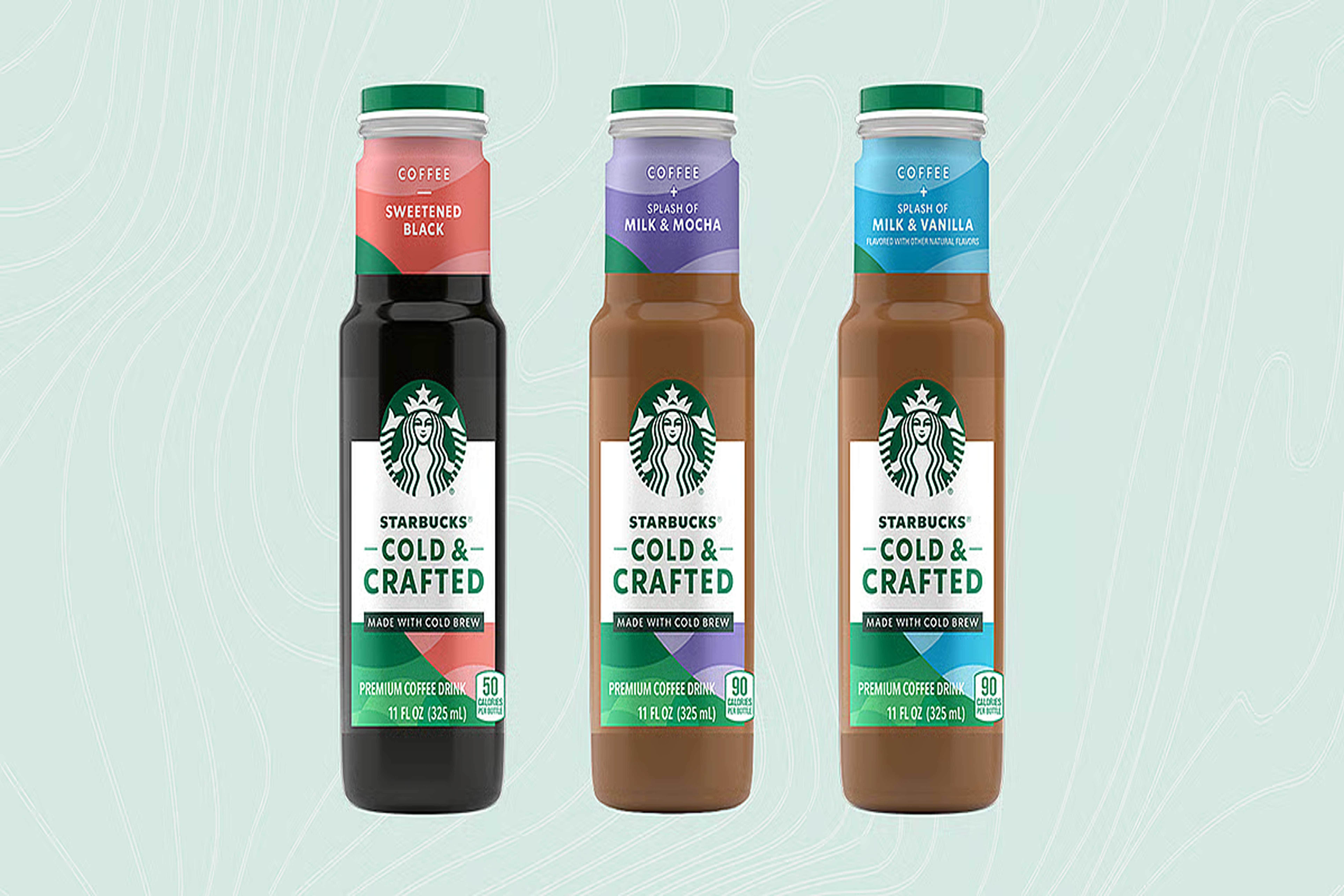
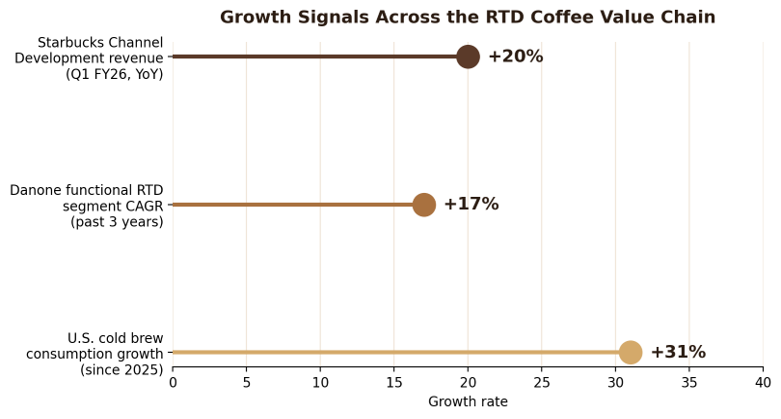
The Starbucks–PepsiCo North American Coffee Partnership has anchored U.S. bottled and canned coffee shelf space for more than two decades, at one point commanding more than 97% share of the branded RTD coffee category in the U.S. Rather than resting on that position, Starbucks is using it to launch new formats: Coffee & Protein RTD beverages moved from Starbucks stores into supermarkets, following the same functional-beverage trend reshaping the wider category. The strategy is paying off financially. Starbucks' Channel Development segment, which includes its RTD coffee business, posted double-digit revenue growth in fiscal 2026, with Q1 net revenues up 20% year-over-year, driven in part by higher global ready-to-drink revenue. The broader company turnaround has strengthened the platform underneath that growth: fiscal third-quarter net income reached $1.05 billion, up sharply from $558.3 million a year earlier, and global same-store sales rose nearly 6% for the year, giving Starbucks more capital and confidence to keep investing in RTD innovation.
Nestlé: Consolidate Around One Coffee Pillar
Nestlé took a structural approach in 2026, folding Nescafé, Nespresso, and its licensed Starbucks at-home business into a single global “coffee pillar,” with RTD explicitly positioned as a growth feature across all three brands. Nespresso backed that strategy with its first-ever U.S. ready-to-drink coffee launch, aiming to extend a premium, boutique-oriented brand into the cold beverage aisle a notable move for a brand historically associated with capsule machines rather than grab-and-go bottles. Coffee remains a stated priority within Nestlé's beverages division, which represented roughly 28.1% of total group sales in 2025 the largest single category in the company's portfolio, ahead of pet care at 20.6% and nutrition and health science at 16%.
Danone: Build Through Functional Nutrition
Danone is taking the most aggressive functional bet. Its Oikos Protein Shakes range added a Mocha Latte coffee variant with 95 milligrams of caffeine, alongside protein and fiber, and Danone has called the line a top-growing RTD product now stocked at Target, Walmart, and Kroger. The company backed up that ambition with a roughly $1 billion acquisition of Huel, signaling a broader push into “complete nutrition” beverages that puts pressure on Nestlé, Unilever, and PepsiCo to respond with their own functional platforms. Danone has framed its target customer broadly from busy professionals to parents to the growing population of GLP-1 medication users seeking nutrient-dense options. These high-protein options fit easily into an existing routine.
The Coca-Cola Company and the Asian Incumbents
A fourth strategy is playing out in parallel: leveraging existing global bottling and cold-chain scale rather than building new brand equity from scratch. The Coca-Cola Company continues to expand its Costa iced coffee latte lineup in the U.S. and internationally. In contrast, its Georgia canned coffee brand remains a dominant player in Japan's mature vending-machine and convenience-store coffee culture. That Japanese market is itself a competitive proving ground, where Suntory (BOSS), UCC Ueshima, DyDo Drinco, Pokka Sapporo, and Kirin have spent decades refining canned and bottled coffee for a shopper who treats it as a daily habit rather than an occasional treat format knowledge that is increasingly valuable as Western brands look to expand into Asia-Pacific, widely cited as the fastest-growing RTD coffee region.
What ties these four strategies together is distribution. RTD coffee, unlike a café pour-over, lives or dies on cold-chain reach: shelf space in a convenience store cooler, a grocery aisle end-cap, or a vending machine network. That is precisely why the legacy beverage infrastructure built over decades by PepsiCo, Coca-Cola, and Japan's canned-coffee incumbents remains such a durable competitive moat, even as newer entrants bring sharper nutritional positioning to the category.
Three Strategies, One Battle
- Starbucks/PepsiCo: defend an entrenched distribution advantage while extending into functional formats.
- Nestlé: consolidate multiple coffee brands under one strategic pillar and push premium RTD into new markets.
- Danone: lead with nutrition science and protein positioning, backed by M&A to build a broader functional-beverage platform.
- Coca-Cola and Asian incumbents: scale existing bottling and cold-chain infrastructure across mature and emerging markets alike.
For the full competitive breakdown and company-by-company positioning, read our ready-to-drink coffee market analysis.