Gen Z Expectations: Redefining Customer Experience Standards
Gen Z expects live chat replies within 5 minutes and discovers brands via short-form video 38% of the time. A 2,240-consumer study on generational CX gaps.


Gen Z expects live chat replies within 5 minutes and discovers brands via short-form video 38% of the time. A 2,240-consumer study on generational CX gaps.
Gen Z consumers broadly defined as those aged 18 to 27 are not simply a younger version of the Millennial customer. They are establishing a distinct and measurably higher bar for what constitutes acceptable customer experience, and brands that apply legacy CX playbooks to this cohort are finding those playbooks fall short with increasing frequency. This report examines how Gen Z’s expectations diverge from older generations across the customer journey, from product discovery through purchase, service, and loyalty, drawing on a research wave covering 2,240 consumers across four generational cohorts: Gen Z, Millennials, Gen X, and Boomers. The research finds that Gen Z rates nearly every core customer experience attribute speed, personalization, authenticity, social proof, sustainability, and mobile seamlessness more highly than older cohorts, with the widest gaps appearing in sustainability credentials (a
2.2-point gap over Gen X on a 10-point scale) and seamless mobile experience (8.8 versus 6.6). Perhaps most strikingly, Gen Z’s tolerance for service delay has compressed dramatically: this cohort expects a live chat response within five minutes, less than a quarter of the twenty-four minutes Gen X considers acceptable, and a fraction of the forty-five minutes Boomers will tolerate.
Equally important is where Gen Z looks for information and validation before buying. Short-form video content on platforms such as TikTok and Instagram Reels is now the leading product discovery channel for this cohort at 38%, ahead of Instagram feed and stories content (27%), search engines (24%), and influencer content specifically (22%). Peer-generated content and user reviews are the single most influential factor in Gen Z purchase decisions, cited by 46% of respondents as "highly influential" nearly four times the influence attributed to traditional advertising. This report unpacks these findings in detail and translates them into a set of concrete implications for how brands should redesign the customer journey to meet this generation on its own terms.
This study surveyed 2,240 consumers across India’s major urban and semi-urban markets, segmented into four generational cohorts: Gen Z (ages 18–27), Millennials (28–43), Gen X (44–59), and Boomers (60+). Respondents were asked to rate the importance of a standard set of customer experience attributes on a 10-point scale, report their preferred discovery and research channels, specify their tolerance thresholds for service response time, and rank the factors that most influence their purchase decisions and brand loyalty. Where relevant, findings are benchmarked against Gen Z-specific research published by global consumer research bodies and social platform insights teams to validate directional consistency with broader market trends beyond this study’s own sample.
The discovery stage of the customer journey looks fundamentally different for Gen Z than for any prior generation. Short-form video content leads all discovery channels at 38%, reflecting the extent to which platforms built around algorithmic, entertainment-first content discovery have become the default entry point into brand awareness for this cohort. Instagram’s broader feed and stories formats follow at 27%, while traditional search engines—long the dominant discovery mechanism for Millennials and Gen X trail at 24%, used more often for validation of a product already discovered elsewhere than as a starting point.
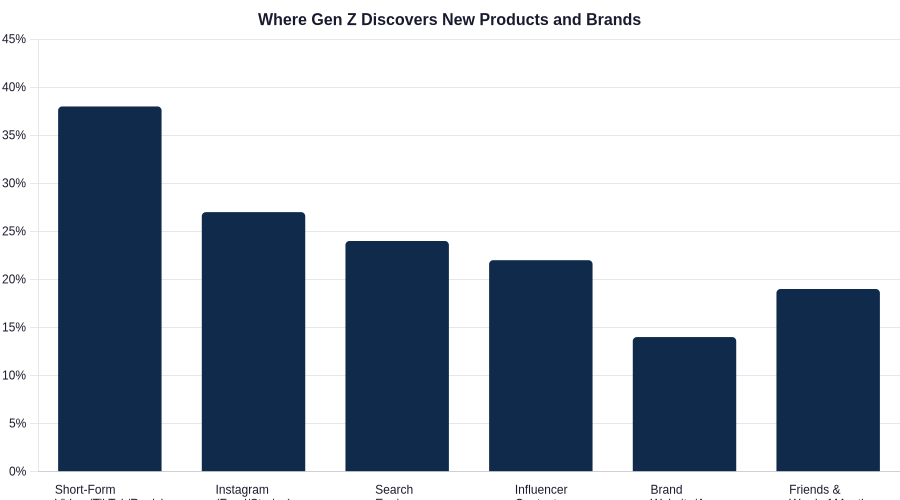
Figure 1: Primary channels through which Gen Z consumers discover new products and brands.
Influencer content (22%) and word-of-mouth from friends (19%) round out the top discovery channels, while brand-owned websites and apps rank lowest at 14% a finding with significant implications for marketing resource allocation. For Gen Z, brand discovery is overwhelmingly mediated by third-party content creators and platforms rather than brand-controlled properties, meaning that the earliest touchpoints in this generation’s customer journey are largely outside a brand’s direct control. This raises the strategic importance of creator partnerships, authentic UGC-style content, and platform-native formats over traditional owned-channel marketing investment.
Attribute-level comparison across the four generational cohorts reveals that Gen Z does not merely prefer better customer experience it expects a qualitatively different standard across nearly every dimension measured. On a 10-point importance scale, Gen Z rates seamless mobile experience at 8.8, authenticity and transparency at 8.7, social proof and reviews at 8.4, speed and responsiveness at 8.6, personalization at 8.2, and sustainability credentials at 7.6. Every one of these scores exceeds the corresponding Millennial rating, and the gap widens further against Gen X and Boomers.
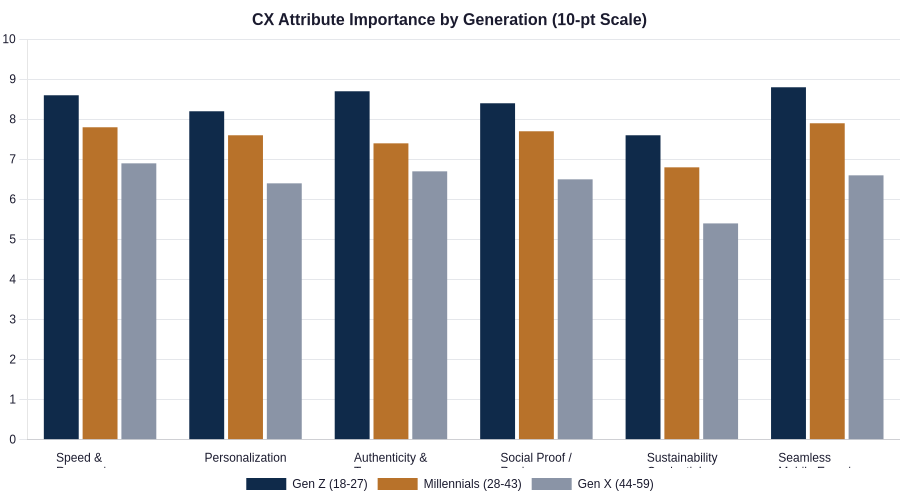
Figure 2: Importance ratings for core CX attributes, compared across four generational cohorts.
The sustainability gap is particularly notable from a strategic standpoint: Gen Z’s 7.6 rating for sustainability credentials sits 2.2 points above Gen X’s 5.4, making it the single widest generational gap of any attribute measured. This does not mean older generations are indifferent to sustainability, but it does mean that a brand underinvesting in credible sustainability communication is disproportionately exposed to Gen Z defection relative to other cohorts. Authenticity and transparency show a similarly pronounced pattern: Gen Z consumers are notably more skeptical of polished, traditional brand messaging and more responsive to communication that acknowledges imperfection, engages in two-way dialogue, and demonstrates values consistency rather than values marketing.
Perhaps the most operationally significant finding in this research concerns response time tolerance. Gen Z consumers expect a live chat response within five minutes before considering the experience unacceptable, compared to twelve minutes for Millennials, twenty-four minutes for Gen X, and forty-five minutes for Boomers. This nearly ninefold compression in patience between the oldest and youngest cohorts reflects a generation raised on real-time digital interaction, where near-instant response has become the implicit baseline rather than a premium service tier.
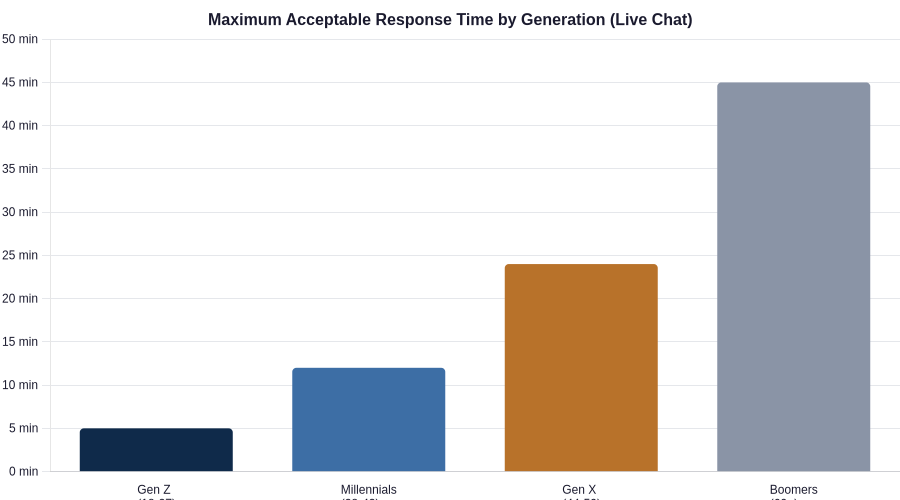
Figure 3: Maximum acceptable customer service chat response time by generational cohort.
This compression has direct staffing and technology implications. Brands relying on legacy service level agreements calibrated to Millennial or Gen X tolerance thresholds are likely under-serving Gen Z customers without realizing it, since a response time that would satisfy 70% of a Gen X customer base may already register as a failure for a majority of Gen Z customers. This finding strengthens the case for AI-assisted first-response systems and proactive, always-on support channels specifically for segments and channels with disproportionate Gen Z representation, while reserving human escalation for complex issues that automated systems cannot adequately resolve.
When asked what most influences their purchase decisions, Gen Z respondents ranked peer-generated content and user reviews highest, with 46% citing it as "highly influential" more than triple the 12% who said the same of traditional advertising. Influencer recommendations (34%), a brand’s values and social stance (31%), and star ratings and review volume (29%) followed, while loyalty program benefits, though meaningful, ranked comparatively lower at 21%.
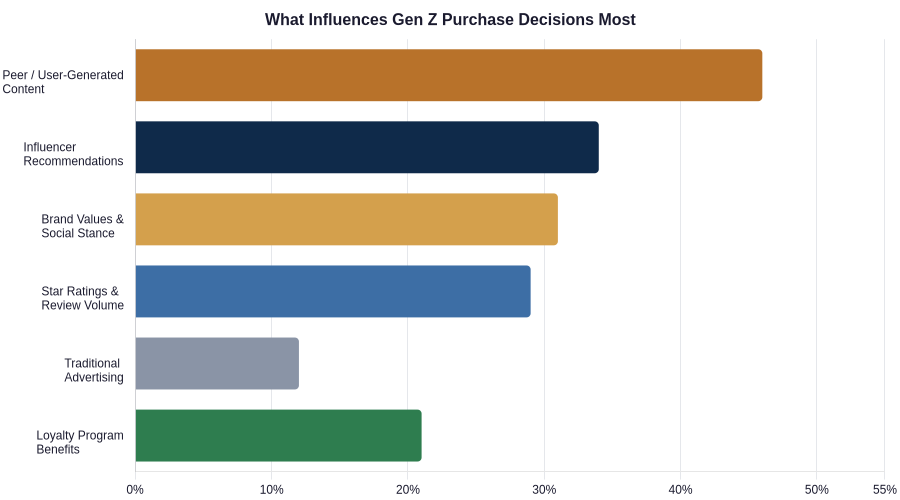
Figure 4: Factors Gen Z consumers cite as most influential to their purchase decisions.
This ranking reflects a broader trust shift away from brand-controlled messaging and toward peer and creator validation. For Gen Z, a product review from a relatable creator or a stream of authentic user-generated content functions as a more credible signal of quality than a brand’s own advertising claims, regardless of production quality. The relatively strong showing of brand values and social stance (31%) also confirms that Gen Z purchase decisions are not purely transactional; a meaningful share of this cohort factors a brand’s perceived ethics and social positioning into the purchase decision itself, not merely into post-purchase advocacy.
Loyalty driver analysis shows Gen Z prioritizes fast issue resolution (8.6/10) and consistent quality (8.5/10) as the top two drivers of continued patronage, followed closely by brand values alignment (8.3/10) and personalized offers (8.0/10). Compared to Millennials, Gen Z places notably higher weight on community and belonging (7.8 versus 6.5) and exclusive access or early-release drops (7.9 versus 6.4), reflecting this cohort’s stronger orientation toward brands that offer a sense of identity and insider status rather than purely transactional value.
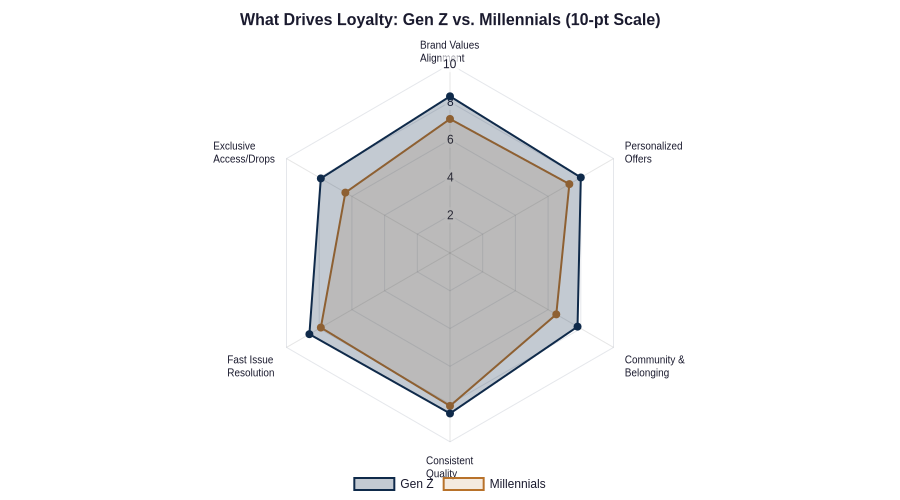
Figure 5: Comparative loyalty drivers, Gen Z versus Millennials, across six dimensions.
The strength of community and exclusivity as loyalty levers for Gen Z suggests that traditional points-based loyalty programs, while still relevant, may underperform relative to community-building initiatives, early-access programs, and co-creation opportunities that make Gen Z customers feel like participants in a brand’s identity rather than passive recipients of its offers. Brands that have successfully built Gen Z loyalty tend to combine functional reliability—fast resolution, consistent quality—with an emotional and social layer that competitors relying solely on discounting struggle to replicate.
While the generational patterns above hold broadly across the sample, this research also surfaces meaningful variation within Gen Z itself. Urban metro Gen Z respondents show even more compressed response-time tolerance and higher sustainability sensitivity than their peers in Tier-2 and Tier-3 towns, where price sensitivity and value-for-money considerations remain comparatively stronger influences on purchase decisions. This suggests that "Gen Z" should not be treated as a monolithic segment for CX design purposes; income, geography, and category familiarity continue to shape the intensity with which these generational preferences express themselves, even as the overall direction of the shift remains consistent nationally.
Category also matters. Gen Z’s expectations around speed and mobile seamlessness are most pronounced in categories with high purchase frequency and low consideration time, such as quick-commerce, food delivery, and fast fashion, where the cohort has effectively normalized near-instant fulfillment as table stakes. In higher-consideration categories such as electronics, financial services, and travel, Gen Z shows more willingness to invest time in research, but still expects that research process itself to be fast, transparent, and socially validated rather than reliant on traditional brand messaging or lengthy in-person consultations. Brands operating across multiple categories should calibrate their CX investment priorities accordingly rather than applying a single Gen Z playbook uniformly across a diversified portfolio.