Key Findings
- The Europe Cold Rolled Steel Market was valued at US$27.53 billion in 2025 and is projected to reach US$38.98 billion by 2034, growing at a CAGR of 3.94% between 2026 and 2034.
- Market volume stood at 32.4 million tonnes in 2025 and is forecast to reach 36.8 million tonnes by 2034, a volume CAGR of 1.42% over the forecast period.
- The mix-weighted average realised price of cold rolled steel in Europe was EUR 752 per tonne in 2025, the lowest point of the current cycle, with the forecast price path masked in this preview.
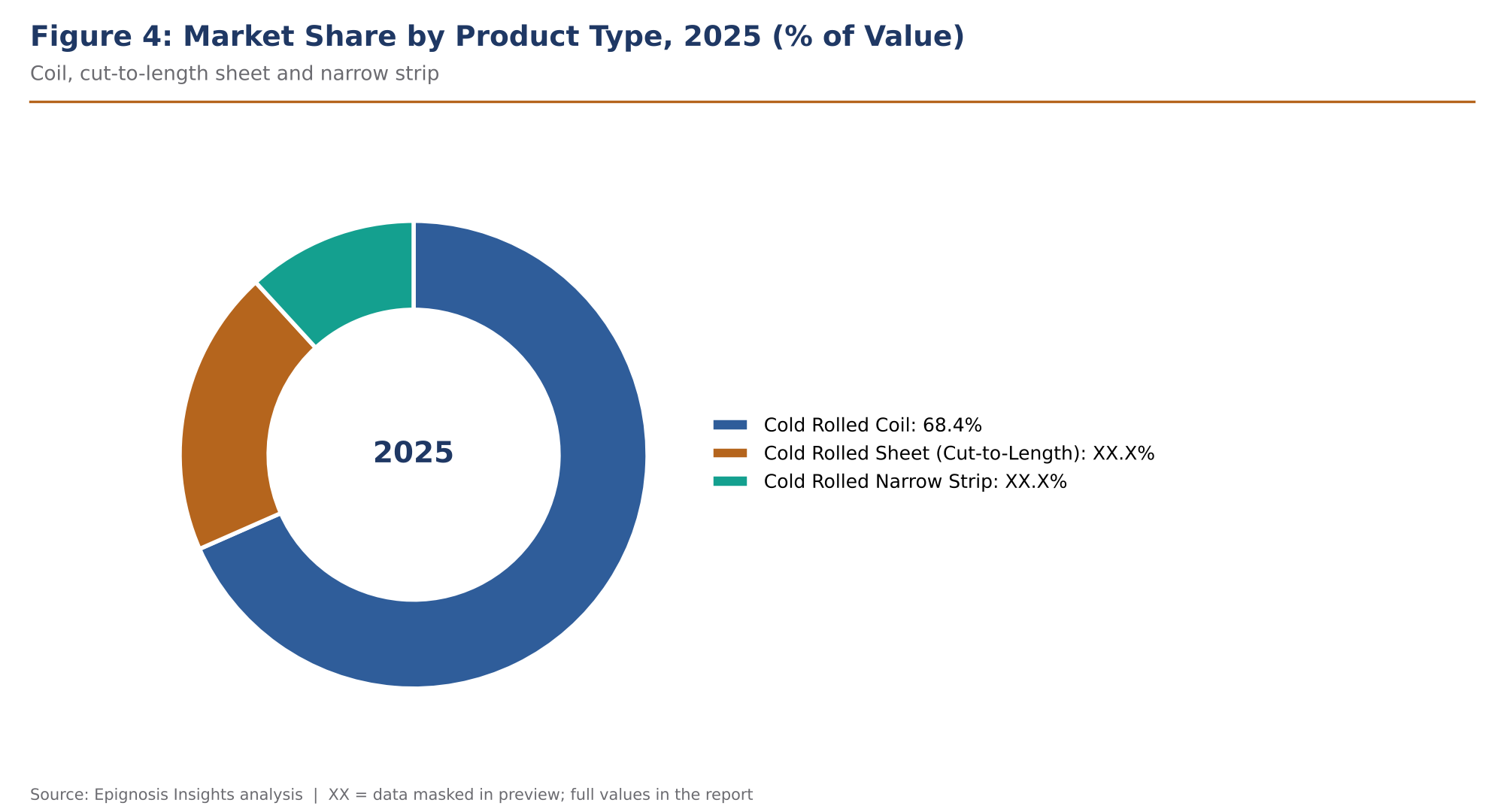
- Cold rolled coil accounted for 68.4% of market value in 2025, reflecting the dominance of coil-fed automotive, appliance and service-centre supply chains.
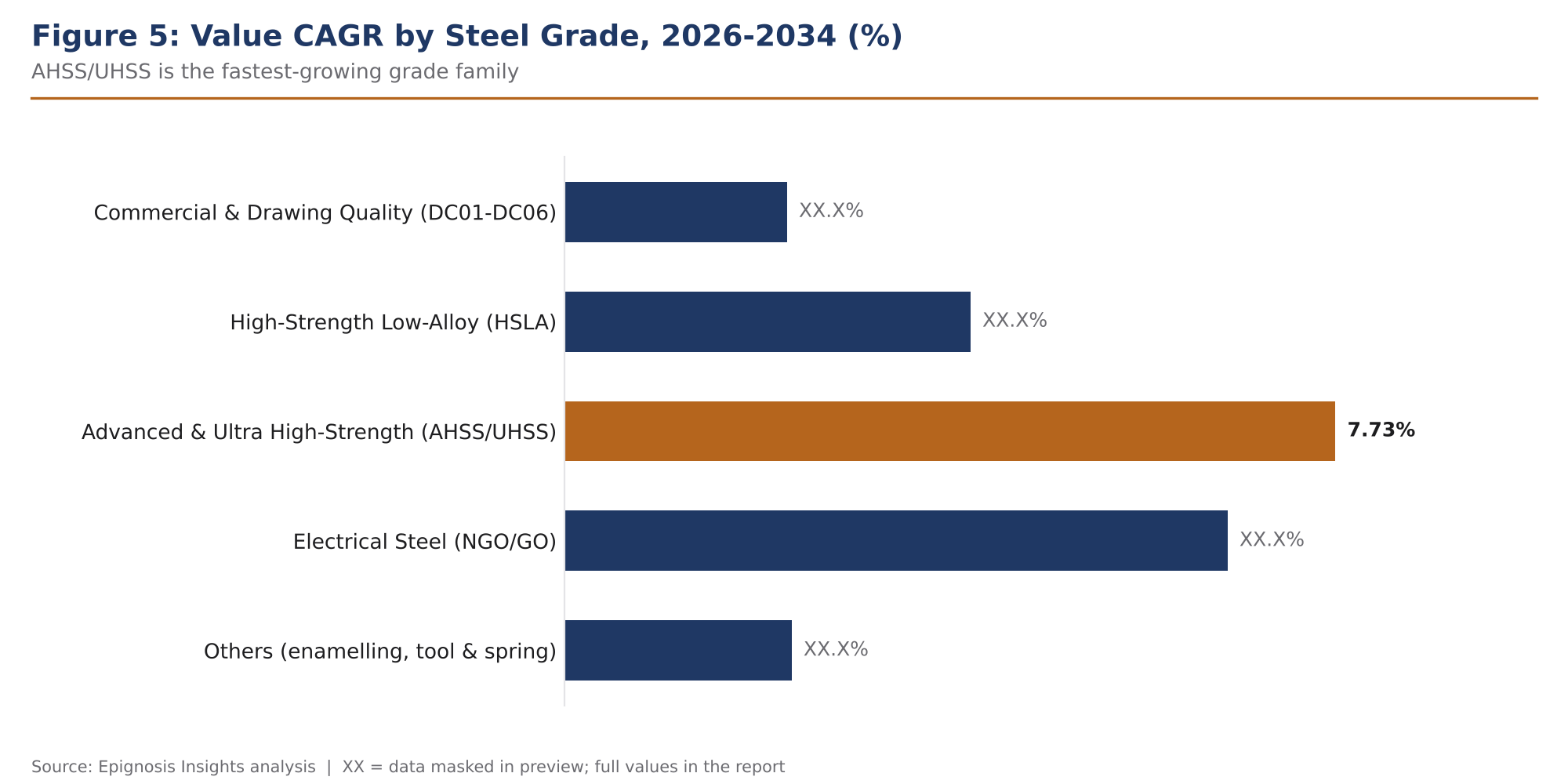
- Advanced and ultra high-strength steel (AHSS/UHSS) is the fastest-growing grade family, with a value CAGR of 7.73% from 2026 to 2034.
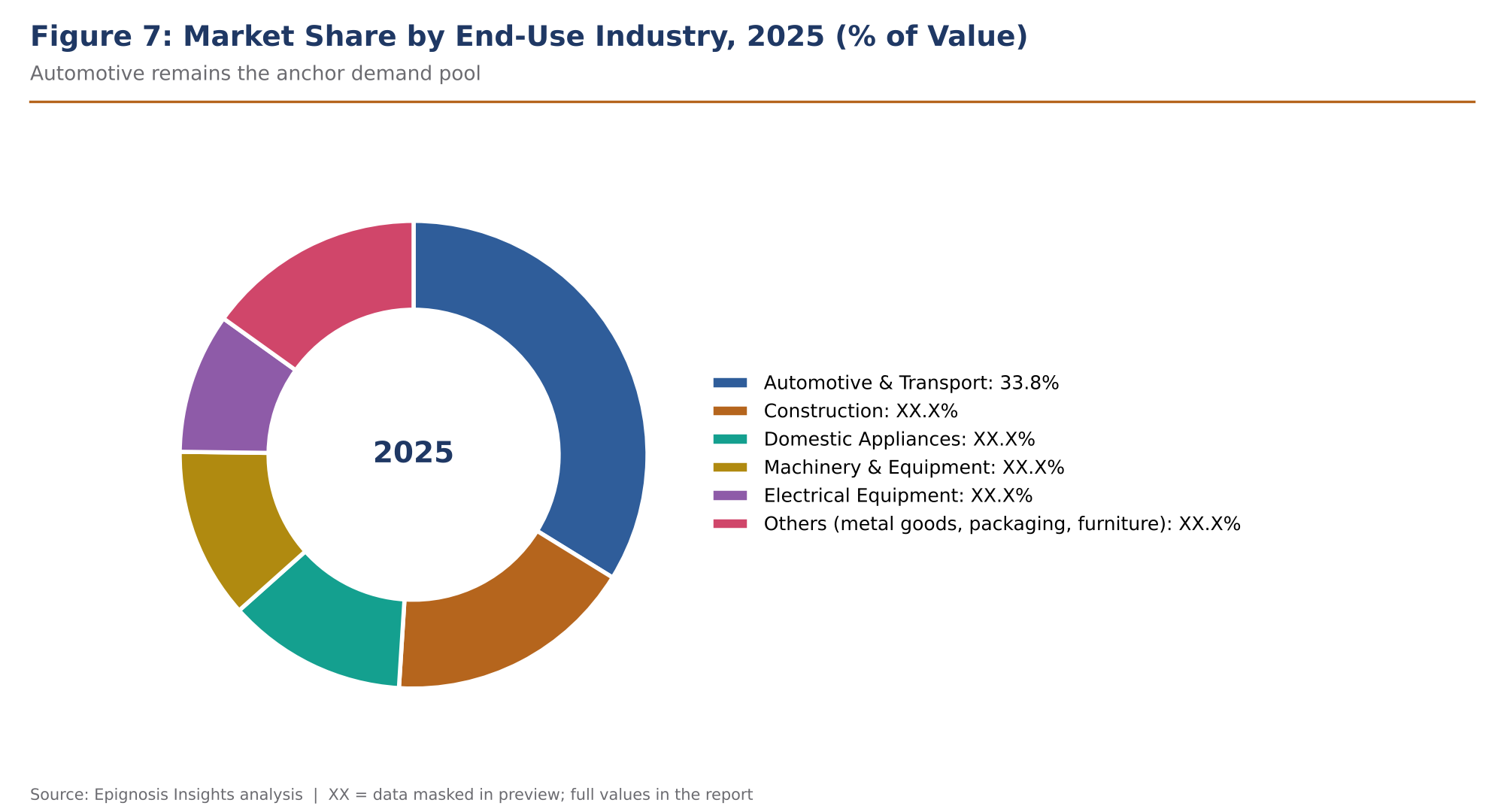
- Automotive and transport is the largest end-use industry, representing 33.8% of 2025 market value.
- Germany is the largest country market with a 26.2% value share in 2025, while Poland is the fastest-growing country market at a CAGR of 5.69%.
- Four policy instruments that came into force or were finalised during 2026 – the CBAM definitive period, the new tariff-rate quota regime, the melt-and-pour origin rule and definitive anti-dumping duties on cold rolled flat steel – are structurally reducing the share of imports in European cold rolled supply.
- Domestic cold-rolling capacity remains a bottleneck: European mills have repeatedly prioritised higher-margin galvanized output over commodity cold rolled coil, creating periodic shortages of uncoated material.
- Low-CO2 cold rolled products made from EAF and DRI-EAF substrate are moving from pilot volumes to commercial volumes from 2027 onward, opening a premium tier within the market.
Europe Cold Rolled Steel Market Outlook
The Europe Cold Rolled Steel Market is projected to reach US$38.98 billion by 2034 from US$27.53 billion in 2025, and market revenue is expected to grow at a 3.94% CAGR from 2026 to 2034. In volume terms, apparent consumption of cold rolled flat steel across the region is projected to rise from 32.4 million tonnes in 2025 to 36.8 million tonnes by 2034, growing at a volume CAGR of 1.42%. The gap between value growth and volume growth is explained by two forces: a gradual recovery in base prices from the 2025 trough, and a steady shift in the product mix toward higher-value grades such as AHSS, electrical steel and thin-gauge precision strip.
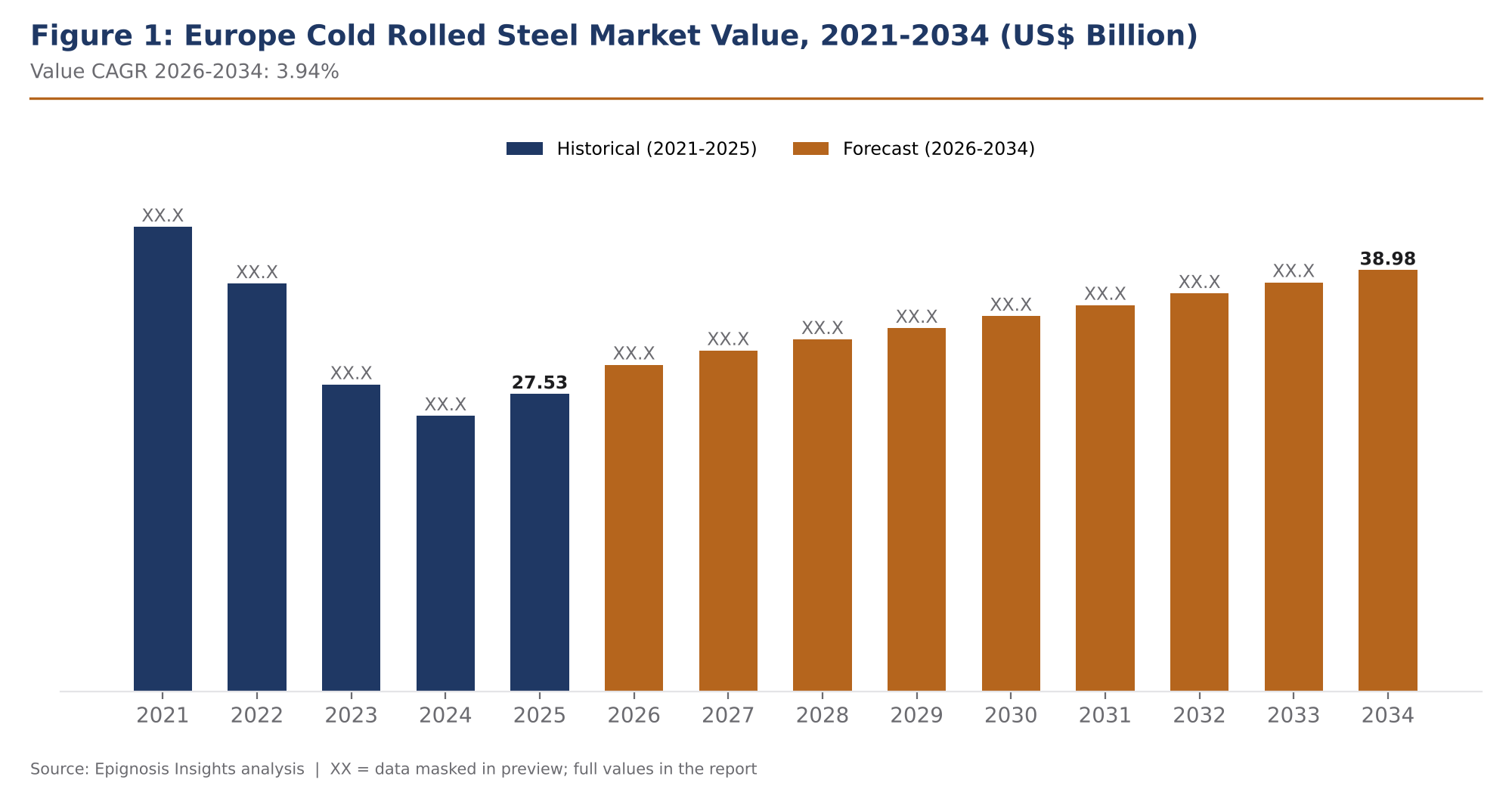
The market went through a sharp correction between 2022 and 2024, when both prices and volumes fell from post-pandemic highs. Value declined by XX.X% between 2022 and 2024 as average realised prices fell by more than a quarter and demand from automotive and construction weakened. Volume bottomed in 2024 at XX.X million tonnes before recovering in 2025, supported by restocking and a temporary surge of imports ahead of tighter trade rules. Epignosis Insights expects 2026 to be a transition year in which volume is broadly flat but value rises by XX.X% as domestic mills recapture market share and lift prices.
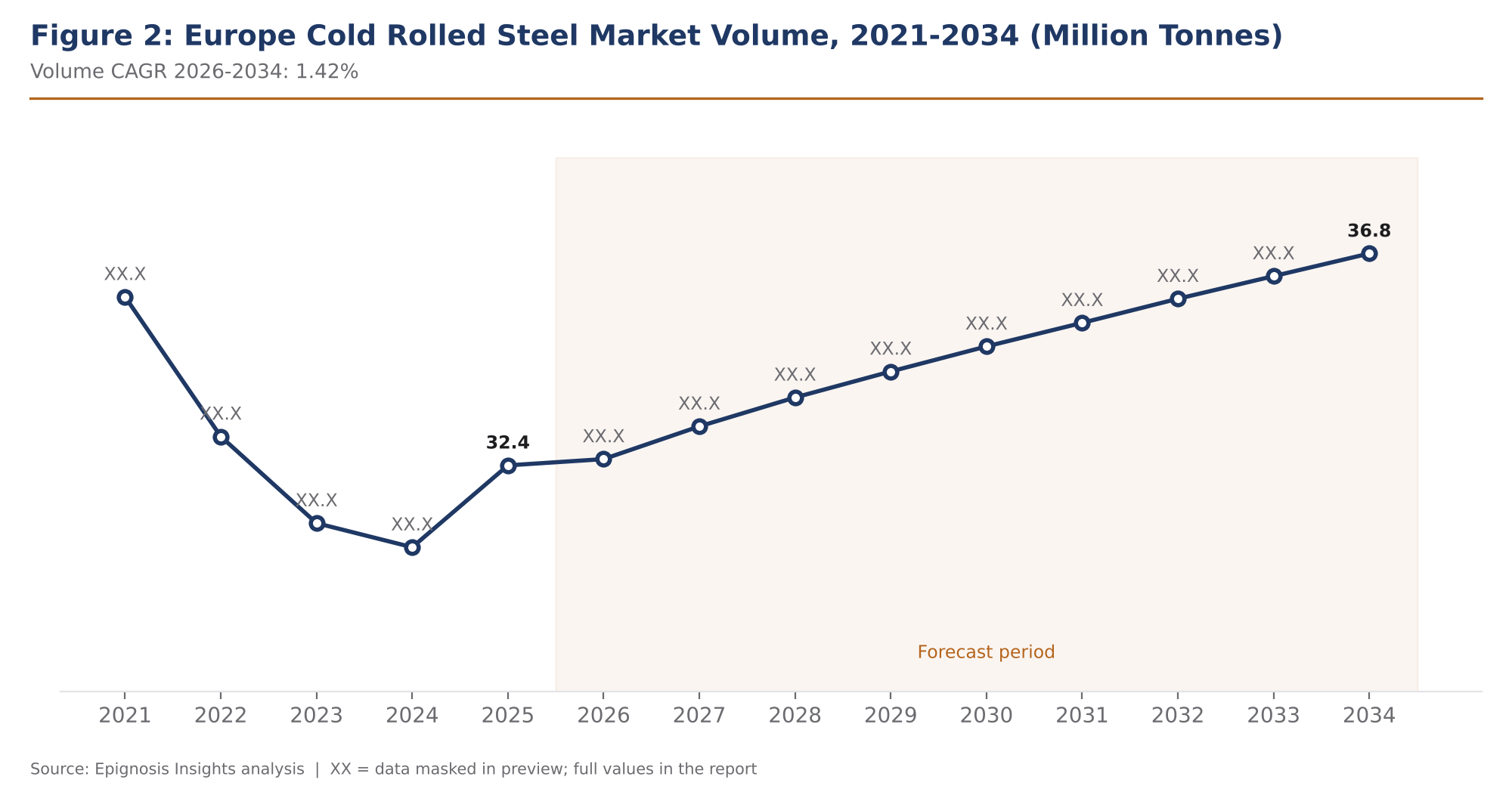
Table 1: Europe Cold Rolled Steel Market – Value, Volume and Average Price, Selected Years
| Year |
Value (US$ Billion) |
Volume (Million Tonnes) |
Average Price (EUR/tonne) |
| 2021 |
XX.X |
XX.X |
X,XXX |
| 2023 |
XX.X |
XX.X |
XXX |
| 2025 |
27.53 |
32.4 |
752 |
| 2027 |
XX.X |
XX.X |
XXX |
| 2030 |
XX.X |
XX.X |
XXX |
| 2034 |
38.98 |
36.8 |
XXX |
| CAGR 2026–2034 |
3.94% |
1.42% |
XX.X% |
Source: Epignosis Insights analysis. XX denotes data masked in this preview; complete annual series for 2021–2034 are provided in the full report and Excel data pack.
Market Definition and Scope
For this study, cold rolled steel refers to flat carbon and alloy steel products that have been reduced in thickness at room temperature after hot rolling and pickling, and supplied uncoated – either full-hard, batch-annealed, continuously annealed or temper-rolled. The scope covers cold rolled coil, cut-to-length sheet and narrow strip below 600 mm width.
Stainless cold rolled products and metallic- or organic-coated products (hot-dip galvanized, electrogalvanized, pre-painted and tinplate) are excluded from market value, although cold rolled substrate consumed captively for coating is tracked separately in the full report. Geographically, Europe covers the EU-27, the United Kingdom, Norway, Switzerland, Iceland and the Western Balkans. Russia, Belarus, Ukraine and Türkiye are treated as external supply sources rather than as part of the consumption base.
Market Dynamics
Trade Defence Reset Is Shifting Cold Rolled Supply Back to European Mills
The single most important change in the market during 2026 is the reset of Europe's import architecture. Imports of cold rolled coil had become a structural part of supply because European mills, facing high energy costs, chose to run fewer commodity cold-rolling hours and to route substrate into galvanizing lines. Service centres and re-rollers filled the gap with material from Asia and Türkiye, often at prices that undercut domestic offers by double-digit percentages.
That arrangement is now being unwound. According to the European Commission, Regulation (EU) 2026/1384 replaced the old safeguard on 1 July 2026, cutting the total annual tariff-free quota to roughly 18.35 million tonnes across 30 product categories and doubling the out-of-quota duty to 50%.
From 1 October 2026, importers must also declare where the steel was melted and poured, closing the route by which slab from one origin was rolled in a third country and re-labelled. On 16 November 2026 the Commission imposed definitive anti-dumping duties on cold rolled flat steel from five origins: 9.5% for India, 27.9% for Japan, 20.7–27% for Taiwan, 3–7.8% for Türkiye and 16% for Vietnam. The investigation itself estimated the EU cold rolled flat market at around EUR 23.2 billion, a figure that sits within the range of the Epignosis Insights base-year estimate once the UK, EFTA and Western Balkan markets are added.
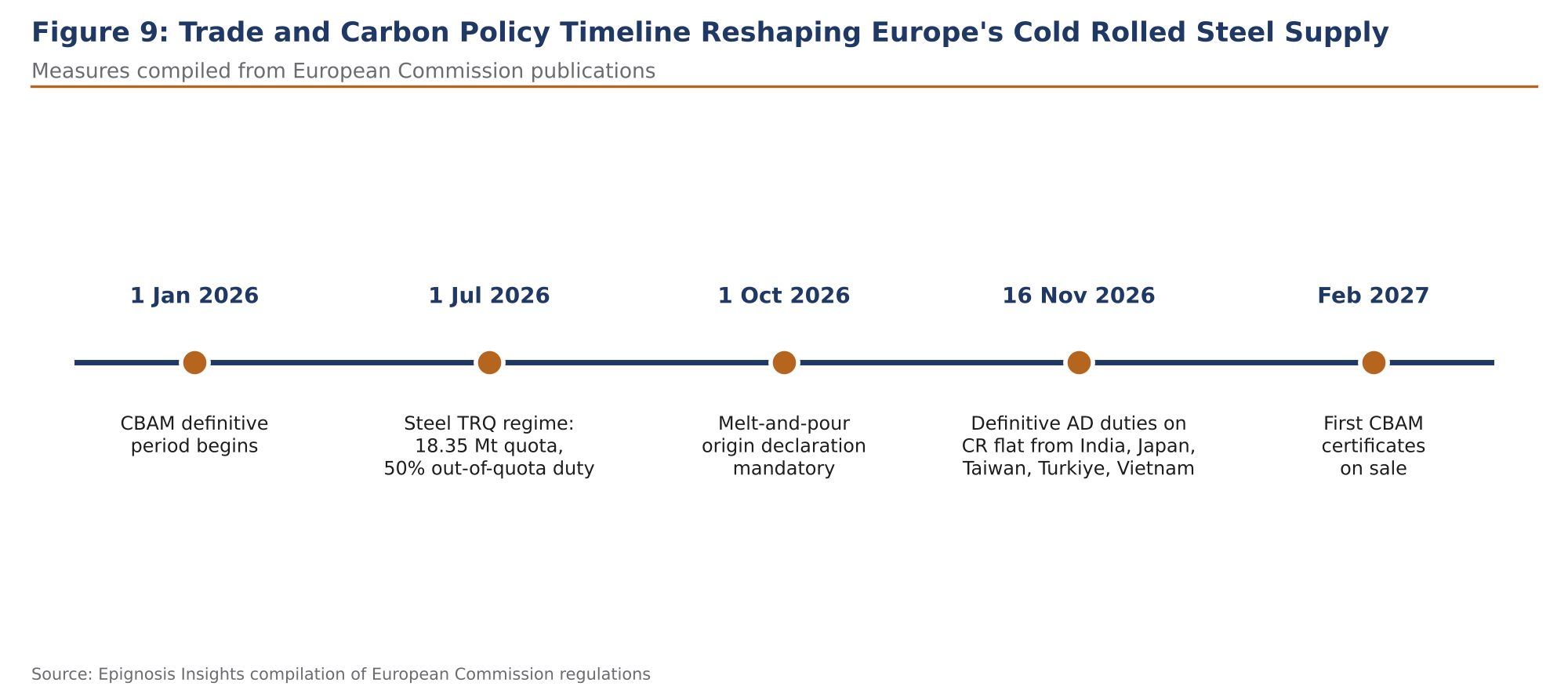
The combined effect is a step change in landed import costs rather than a marginal adjustment. Epignosis Insights estimates that the import share of European cold rolled consumption will fall from XX.X% in 2025 to XX.X% by 2028, with the largest substitution occurring in commodity drawing-quality grades used by tube makers, furniture producers and general fabricators. The market does not, however, become closed: quota volumes remain available to traditional suppliers, free-trade partners retain preferential access, and grades that European mills do not produce in sufficient volume – certain thin-gauge and wide-width products – will continue to be imported.
Automotive Lightweighting and Electrification Are Upgrading the Grade Mix
Automotive remains the largest single outlet for cold rolled steel, and its requirements are changing faster than its volumes. Per the European Automobile Manufacturers' Association (ACEA), EU car production rose only 0.3% in 2025 to just under 11.5 million units, still well below pre-pandemic levels. Volume growth from this sector will therefore be modest.
What is changing is the content per vehicle. Battery-electric platforms need stronger, lighter body-in-white structures to offset battery mass and protect the battery pack in side impacts, which pushes demand toward dual-phase, complex-phase and martensitic grades in the 780–1,500 MPa range. Non-oriented electrical steel for traction motors is a second, separate source of upgrade demand.
The outcome is a grade mix that moves up the value curve. Commercial and drawing-quality grades accounted for XX.X% of market value in 2025, but their share is projected to decline steadily as AHSS/UHSS grows at a 7.73% CAGR and electrical steel grows at XX.X%. For mills, this means that a tonne lost in commodity grades can be more than offset in revenue by a tonne gained in advanced grades, provided they have the annealing capability and OEM qualifications to supply them.
Energy Costs and Capacity Rationalisation Restrain Domestic Supply
Cold rolling and continuous annealing are among the most electricity- and gas-intensive downstream steps in flat steel production. European producers continue to face power prices well above those of competitors in Asia and North America, and the Middle East tensions that weighed on European business confidence through 2026 have kept energy-cost risk elevated. Mills have responded in two ways: by idling or closing older cold mills and batch-annealing shops, and by prioritising coated products where margins better cover energy costs. Buyers in Italy and Germany reported shortages of uncoated cold rolled coil between late 2025 and early 2026 for exactly this reason.
This restraint matters for the forecast because it limits how quickly domestic supply can replace imports. Epignosis Insights models effective cold-rolling capacity in Europe at XX.X million tonnes in 2025, with net additions of only XX.X million tonnes through 2030 after accounting for closures. Where capacity is tight, the adjustment comes through price rather than volume, which is one reason value growth is projected to outpace volume growth for most of the forecast period.
Low-CO2 Cold Rolled Products Open a Premium Tier
The fourth dynamic is a supply-side opportunity. A wave of electric arc furnace capacity linked to flat products is due between 2027 and 2030, which will allow mills to offer cold rolled coil with materially lower embedded emissions. voestalpine is preparing to commission a 1.6 million tonne EAF at Linz in the first half of 2027; Salzgitter's SALCOS first stage, combining a direct reduction plant and an EAF, is scheduled to start production in the first half of 2027; ArcelorMittal has committed EUR 1.3 billion to a 2 million tonne EAF at Dunkirk due in 2029; and the Košice works in Slovakia, now directly owned by Nippon Steel, plans a 1.6 million tonne EAF for 2030.
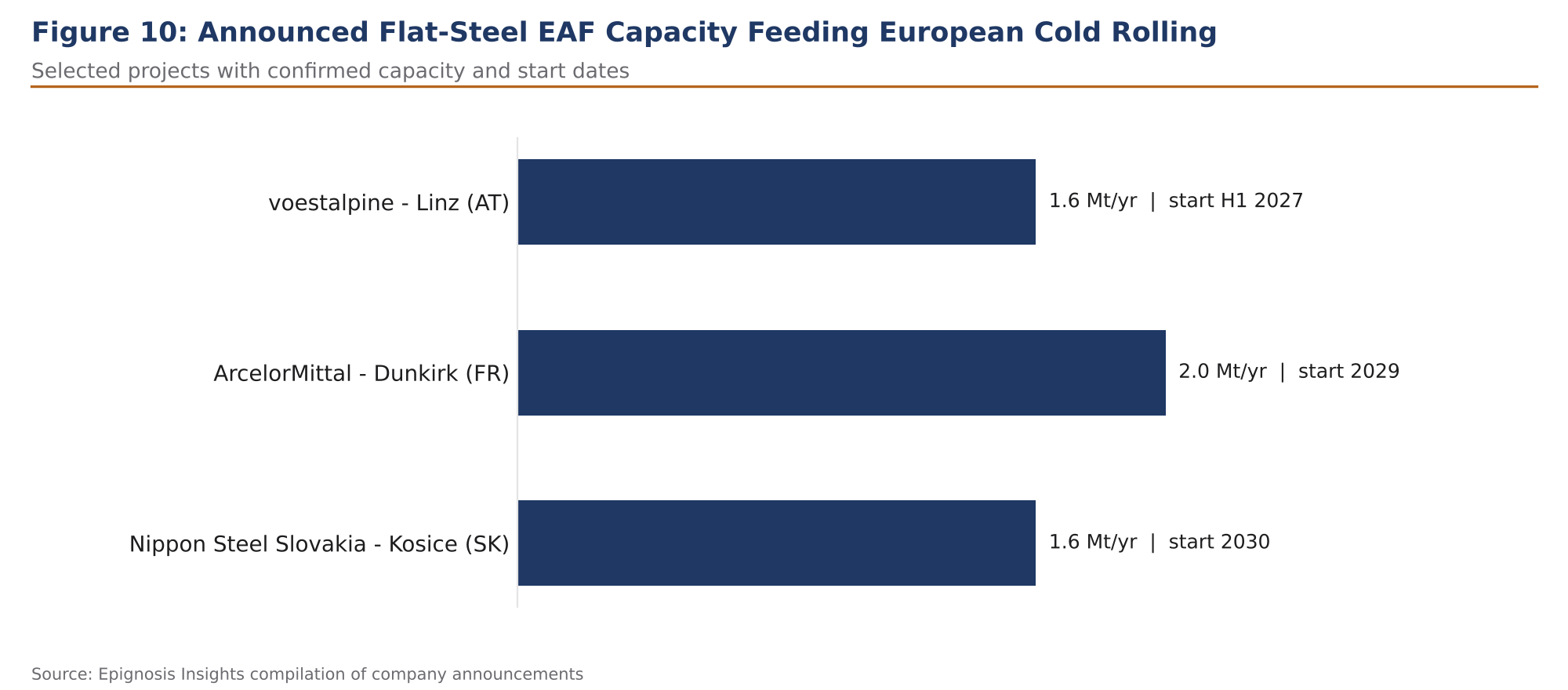
Automotive OEMs with Scope 3 targets are the first buyers willing to pay for this material, followed by appliance makers and premium construction-product brands. Epignosis Insights estimates that low-CO2 cold rolled products will represent XX.X% of market volume by 2030 and XX.X% by 2034. The premium these products can sustain is still contested; buyers in the spot market resist paying more than a modest uplift, while contract buyers with published decarbonisation commitments have shown greater willingness. The full report quantifies premium bands by grade and end use.
Pricing Analysis
Cold rolled steel prices in Europe track hot rolled coil (HRC), the primary input, plus a conversion spread that reflects pickling, rolling, annealing and temper-rolling costs. The mix-weighted average realised price across all grades and countries was EUR 752 per tonne in 2025, down from a 2022 peak of EUR XXX per tonne. The decline was driven by weak end-use demand, high inventories across the distribution chain and heavy import offers that capped domestic pricing power.
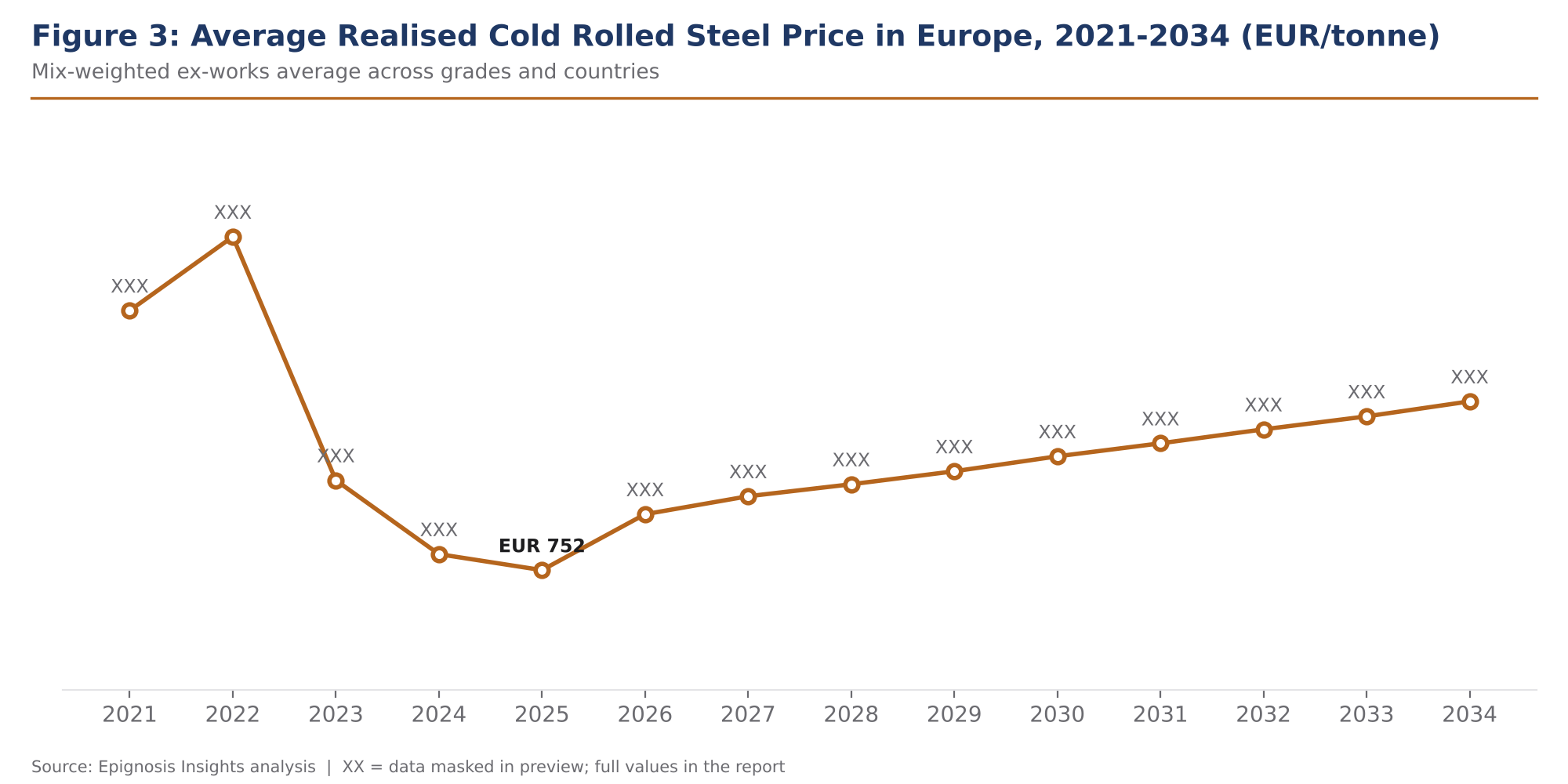
The pricing environment changed direction once the new trade regime was announced. In October 2025, Fastmarkets assessed domestic cold rolled coil ex-works Northern Europe at EUR 670–690 per tonne, with local mills seeking EUR 730–750 per tonne for January 2026 delivery. Through the first half of 2026, cold rolled and galvanized prices posted sharper gains than HRC as limited domestic capacity was unable to offset reduced import flows, and by May 2026 Kallanish reported mills and buyers broadly agreeing on a range of EUR 800–830 per tonne ex-works for both products. Epignosis Insights projects the average realised price to rise by XX.X% in 2026 and to grow at a compound rate of XX.X% per year thereafter. Three features of the forecast are worth noting:
- The CRC–HRC spread widens. Because the bottleneck sits in cold-rolling capacity rather than in crude steel, the spread between cold rolled and hot rolled coil is projected to widen from EUR XX per tonne in 2025 to EUR XX per tonne by 2028.
- Grade extras rise faster than base prices. Extras for AHSS, deep-drawing and exposed-surface automotive quality are projected to grow faster than the base price, as mills ration annealing-line time toward these products.
- Regional price gaps narrow. Southern European prices, historically set by import parity, are expected to converge toward Northern European levels as the import discount shrinks.
Carbon Cost Pass-Through and CBAM Exposure
Separate from tariffs and quotas, the Carbon Border Adjustment Mechanism changes the cost comparison between imported and domestic cold rolled steel. The definitive period started on 1 January 2026, which means importers incur a financial liability for the embedded emissions of every tonne they bring in, even though certificates covering 2026 imports are only surrendered in 2027. For iron and steel products, direct emissions from the upstream steelmaking route dominate the calculation, so a cold rolled coil made from blast-furnace steel in a coal-heavy grid carries a much higher CBAM cost than one rolled from EAF substrate.
The practical consequence for the cold rolled market is threefold. First, importers are demanding verified actual-emissions data from suppliers, because default values are set deliberately high and can make an otherwise competitive offer uneconomic. Second, some Asian suppliers have offered material on terms that absorb CBAM risk, which shifts the cost burden but does not eliminate it. Third, as free allowances under the EU ETS are phased out in parallel, the carbon cost embedded in domestic blast-furnace steel also rises, narrowing the advantage domestic mills gain from CBAM until their own EAF capacity comes online. Epignosis Insights models the CBAM cost on a typical imported cold rolled coil at EUR XX–XX per tonne in 2027, rising to EUR XX–XX per tonne by 2030 under its central carbon-price assumption.
Segment Analysis
By Product Type
Cold rolled coil held 68.4% of market value in 2025 and remains the main form in which material moves from mills to automotive presses, appliance lines and steel service centres. Cut-to-length sheet accounted for XX.X% and is supplied mainly through distributors to fabricators, furniture producers and small manufacturers who lack decoiling equipment. Cold rolled narrow strip, at XX.X% of value, is the fastest-growing product form with a CAGR of XX.X%, because precision strip for seat mechanisms, chains, springs, saw blades and electrical laminations commands high unit values and benefits directly from automotive and electrification demand. Specialist re-rollers such as C.D. Wälzholz and Bilstein dominate this sub-segment.
By Steel Grade
Commercial and drawing-quality grades (DC01 to DC06) remain the largest grade family by value but are growing at only XX.X% per year, roughly in line with volume. HSLA grades, used in structural automotive parts, racking and agricultural equipment, grow at XX.X%. The two upgrade segments carry the market's value growth: AHSS/UHSS, growing at 7.73%, and electrical steel, growing at XX.X%. ArcelorMittal's EUR 500 million electrical steel project at Mardyck in France, with initial tests targeted for spring 2027, illustrates where producers are placing capital. Enamelling, tool and spring grades make up the remainder and are projected to lose share.
By Thickness
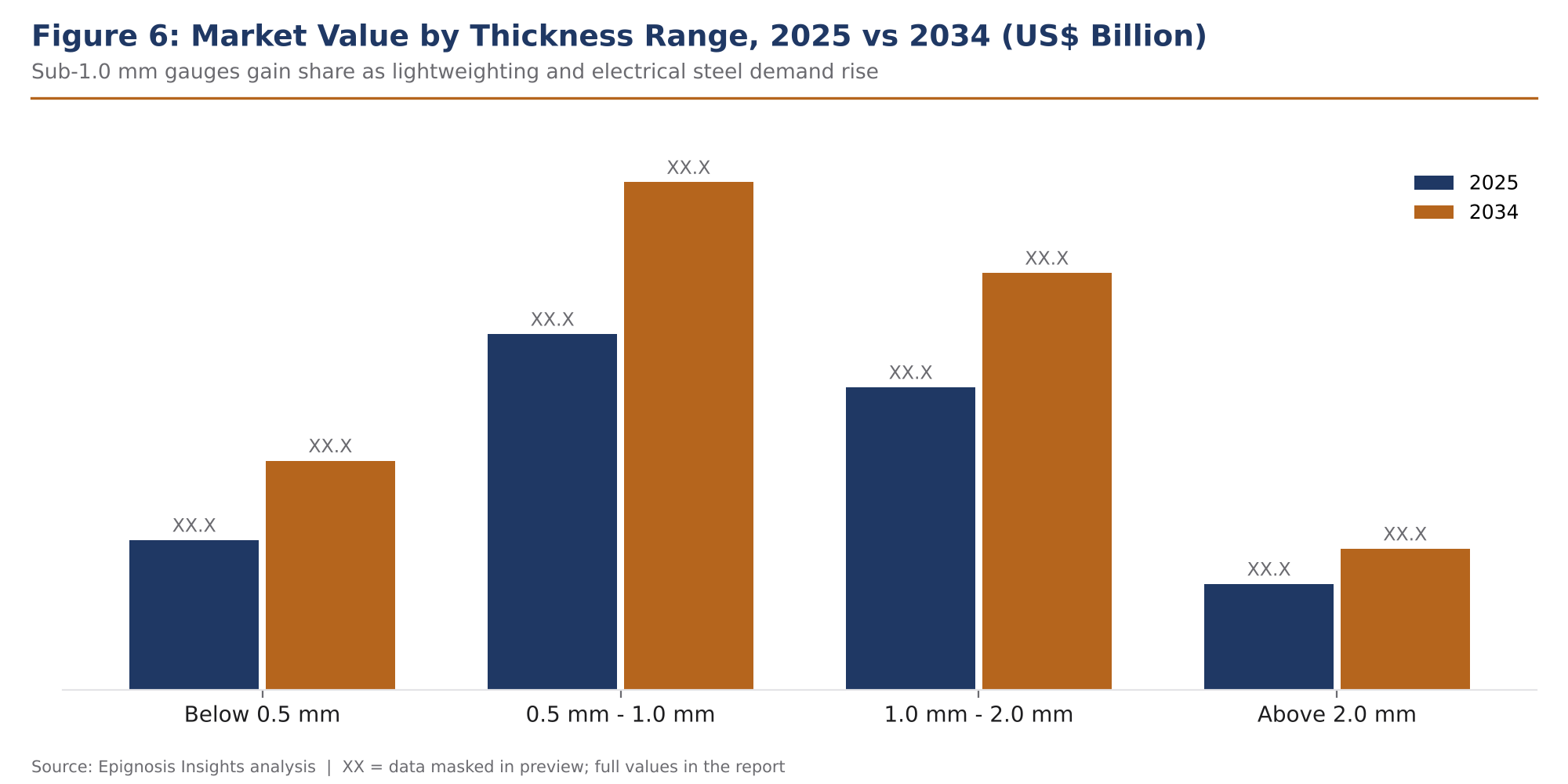
The 0.5–1.0 mm range is the largest thickness band at XX.X% of 2025 value, covering most automotive outer panels, appliance housings and general-purpose sheet. The below-0.5 mm band is growing fastest at XX.X% CAGR, driven by electrical steel laminations and lightweight appliance components. Gauges above 2.0 mm, which compete most directly with hot rolled pickled and oiled material, show the slowest growth as buyers substitute thinner, stronger grades for heavier commodity sheet.
By End-Use Industry
Automotive and transport accounted for 33.8% of market value in 2025. Construction, at XX.X%, uses cold rolled steel mainly as substrate for profiles, doors, partitions and HVAC ducting, and is the steadiest demand pool because it is supported by renovation and infrastructure activity even when new-build is weak. Domestic appliances account for XX.X%, and their demand is sensitive to housing transactions and to competition from imported finished appliances. Machinery and equipment represent XX.X%. Electrical equipment – motors, transformers, generators and grid components – is the fastest-growing end-use at a CAGR of XX.X%, driven by grid investment, heat pumps and industrial electrification. The remaining XX.X% is spread across metal goods, packaging drums, furniture and shelving.
Country Analysis
Germany is the largest country market with a 26.2% value share in 2025, reflecting its concentration of automotive assembly, tier-one suppliers, appliance makers and machinery builders, as well as the integrated flat-steel works at Duisburg, Salzgitter, Bremen and Eisenhüttenstadt. German demand growth of XX.X% CAGR is below the regional average because automotive output is unlikely to return to pre-pandemic levels, but the country leads on AHSS and electrical steel consumption.
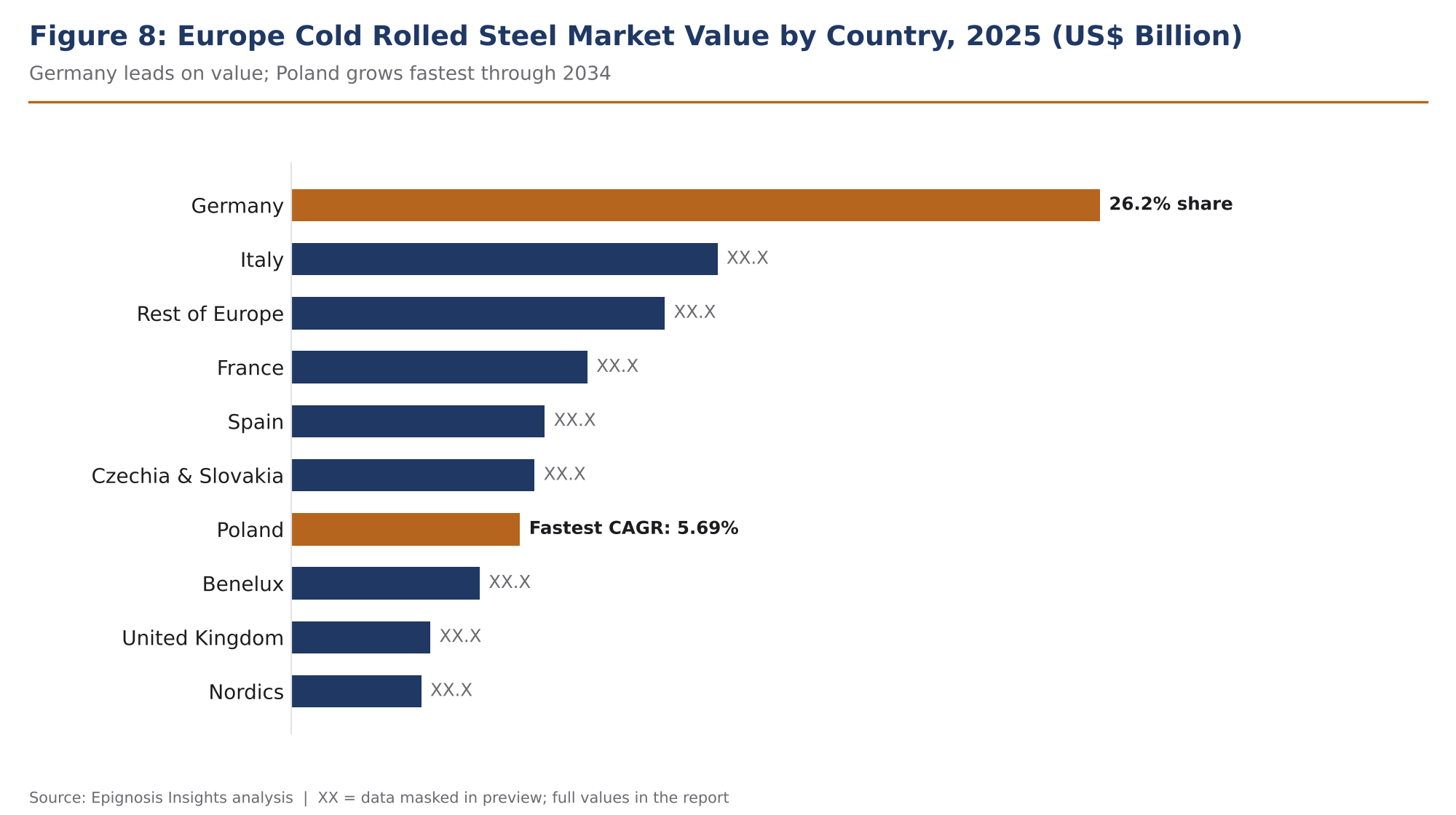
- Italy (XX.X% share) is the largest re-rolling hub in Europe, with a dense network of independent cold mills and service centres around Brescia, Mantua and Udine. Italian buyers have been the most exposed to import substitution and the most affected by recent cold rolled shortages.
- France (XX.X%) combines automotive, appliance and packaging demand, and is the site of two of the most significant supply-side investments: the Dunkirk EAF and the Mardyck electrical steel line.
- Spain (XX.X%) benefits from the second-largest car production base in the EU and a growing share of battery-electric vehicle assembly, giving it an above-average CAGR of XX.X%.
- Poland is the fastest-growing country market at a CAGR of 5.69%, supported by appliance manufacturing, automotive component plants, battery and electrical-equipment investment, and construction activity linked to EU cohesion funds.
- Czechia and Slovakia (XX.X% combined) form a dense automotive corridor whose cold rolled supply is anchored by the Košice works and the Ostrava region.
- Benelux (XX.X%) hosts major cold-rolling assets at IJmuiden, Ghent and Liège and serves as a distribution gateway for North-West Europe.
- United Kingdom (XX.X%) depends heavily on imported substrate following the closure of blast furnaces at Port Talbot, and its demand pattern is shaped by its own trade-defence measures.
- Nordics and Rest of Europe (XX.X% combined) include high-specification demand from Sweden and Finland and fast-growing appliance and automotive clusters in Romania, Hungary and the Western Balkans.
Supply Landscape and Capacity Outlook
European cold rolled supply is concentrated in roughly 30 integrated and independent cold-rolling sites. Integrated producers control the majority of capacity and almost all wide, high-strength automotive capability, while independent re-rollers dominate narrow strip and specialised precision products. 2026 brought ownership and strategy changes at several major producers. thyssenkrupp ended sale talks for its steel division with Jindal Steel International in May 2026, stating that the conditions underpinning a sale had changed for the better, and it continues to pursue a stand-alone structure for thyssenkrupp Steel Europe. Nippon Steel moved the Košice works to direct ownership on 1 October 2026, renaming it Nippon Steel Slovakia and positioning it as its core European hub. In Italy, the sale of Acciaierie d'Italia remained unresolved, with fresh bids from Arvedi and Jindal received in November 2026.
These changes matter for buyers because they affect which suppliers will invest in cold-rolling and annealing upgrades over the forecast period. Epignosis Insights tracks announced and probable capacity changes at each site in the full report, including line-by-line assessment of continuous annealing, batch annealing and temper-rolling capability.
Competitive Landscape
The Europe cold rolled steel market is moderately consolidated at the top and fragmented in the specialist tier. The leading integrated producers together account for XX.X% of market volume, with the remainder supplied by independent re-rollers, narrow-strip specialists and importers. Competition among integrated mills centres on automotive qualification, AHSS and electrical steel capability, low-CO2 product availability and cost position, while independent re-rollers compete on flexibility, short lead times and precision tolerances.
Key companies profiled in the report include ArcelorMittal Europe, thyssenkrupp Steel Europe, Tata Steel Nederland, Tata Steel UK, Salzgitter Flachstahl, voestalpine Stahl, SSAB, Nippon Steel Slovakia (formerly U. S. Steel Košice), Acciaierie d'Italia, Marcegaglia, Acciaieria Arvedi, NLMK Europe, Liberty Steel Group, ArcelorMittal Poland, C.D. Wälzholz, Bilstein Group and Gonvarri Industries, among others.
Epignosis Insights Competitive Assessment Framework (EICAF)
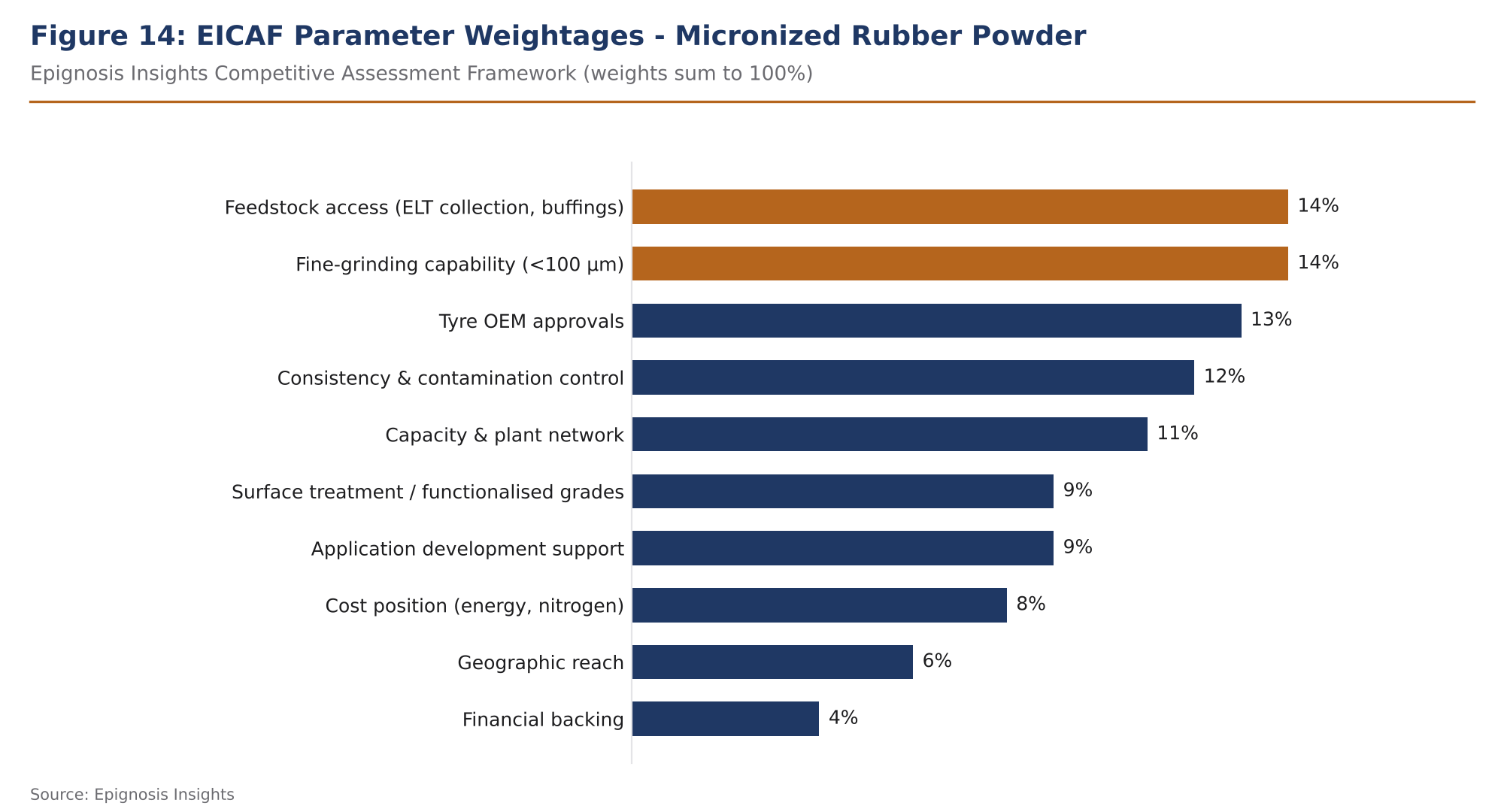
Epignosis Insights evaluates participants in the Europe cold rolled steel market using its proprietary Competitive Assessment Framework (EICAF). The framework weighs ten parameters that reflect how buyers in this market actually select suppliers. Cold-rolling and annealing capacity carries the highest weight at 14%, followed by product and grade breadth at 13%, automotive OEM qualification at 12% and low-CO2 product availability at 12%. Cost position and energy exposure account for 11%, geographic reach and service-centre network for 9%, downstream integration for 9%, financial resilience for 8%, quality and surface performance for 7%, and R&D and innovation pipeline for 5%.
EICAF Scoring Method
Each company is scored from 1 to 5 on every parameter, based on published capacity data, product catalogues, OEM approval lists, sustainability disclosures, financial statements and primary interviews with buyers and distributors. Each score is multiplied by the parameter weight and summed to give a composite EICAF score out of 5. Companies are then positioned as Leaders, Challengers, Specialists or Emerging Players. The full report includes the scored matrix for all profiled companies.
Research Methodology
This study combines top-down and bottom-up estimation. The top-down model starts from apparent steel consumption published by EUROFER and allocates flat-product consumption to cold rolled products using production, trade and capacity data. The bottom-up model builds demand from end-use industries – vehicle production, appliance output, construction activity and machinery production – multiplied by cold rolled intensity factors for each country. Prices are built from weekly assessments, mill offers and buyer interviews, adjusted for grade extras and currency. The two models are reconciled and validated through primary interviews with mills, re-rollers, service centres, automotive and appliance buyers, and trade specialists across Europe.