Global Automotive 48-Volt Battery System Market
Analysis by Component (48-Volt Lithium-Ion Battery, AC/DC Inverter, Battery Controller, Power Distribution Box, Other Components), Vehicle Type (Passenger Vehicle, Commercial Vehicle) and Region


Analysis by Component (48-Volt Lithium-Ion Battery, AC/DC Inverter, Battery Controller, Power Distribution Box, Other Components), Vehicle Type (Passenger Vehicle, Commercial Vehicle) and Region
The Global Automotive 48-volt Battery System Market was valued at US$7,182.6 million in 2023 and US$8,190.0 million in 2024. It is estimated at US$9,410.3 million in 2025 and is projected to reach US$29,302.7 million by 2032, registering a CAGR of 17.6% during the 2026 to 2032 forecast period. Annual revenue rises by approximately US$19,892.4 million between 2025 and 2032, and the 2032 market is more than four times the size of the 2023 market.
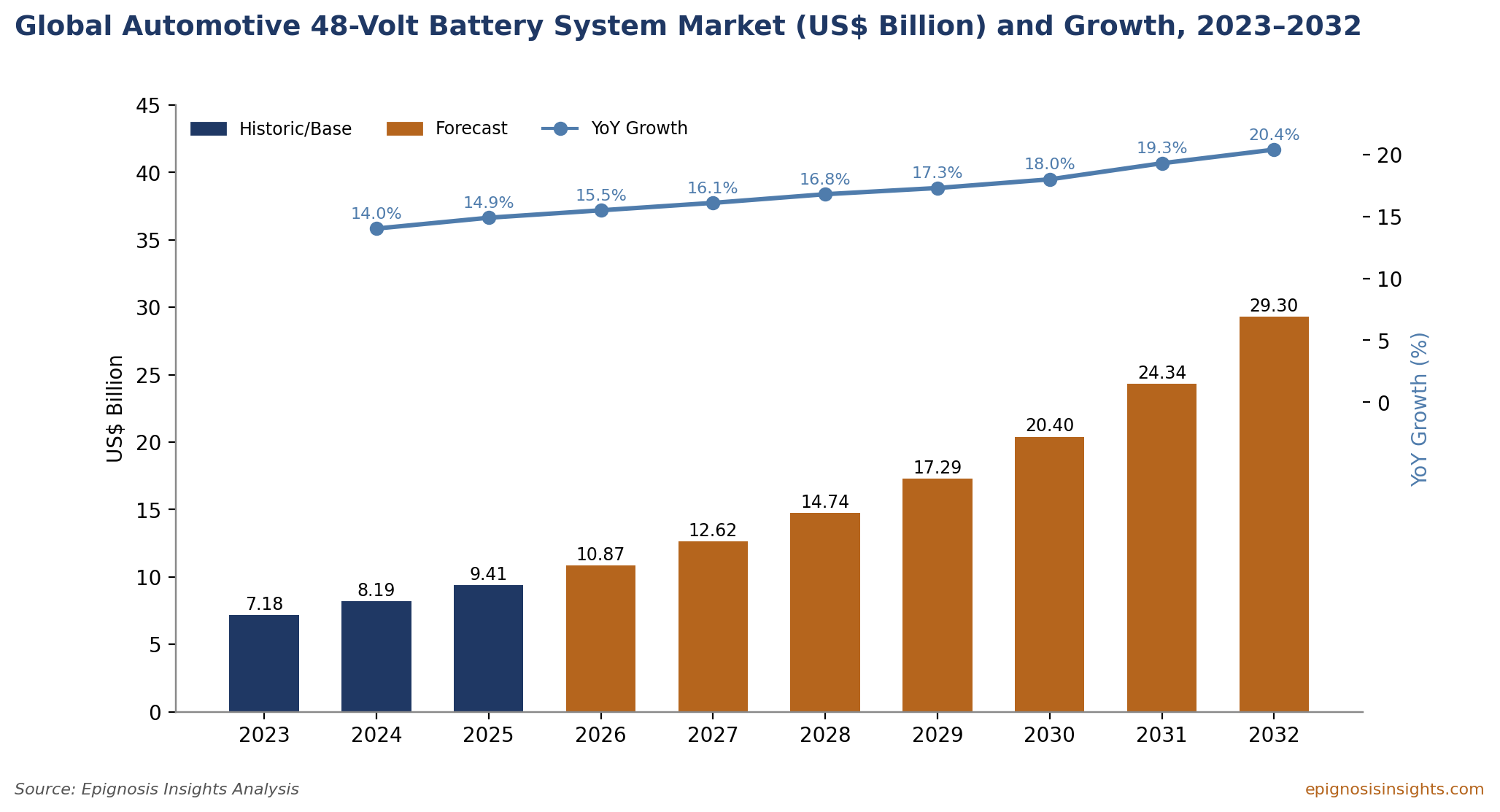
Figure 1: Global Automotive 48-Volt Battery System Market (US$ Billion) and Year-on-Year Growth, 2023–2032
The market's growth accelerates throughout the forecast period. Annual growth of 14.0% in 2024 and 14.9% in 2025 rises to 15.5% in 2026, 17.3% in 2029 and 20.4% in 2032. This pattern reflects the spread of 48-volt electrical architectures from premium vehicles into mainstream models and from Europe into Asia, North America and emerging markets. As 48-volt systems become standard on more vehicle platforms, each new model generation adds volume at a rate that compounds over time.
A 48-volt system operates alongside or in place of a vehicle's conventional 12-volt network. It typically combines a compact lithium-ion battery, a belt-driven or integrated starter-generator, an inverter, a battery controller and a power distribution box. In mild hybrid configurations, the system recovers energy during braking, supports the engine during acceleration, enables smoother start-stop operation and allows the engine to switch off while coasting. It also powers high-load electrical consumers such as electric turbochargers, active suspension, electric air conditioning compressors and heated catalytic converters.
Epignosis Insights estimates global shipments of 48-volt battery systems at approximately 6.2 million units in 2023, 7.4 million units in 2024 and 8.8 million units in 2025. Shipments are projected to reach about 10.5 million units in 2026, 22.8 million units in 2030 and 35.1 million units by 2032, representing a volume CAGR of approximately 22.3% between 2026 and 2032. Volume estimates are derived from the market value model and an estimated average system price that reflects the combined cost of the battery, inverter, controller, power distribution box and associated components.
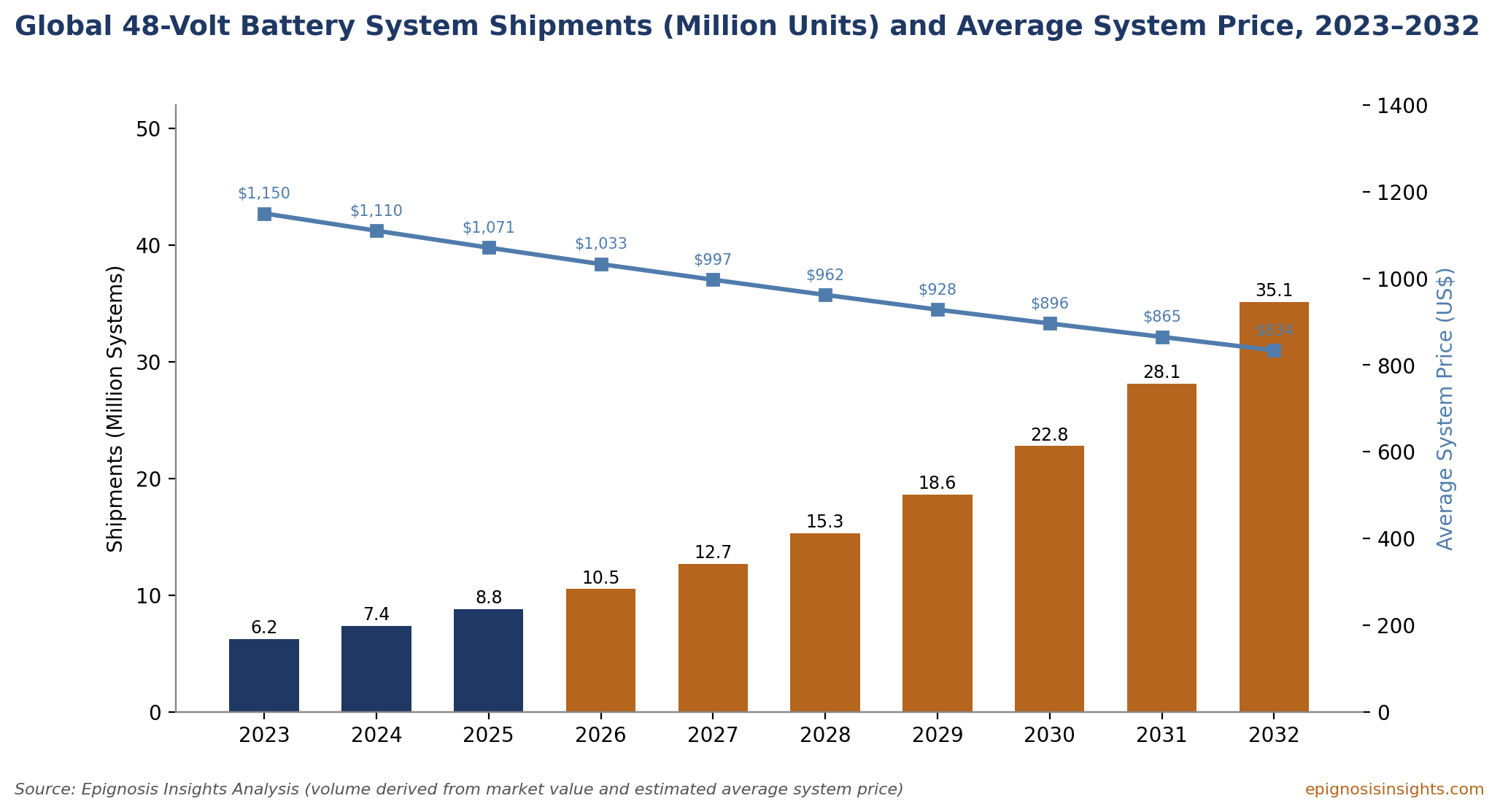
Figure 2: Global 48-Volt Battery System Shipments (Million Units) and Average System Price (US$), 2023–2032
The average system price is estimated to fall from approximately US$1,150 in 2023 and US$1,071 in 2025 to about US$834 by 2032, an annual decline of roughly 3.6%. Three forces drive this decline. Lithium-ion cell costs continue to fall as global cell manufacturing capacity expands and chemistries such as lithium iron phosphate gain share in cost-sensitive applications. Higher production volumes allow suppliers to spread engineering and tooling costs over more units. Integration is also reducing system cost, as suppliers combine inverter, controller and power distribution functions into fewer housings with shared electronics.
The volume trajectory implies a substantial increase in adoption. Global vehicle production exceeds 90 million units a year, so the estimated 8.8 million systems shipped in 2025 represent fewer than one in ten new vehicles. By 2032, shipments of about 35.1 million systems would equate to roughly one in three new vehicles produced worldwide, reflecting the transition of 48-volt technology from an optional feature to a mainstream electrical architecture.
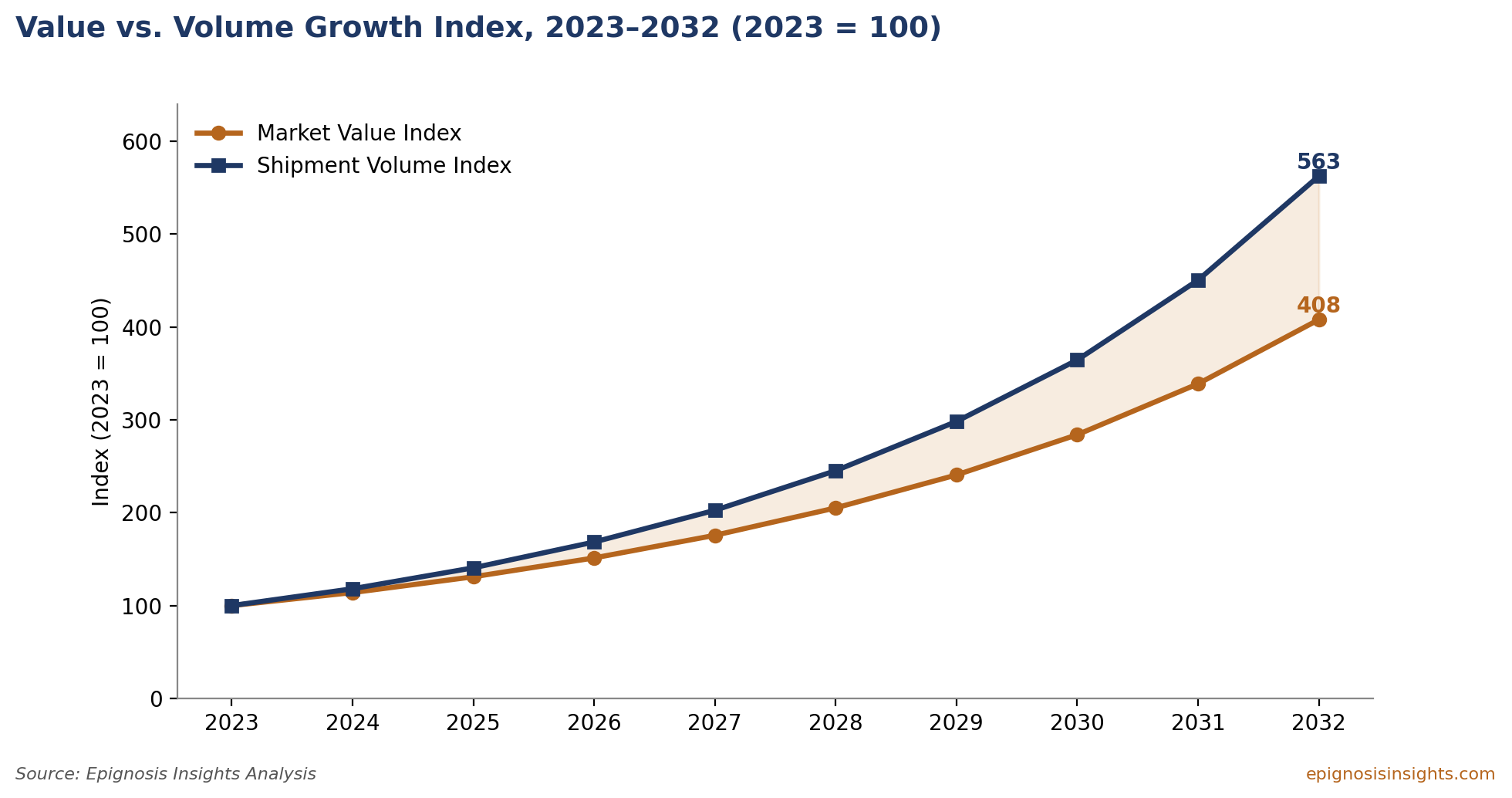
Figure 3: Value vs. Volume Growth Index, 2023–2032 (2023 = 100)
The value and volume index illustrates the growing gap between the two measures. By 2032, market value reaches about four times its 2023 level, while shipment volume reaches more than five and a half times its 2023 level. For suppliers, this means that revenue growth depends on winning substantially more units each year to offset falling prices, which places a premium on manufacturing scale, cost engineering and platform wins with high-volume automakers.
The strongest driver of the market is tightening vehicle emissions regulation, particularly in Europe. Under Regulation (EU) 2019/631, the EU fleet-average CO2 target for new cars was reduced by 15% compared with 2021 levels for the 2025 to 2029 period. Regulation (EU) 2025/1214, adopted on 17 June 2025, gives manufacturers a one-off flexibility to meet their obligations for 2025, 2026 and 2027 on a three-year average basis rather than in each individual year, while keeping the underlying reduction targets intact.
For automakers, 48-volt mild hybrid systems offer one of the most cost-effective ways to reduce CO2 emissions from combustion-engine vehicles. They deliver meaningful fuel savings at a fraction of the cost of full hybrid or plug-in hybrid systems and can be integrated into existing platforms with limited redesign. As manufacturers balance investment in battery electric vehicles with the need to reduce emissions from their remaining combustion and hybrid fleet, 48-volt technology has become a standard element of powertrain portfolios. The three-year averaging flexibility extends the period in which mild hybrids play a central role in compliance strategies.
The second driver is the steady increase in vehicle electrical demand. Advanced driver assistance systems, larger infotainment displays, electric power steering, active chassis systems, heated seats and windows and electric climate control all draw more power than a conventional 12-volt network can supply efficiently. Higher voltage reduces current for the same power, allowing thinner wiring, lower losses and lighter harnesses.
This trend supports 48-volt adoption beyond mild hybrid powertrains. Some battery electric vehicle architectures are adopting 48-volt low-voltage networks to replace or supplement 12-volt systems, reducing wiring weight and enabling more efficient power distribution. As software-defined vehicles and zonal electrical architectures become common, 48-volt networks are expected to become a structural feature of vehicle design rather than solely a powertrain technology.
The main long-term constraint is the industry's shift toward full battery electric vehicles, which use high-voltage traction batteries and may not require a 48-volt mild hybrid system. In markets where battery electric adoption accelerates rapidly, demand for mild hybrid systems could plateau sooner. However, the expanding role of 48-volt networks in battery electric vehicle architectures partly offsets this risk.
Cost pressure is a second constraint. Automakers expect continuous price reductions from suppliers, while lithium, nickel and other battery materials remain subject to price volatility. Suppliers must manage thermal performance, functional safety and electromagnetic compatibility requirements while reducing cost each year. Smaller suppliers without scale or vertical integration face particular difficulty competing on price.
48-volt systems are commonly classified by where the electric machine is positioned in the powertrain. In P0 configurations, a belt-driven starter-generator replaces the conventional alternator on the front of the engine. This is the simplest and lowest-cost architecture and accounts for the majority of current installations. P1 systems place the electric machine directly on the crankshaft, while P2 systems position it between the engine and transmission, allowing the vehicle to be decoupled from the engine for electric coasting and limited electric driving. P3 and P4 systems place the machine on the transmission output or the rear axle, enabling functions such as electric all-wheel drive.
Higher-numbered configurations recover more energy and deliver larger fuel savings, but they also require more powerful inverters, larger batteries and more complex integration. As automakers seek greater CO2 reductions from mild hybrids, the mix is gradually shifting from basic P0 systems toward P1 and P2 architectures, increasing the value of power electronics and battery content per vehicle and partly offsetting the decline in average system price.
Cell chemistry is another area of change. Most 48-volt batteries use lithium nickel manganese cobalt oxide cells optimised for high power, while lithium iron phosphate is gaining share where cost and thermal stability are priorities, and lithium titanate cells are used in some applications requiring very fast charging and long cycle life. Battery packs are increasingly air-cooled and compact enough to fit under seats or in the luggage compartment, which simplifies vehicle integration and reduces cost.
The 48-volt lithium-ion battery is the largest component, valued at US$3,354.4 million in 2025, equivalent to 35.6% of the market. It is also the fastest growing component at an 18.4% CAGR, reaching US$10,967.5 million by 2032 and contributing approximately US$7.6 billion of new revenue. Battery packs for 48-volt systems typically store between 0.5 and 1 kWh and are optimised for high power output and frequent charge and discharge cycles rather than energy capacity.
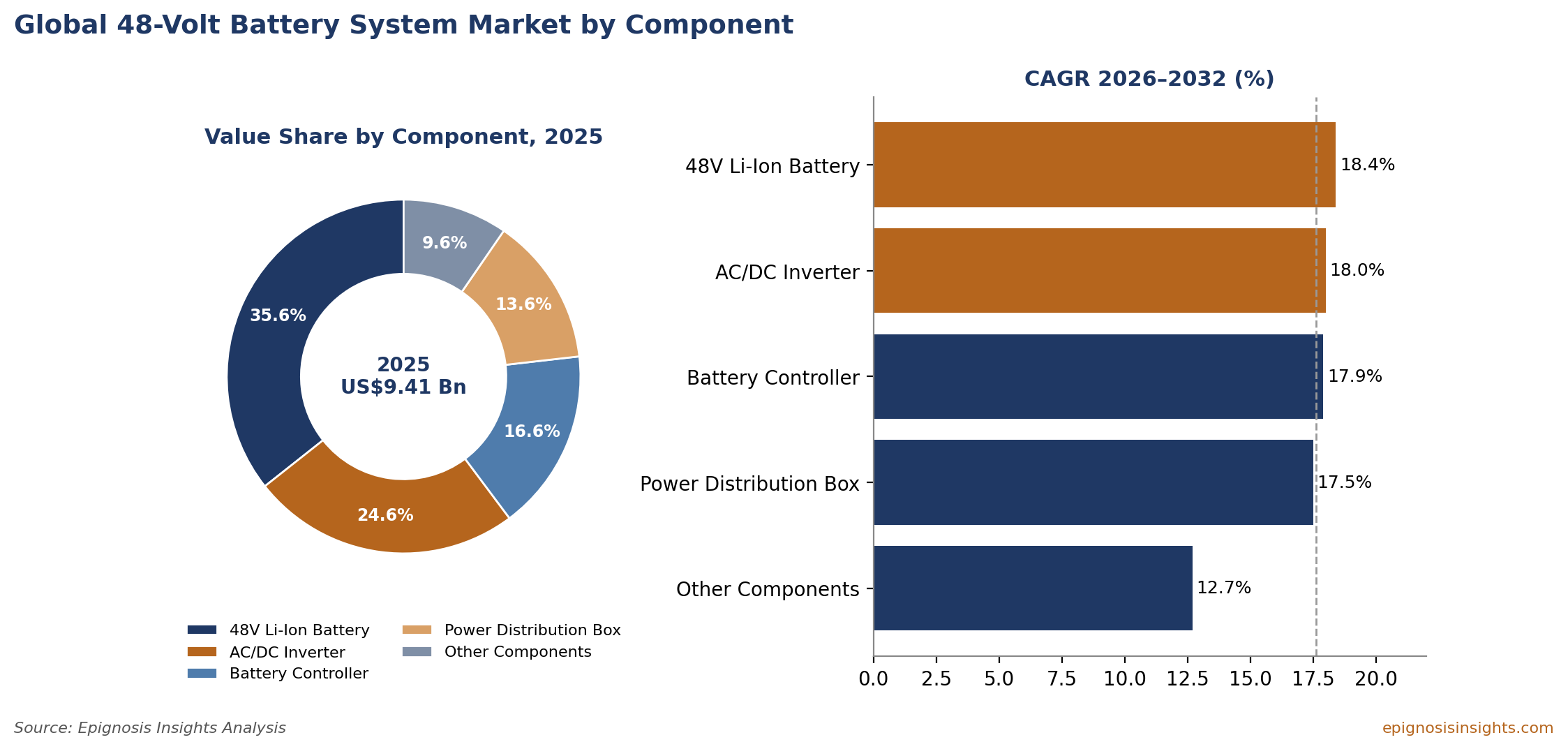
Figure 4: Global 48-Volt Battery System Market by Component – 2025 Share and 2026–2032 CAGR
The AC/DC inverter is the second largest component at US$2,312.1 million in 2025, growing at 18.0% to US$7,351.2 million by 2032. Inverters convert direct current from the battery into alternating current for the starter-generator or electric motor and manage energy recovery during braking. The battery controller, valued at US$1,562.1 million, grows at 17.9%, reflecting its critical role in monitoring cell voltage, temperature and state of charge. The power distribution box, valued at US$1,279.4 million, grows at 17.5% as vehicles require more sophisticated protection and switching for 48-volt loads. Other components, including DC/DC converters, cabling and thermal management elements, grow more slowly at 12.7%, as integration reduces the number of separate parts per system.
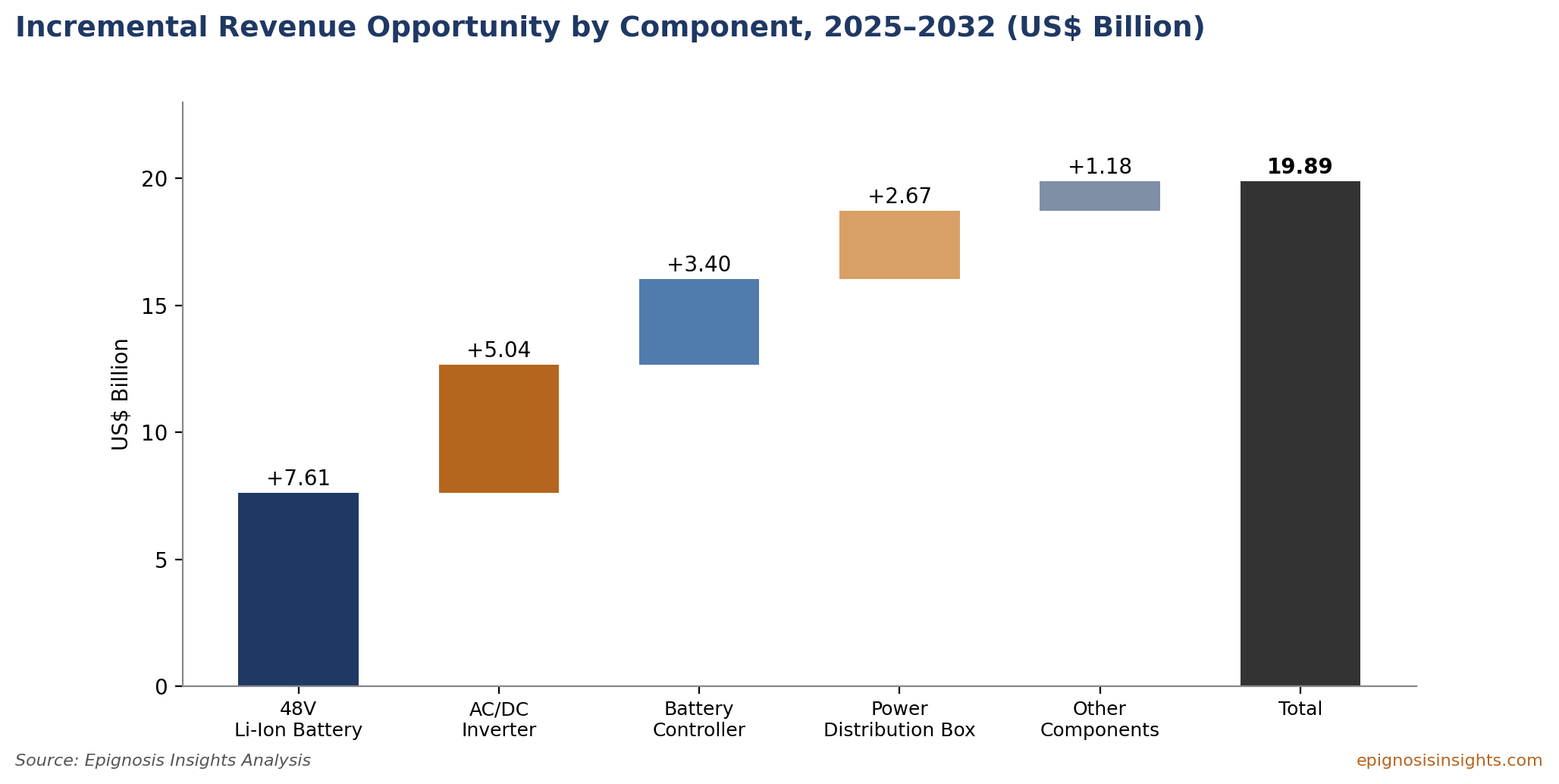
Figure 5: Incremental Revenue Opportunity by Component, 2025–2032 (US$ Billion)
Of the approximately US$19.9 billion in new revenue between 2025 and 2032, the battery contributes US$7.61 billion or 38%, the inverter US$5.04 billion or 25%, the battery controller US$3.40 billion or 17%, the power distribution box US$2.67 billion or 13% and other components US$1.18 billion or 6%. Power electronics, combining the inverter, controller and power distribution box, therefore account for more than half of new revenue, underlining the importance of electronics capability alongside cell and pack expertise.
Passenger vehicles dominate the market, valued at US$7,903.4 million in 2025, or 84.0% of total value, and projected to reach US$24,433.0 million by 2032 at a 17.5% CAGR. Passenger vehicle shipments are estimated at about 7.4 million systems in 2025, rising to about 29.3 million systems by 2032. Mild hybrid systems are now offered across compact cars, SUVs and premium sedans, and in many European model ranges they have become the default configuration for petrol and diesel engines.
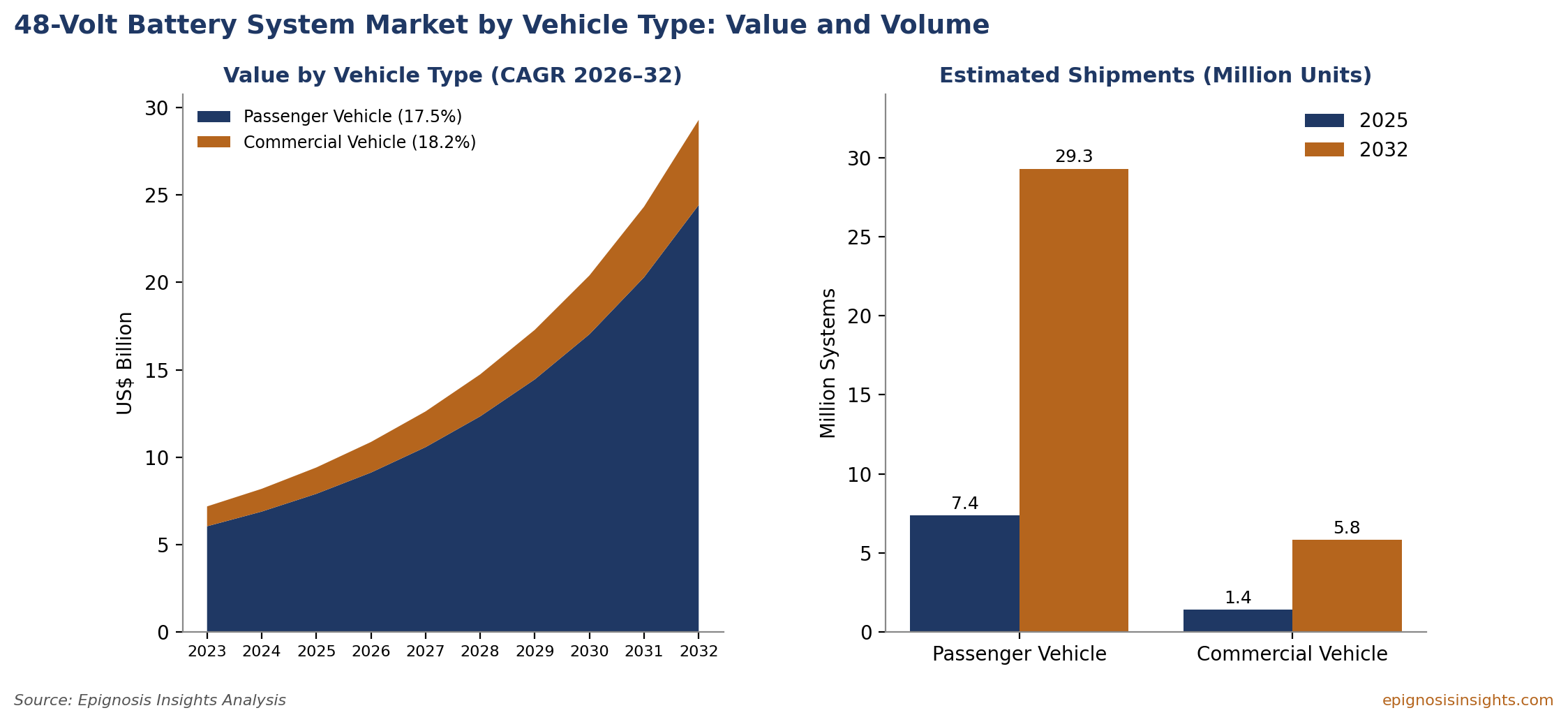
Figure 6: 48-Volt Battery System Market by Vehicle Type – Value and Estimated Shipments
Commercial vehicles are valued at US$1,506.9 million in 2025 and grow faster at 18.2%, reaching US$4,869.7 million by 2032. Estimated commercial vehicle shipments rise from about 1.4 million systems in 2025 to about 5.8 million systems by 2032. Light commercial vehicles benefit from 48-volt mild hybridisation in urban delivery cycles with frequent stops, while heavier trucks use 48-volt systems to power auxiliary loads such as refrigeration units, liftgates, cabin climate systems and electrified ancillaries, reducing engine idling.
Asia Pacific is the largest regional market, valued at US$3,887.9 million in 2025, or 41.3% of global value, and is projected to reach US$12,581.6 million by 2032 at an 18.3% CAGR, the fastest of any region. Estimated regional shipments grow from about 3.6 million systems in 2025 to about 15.1 million by 2032. China is the largest country market in the world at US$2,755.3 million in 2025 and the fastest growing at 19.0%, reaching US$9,310.4 million by 2032. Chinese automakers are adopting 48-volt systems to meet national fuel consumption standards for combustion-engine vehicles, while the country's large lithium-ion manufacturing base supports competitive pricing. Japan, valued at US$573.8 million, grows at 17.3%, and India, valued at US$308.1 million, grows at 17.7%.
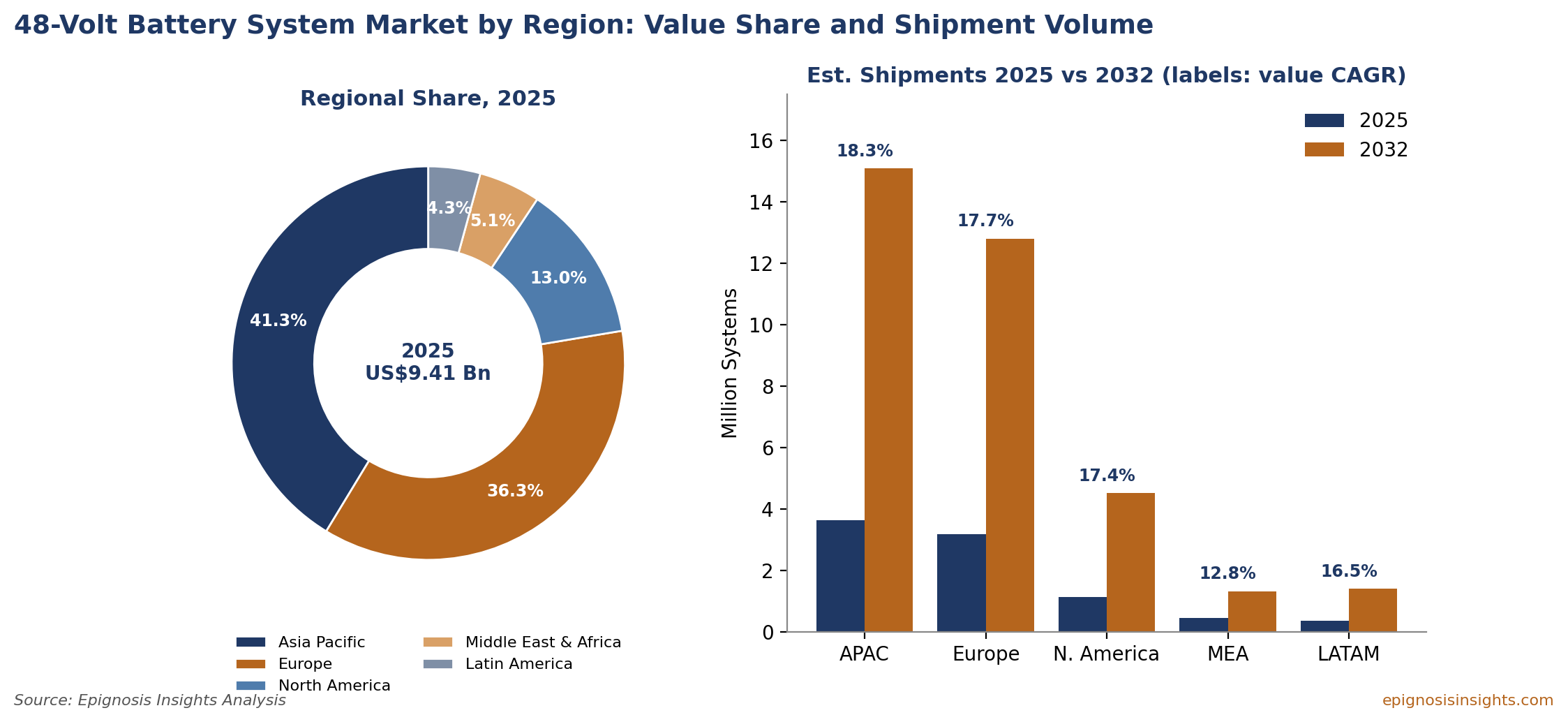
Figure 7: 48-Volt Battery System Market by Region – Value Share and Estimated Shipments
Europe is the second largest region at US$3,417.2 million in 2025, or 36.3% of global value, and grows at 17.7% to US$10,675.8 million by 2032. Estimated European shipments rise from about 3.2 million to about 12.8 million systems. Europe was the first region to adopt 48-volt mild hybrids at scale, and Germany remains its largest market at US$961.2 million in 2025, growing at 17.9%, supported by the domestic premium automakers that pioneered the technology. The UK, valued at US$545.9 million, grows at 17.6%, and France, valued at US$442.0 million, grows at 17.4%.
North America is valued at US$1,226.0 million in 2025 and grows at 17.4% to US$3,769.3 million by 2032. The U.S. accounts for US$858.5 million, while Mexico, valued at US$198.0 million, grows fastest in the region at 17.9%, supported by its role as a vehicle manufacturing hub. North America's relatively smaller share reflects the region's historical preference for larger engines and full hybrids, although rising use of 48-volt systems in pickups and SUVs is expanding demand.
Figure 8: Country Snapshot – Market Value 2025 vs. 2032 and CAGR 2026–2032
The Middle East and Africa, valued at US$477.5 million, is the slowest growing region at 12.8%, with Saudi Arabia at US$168.1 million and the UAE at US$135.1 million. Latin America, valued at US$401.6 million, grows at 16.5%, led by Brazil at US$190.2 million, where flex-fuel engines combined with mild hybrid systems are gaining attention as a low-carbon solution.
Regional shares shift gradually over the forecast period. Asia Pacific's share of global value rises from 41.3% in 2025 to 42.9% by 2032, while Europe's share remains broadly stable at around 36%, and North America's share holds at about 13%. The Middle East and Africa's share declines from 5.1% to 3.8%, reflecting slower adoption in markets where fuel prices are low and emissions regulation is less stringent. Latin America's share eases slightly from 4.3% to 4.0%. In absolute terms, Asia Pacific adds about US$8.7 billion and Europe about US$7.3 billion in annual revenue between 2025 and 2032, together accounting for more than 80% of the market's growth.
Key companies analyzed within the global automotive 48-volt battery system market are: Continental, Robert Bosch, Valeo, Schaeffler, BorgWarner, Hitachi Astemo, LG Energy Solution, Samsung SDI, CATL, Clarios, A123 Systems, SEG Automotive and others.
The market brings together three groups of suppliers. Tier 1 powertrain and electrical system suppliers such as Continental, Bosch, Valeo, Schaeffler, BorgWarner and Hitachi Astemo offer complete 48-volt systems, including starter-generators, inverters, DC/DC converters and battery packs, and hold long-term platform contracts with major automakers. Cell manufacturers such as LG Energy Solution, Samsung SDI and CATL supply the lithium-ion cells and, in some cases, complete battery modules. Battery and electrical specialists such as Clarios and A123 Systems focus on low-voltage battery packs, while SEG Automotive specialises in starter-generators.
Competition is intensifying as Chinese suppliers expand internationally with cost-competitive cells and integrated systems, and as automakers consolidate supplier bases around fewer, larger partners capable of delivering complete systems across global platforms. Integration of power electronics, software-based battery management and functional safety capability are becoming key differentiators.
Supply chain localisation is also reshaping competition. Automakers in North America and Europe increasingly require battery cells and modules to be sourced from regional manufacturing plants to reduce logistics risk, comply with local content rules and qualify for incentives. This favours suppliers with production footprints in each major region and encourages partnerships between Western Tier 1 suppliers and Asian cell manufacturers. At the same time, automakers are developing in-house expertise in battery management software, which may shift some value away from suppliers toward vehicle manufacturers over time.
The Epignosis Insights Competitive Assessment Framework EICAF for the global automotive 48-volt battery system market evaluates companies across 10 weighted parameters. OEM platform wins and customer base receives the highest weighting at 15%, because multi-year platform contracts determine supplier revenue. Cell chemistry and battery pack expertise and system integration across inverter, battery management and power distribution each receive 13%. Cost and scale of production receives 12%, reflecting continuous price-down pressure. Thermal and functional safety engineering and global manufacturing footprint each receive 10%, R&D and 48-volt architecture roadmap receives 9%, and supply chain and raw material security receives 8%. Aftermarket and service support and sustainability and recycling each receive 5%. The total weighting equals 100%.
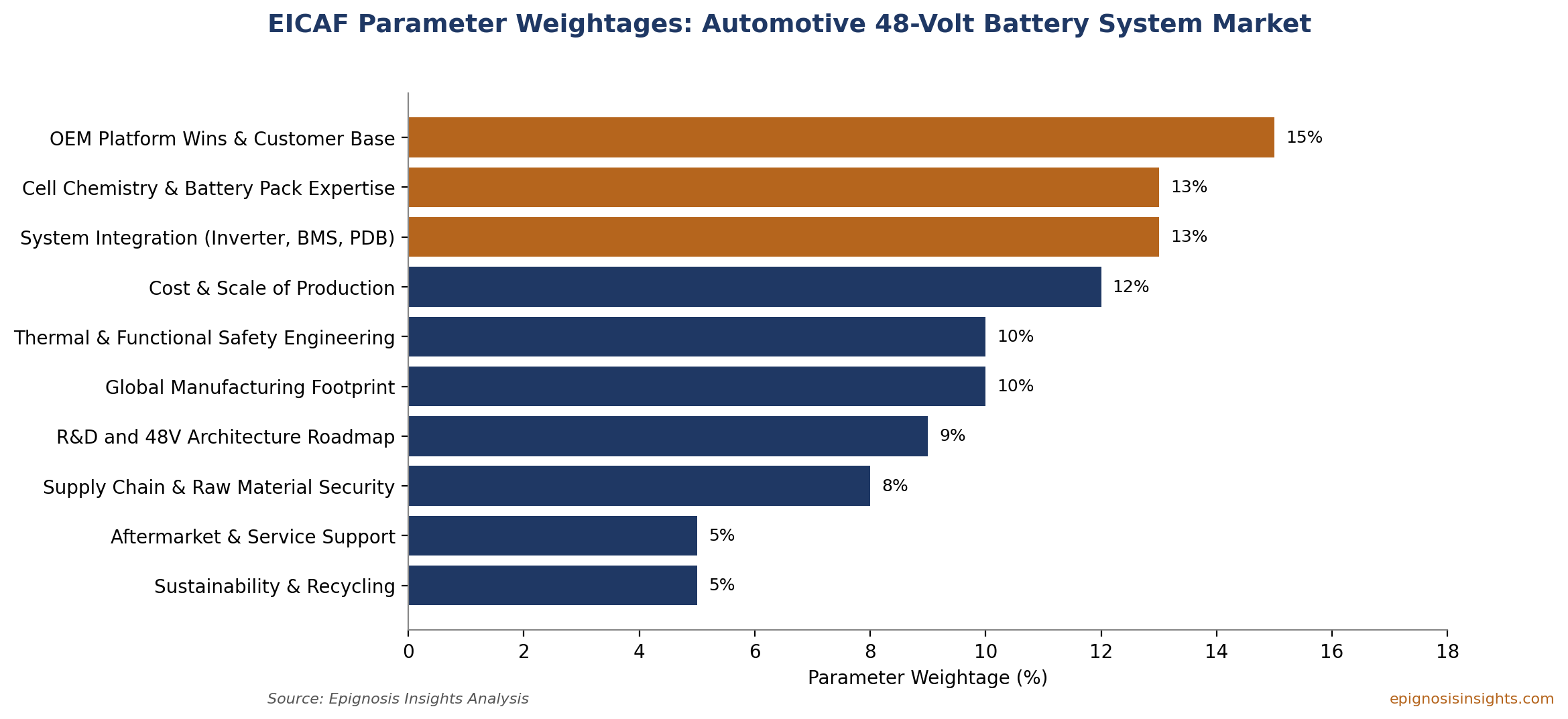
Figure 9: EICAF Parameter Weightages for the Global Automotive 48-Volt Battery System Market
Each company is assigned a score from 1 to 5 against every parameter, with the weighted score calculated as Company Score × Parameter Weightage. The resulting EICAF score allows Tier 1 system suppliers, cell manufacturers and component specialists to be compared on a consistent basis, highlighting which suppliers are best positioned to win high-volume platforms as prices decline and integration increases.