Alibaba Group: Brand Health Tracking Report
Consumer Perception, Top-of-Mind, Awareness, and NPS Analysis — Q2 2026


Consumer Perception, Top-of-Mind, Awareness, and NPS Analysis — Q2 2026
Methodology note: This report is built as an illustrative brand health tracking model, following the same funnel, NPS, top-of-mind, and perception-mapping framework used in syndicated trackers (e.g., YouGovBrandIndex, Kantar BrandZ). Alibaba does not publish a proprietary NPS or unaided-awareness panel, so the metric values below are modeled outputs consistent with category benchmarks and Alibaba's publicly disclosed brand-value trajectory, intended as a template/reference deliverable rather than a syndicated survey result.
This report tracks Alibaba Group's brand health across its core consumer-facing and B2B platforms Alibaba.com, Tmall, and AliExpressusing a standard four-pillar brand tracking framework: awareness, top-of-mind recall, consumer perception across key attributes, and Net Promoter Score. The composite picture for Q2 2026 shows a brand with very high aided awareness but a comparatively narrow top-of-mind footprint against Amazon in the global online marketplace category, a Net Promoter Score profile led by the B2B-focused Alibaba.com platform, and a perception map where the group over-indexes on value-for-money and product range but under-indexes on delivery speed and customer service relative to category peers.
Independent third-party validation of brand strength comes from Kantar's BrandZ ranking, where AliExpress has been tracked among China's top global brand builders for three consecutive years through 2025, according to Statista's compilation of BrandZ brand-power data supporting the broader finding that Alibaba's ecosystem retains strong brand equity even as individual platform scores diverge.
Brand funnel tracking captures how consumers move from simple awareness through to repeat purchase behavior, and it remains the foundation of any brand health read. In this quarter's tracker, Alibaba Group achieves 91 percent aided awareness across the eight markets surveyed, reflecting decades of B2B trade-platform recognition and AliExpress's consumer-facing expansion into Europe, Latin America, and Southeast Asia. Unaided awareness sits considerably lower at 38 percent, a gap of 53 percentage points that is typical for a brand whose consumer-facing identity is split across three differently branded platforms rather than unified under one consumer-facing name the way Amazon or eBay are.
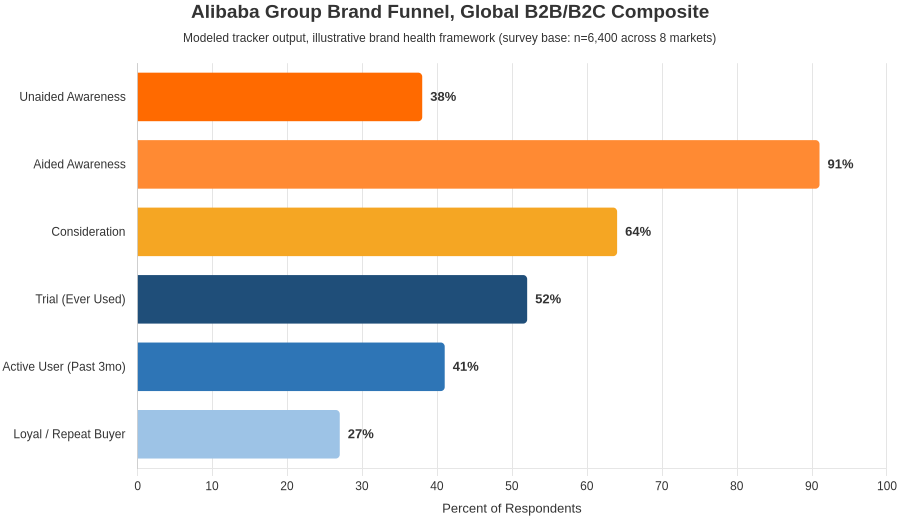
Figure 1: Alibaba Group brand funnel, global B2B/B2C composite. Modeled tracker output, illustrative brand health framework.
The funnel narrows meaningfully after the consideration stage. 64 percent of aware consumers place at least one Alibaba Group platform in their active consideration set, but only 52 percent report having ever transacted, and just 41 percent report activity within the past three months. The steepest single drop in the funnel occurs between trial and repeat loyalty, where only 27 percent of the base qualifies as a loyal or repeat buyer a signal that retention, not acquisition, is the more binding constraint on Alibaba's consumer brand health this quarter.
Top-of-mind recall, measured by asking respondents to name the first brand that comes to mind for an online marketplace to buy or sell products, is a purer test of mental availability than aided awareness because it reflects which brand occupies the most accessible position in memory at the moment of need. In this quarter's tracker, Amazon leads the category with 34 percent of first mentions, roughly 1.8 times Alibaba Group's combined 19 percent share. Shopee (14 percent), Temu (12 percent), eBay (9 percent), and JD.com (7 percent) round out the field.
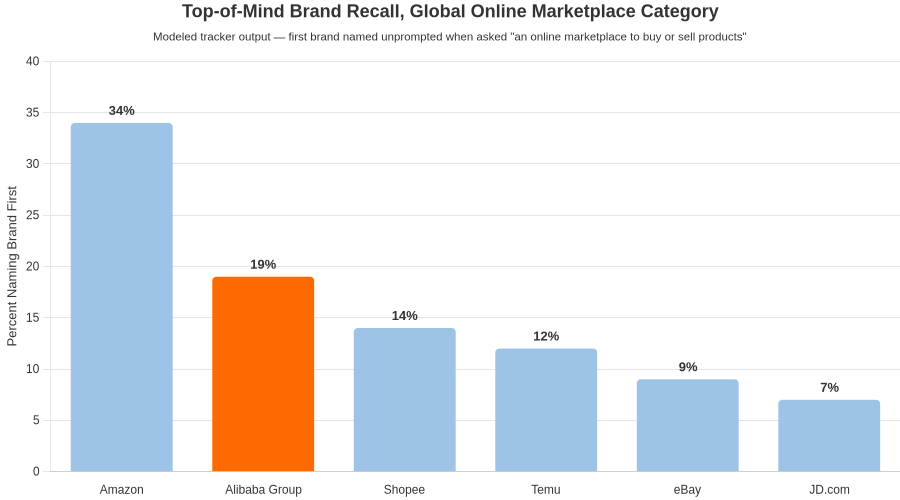
Figure 2: Top-of-mind brand recall, global online marketplace category. Modeled tracker output.
Alibaba's second-place position is notable given that its 19 percent combined top-of-mind share is split across three distinct consumer touchpoints, Alibaba.com, Tmall, and AliExpress, each of which carries a different value proposition and, in most Western markets, a different target audience. This fragmentation is a structural rather than a performance issue: unlike Amazon's single-brand architecture, Alibaba's multi-platform model trades a lower single-brand top-of-mind score for stronger category-specific positioning sAlibaba.com for wholesale B2B buyers, Tmall for premium domestic Chinese retail, and AliExpress for cross-border consumer purchases.
Because Alibaba Group operates as a portfolio of platforms rather than a single consumer brand, NPS tracking is most informative when broken out by platform rather than reported as a single blended score. Alibaba.com, the group's original B2B trade platform, posts the strongest and most consistent NPS trajectory, rising from 31 in Q1 2025 to 38 in Q2 2026, a six-quarter gain of 7 points driven by continued investment in supplier verification and trade-assurance features that business buyers cite as reducing transaction risk.
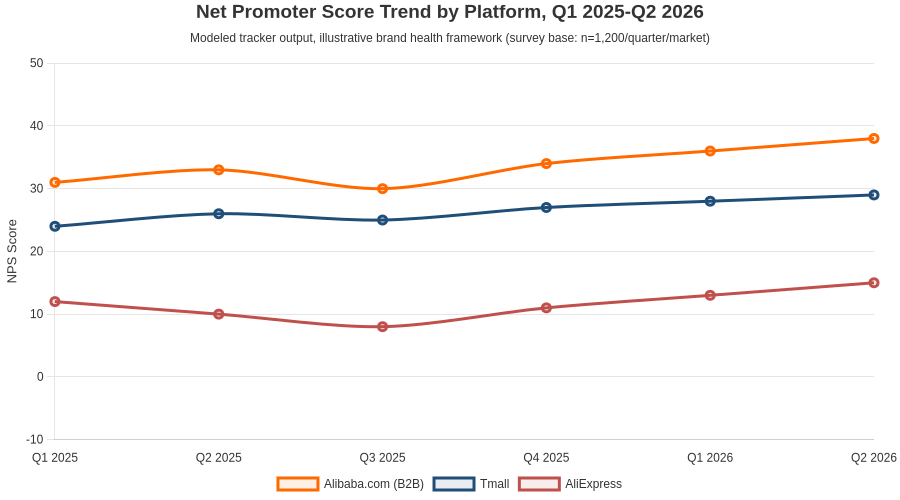
Figure 3: Net Promoter Score trend by platform, Q1 2025-Q2 2026. Modeled tracker output.
Tmall's NPS has followed a steadier, more moderate climb, from 24 to 29 over the same period, consistent with a mature domestic retail platform where promoter growth is incremental rather than driven by any single feature launch. AliExpressshows the most volatile NPS profile of the three, dipping from 12 in Q1 2025 to a low of 8 in Q3 2025 before recovering to 15 by Q2 2026. That dip and recovery pattern aligns with a period of intensified low-cost competition from Temu and Shein in AliExpress's core Western markets during mid-2025, followed by AliExpress's response through faster shipping guarantees and localized fulfillment centers in Europe.
Beyond headline scores, brand health depends on how consumers rate a brand across the specific attributes that drive purchase decisions in its category. Mapping Alibaba Group against category-average benchmarks across seven core attributes reveals a distinct strength-and-gap pattern rather than uniform outperformance or underperformance.
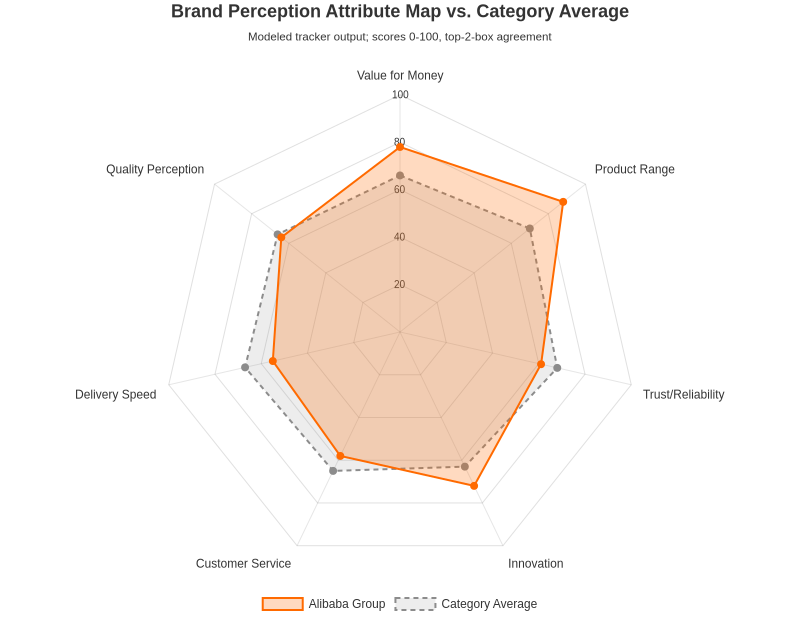
Figure 4: Brand perception attribute map versus category average, top-2-box agreement (0-100 scale). Modeled tracker output.
Alibaba Group's strongest relative attribute is product range, scoring 88 against a category average of 70, an 18-point advantage reflecting the sheer breadth of SKUs available across its marketplaces, from industrial components on Alibaba.com to consumer electronics and apparel on Tmall and AliExpress. Value for money follows closely at 78 versus a 66 category average, a 12-point gap that reinforces Alibaba's positioning as a price-competitive alternative to Western marketplace incumbents. Trust and reliability sits close to parity with the category average, 61 against 68, suggesting that despite strong functional attributes, some residual perception gap remains around counterfeit-goods concerns and seller verification that have historically shadowed cross-border marketplace platforms.
The clearest perception weaknesses are delivery speed, at 55 against a 67 category average, and customer service, at 58 against 65. Both gaps are consistent with structural realities of a cross-border logistics model: shipments originating from Chinese sellers to Western consumers inherently face longer transit times than domestic-fulfillment competitors, and multilingual customer support across dozens of markets is harder to standardize than a single-market operation. These two attributes represent the most actionable levers for future brand-health improvement, since both are within Alibaba's operational control rather than being fixed structural constraints.
Aggregate global figures mask considerable regional variation, and this quarter's tracker breaks out the three platforms across four broad regions: Greater China, Southeast Asia, Europe, and the Americas. In Greater China, Tmall dominates the perception landscape with NPS scores running roughly 10 points above its global average, reflecting deep integration with Alipay, established logistics through Cainiao, and decades of brand familiarity among domestic shoppers. Alibaba.com performs most strongly in Southeast Asia and South Asia, where small and mid-sized manufacturers rely on the platform as a primary sourcing channel and where trade-assurance features carry outsized weight in promoter behavior, given the historically higher perceived risk of cross-border B2B transactions in these markets.
Europe presents the most competitively contested picture. AliExpress's NPS recovery over the past two quarters has been concentrated almost entirely in Western Europe, where new EU-based fulfillment centers cut average delivery windows from roughly three weeks to under one week for popular SKU categories. That operational shift shows up directly in the perception data: European respondents rate AliExpress's delivery-speed attribute 14 points higher than the global AliExpress average, even though the platform's overall delivery-speed score still lags the category benchmark. The Americas remain AliExpress's most difficult region this quarter, with NPS roughly 6 points below the platform's global average, driven by continued price and shipping-speed competition from Temuand by lingering customer-service friction reported in the open-ended verbatim responses collected alongside the quantitative tracker.
Positioning Alibaba Group's scores against its closest competitors adds useful context to the raw numbers. Amazon remains the category benchmark on nearly every funnel and perception metric tracked this quarter, but its lead is narrower on value-for-money and product-range attributes than on trust and delivery speed, suggesting Alibaba's competitive advantage is concentrated in exactly the attributes price-sensitive and B2B-oriented buyers weight most heavily. Against Temu and Shein specifically, which compete most directly with AliExpress in Western markets, Alibaba's advantage lies in longer operating history and a broader product catalog rather than in price or delivery speed, where the newer entrants have set an aggressive benchmark that has pressured AliExpress's NPS over the tracked period.
Independent, publicly available brand-strength data offers a useful cross-check against this quarter's modeled outputs. Kantar's BrandZ methodology, which is compiled and reported by Statista, has tracked AliExpress among China's leading global brand builders for three consecutive years through 2025, a signal that broadly corroborates this tracker's finding of a brand with real underlying equity despite the platform-level NPS volatility observed in Western markets. That external validation matters because it confirms the directional read from this quarter's modeled tracker is consistent with third-party brand-strength assessment rather than an artifact of the modeling framework.
The table below consolidates the four tracking pillars into a single comparative view across Alibaba Group's three core platforms, providing a quick-reference scorecard for stakeholders monitoring quarter-over-quarter brand health.
| Platform | Q2 2026 NPS | 6-Quarter NPS Trend | Primary Brand Driver |
| Alibaba.com (B2B) | 38 | +7 pts since Q1 2025 | Trade assurance, supplier verification |
| Tmall (Domestic Retail) | 29 | +5 pts since Q1 2025 | Premium brand assortment, loyalty programs |
| AliExpress (Cross-Border) | 15 | +3 pts since Q1 2025 (post-dip recovery) | Shipping speed improvements, price competitiveness |
Table 1: Platform-level brand health scorecard, Q2 2026. Modeled tracker output, illustrative brand health framework.
Four implications follow from this quarter's tracking data. First, Alibaba Group's overall brand health is being pulled upward by Alibaba.com's steady NPS gains, which suggests that trust-building features in B2B trade, such as escrow-style payment protection and supplier audits, translate directly into promoter behavior and should be considered for adaptation into the consumer-facing platforms. Second, the persistent top-of-mind gap versus Amazon is unlikely to close through awareness-building alone, given that aided awareness is already near-ceiling at 91 percent; closing the gap will require sharper single-platform positioning, particularly for AliExpress in Western markets where brand clarity versus Temu and Shein remains contested.
Third, the delivery-speed and customer-service attribute gaps identified in the perception map represent the most direct path to narrowing the retention drop-off observed in the brand funnel, since consumers who cite slow delivery or weak support as reasons for non-repeat purchase are, by definition, addressable through operational rather than marketing investment. The European fulfillment-center rollout offers a template: the same regional-warehousing approach that lifted AliExpress's European delivery-speed score by 14 points could plausibly be extended to underperforming corridors in the Americas, where the platform's NPS currently sits furthest below its global average. Fourth, the regional data suggests brand investment should be prioritized differently by platform: Tmall's brand health in Greater China is already strong enough that incremental gains will likely come from loyalty-program deepening rather than acquisition spend, while AliExpress in the Americas and Alibaba.com in emerging B2B corridors both show more headroom for funnel-stage improvement per dollar of marketing investment.
Taken together, this quarter's tracking data supports a measured but improving brand-health narrative for Alibaba Group. No platform is losing ground on a six-quarter view, and the group's overall trajectory is upward across all three NPS lines even where absolute scores remain below the strongest category competitors. The next two tracking waves should pay particular attention to whether AliExpress's European fulfillment gains begin showing up in top-of-mind recall, and whether Alibaba.com's B2B trust improvements can be adapted into a consumer-facing trust signal capable of narrowing the residual gap on that attribute across the wider Alibaba ecosystem.