
Why Mental Health Apps Became a $26 Billion Bet

A decade ago, a mental wellness app meant a meditation timer and some rain sounds. Today it can mean an FDA-cleared prescription treatment, an AI chatbot that triages a crisis at 2 a.m., or the front door to a therapy benefit your employer pays for every month. That shift isn't marketing spin; it shows up directly in the numbers, and it explains why so much capital and clinical attention have piled into this category in a short window of time.
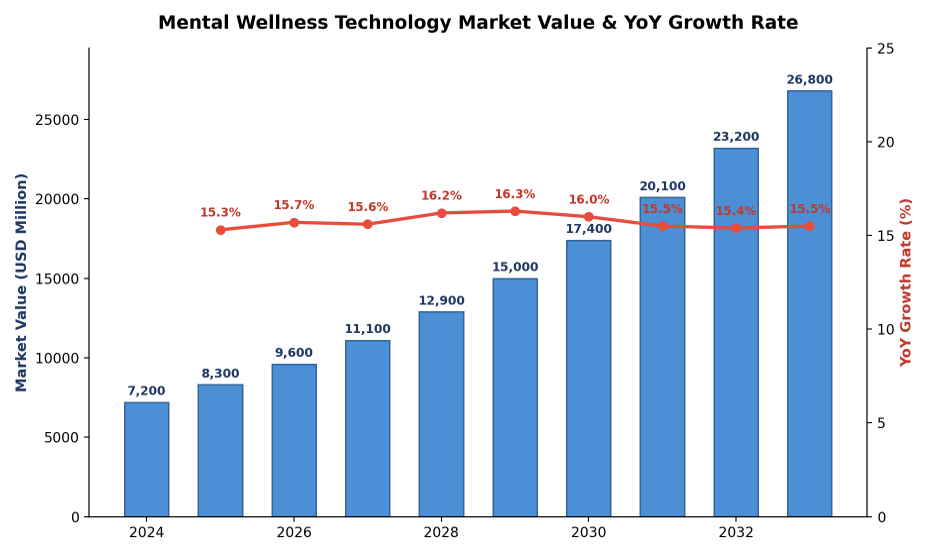
The global mental wellness technology market is valued at approximately USD 9.6 billion in 2026 and is projected to reach around USD 26.8 billion by 2033. What makes this figure worth a second look isn't just its size; it's how steady the growth has been. A full mental wellness technology market analysis shows the year-over-year growth rate holding in a tight 15 to 16 percent band across nearly every year of the forecast, which is unusual. Markets driven by hype tend to spike and then flatten. A rate this consistent points to demand tied to something structural rather than a trend.
The Structural Problem: There Aren't Enough Therapists
That structural driver has a name, and it's not subtle. Roughly 163 million Americans live in a federally designated Mental Health Professional Shortage Area, according to Health Resources and Services Administration tracking, and the national mental health provider adequacy rate stood at just 27 percent in 2025. In plain terms, the available psychiatric workforce covers barely a quarter of calculated need. Average wait times for a new mental health appointment run around 48 days nationally, and considerably longer in rural counties, where nearly seven in ten lack even a psychiatric nurse practitioner.
Digital tools didn't create this gap, but they're the only lever that can close it at scale, because you can't train enough new psychiatrists fast enough to meet a shortfall this large. That's the real reason mental health now accounts for close to 28 percent of all telehealth visits nationally, by far the highest utilization rate of any clinical specialty.
Following the Funnel, Where the Gap Actually Closes
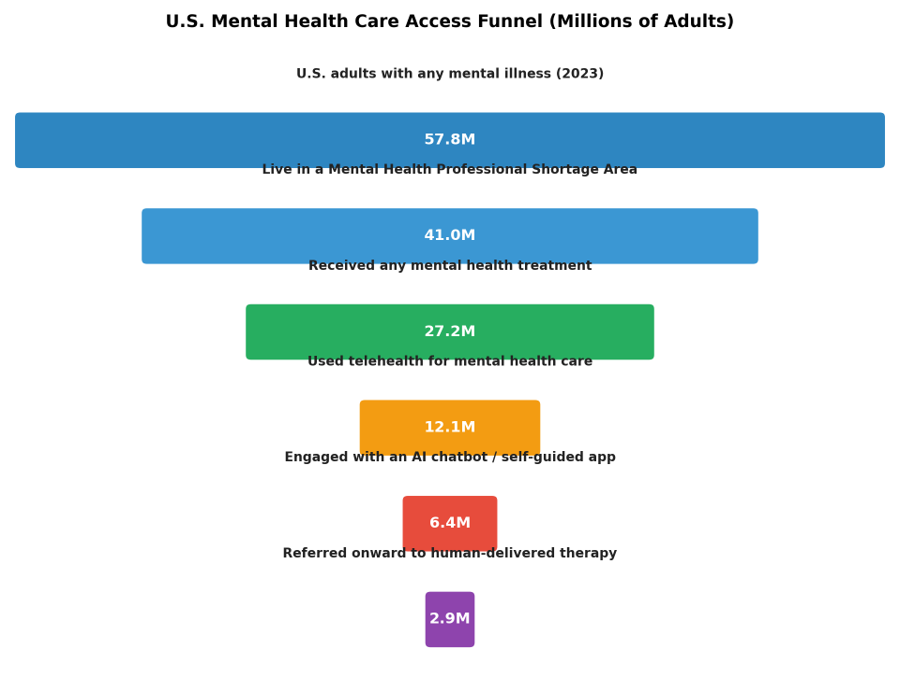
The clearest way to see where digital tools are actually making a difference is to follow a single cohort of people through the system, from everyone who needs care down to the small number who reach a therapist through a digital front door.
Of the roughly 57.8 million U.S. adults with a diagnosable mental illness in a given year, about 41 million live in a shortage area. Only around 27 million receive any treatment at all, and of those, about 12 million now do so at least partly through telehealth. Roughly 6.4 million engage with an AI chatbot or self-guided digital tool as part of that care, and a smaller number are still referred to human-delivered therapy through the same platform. That last step, low-friction self-help handing off cleanly to a licensed clinician, is the specific feature that separates a serious mental wellness technology platform from a simple meditation app, and it's where most of the product investment in this market is actually going.
Why the Growth Rate Stays So Steady
Put the two charts together, and the market's consistency stops looking like a coincidence. As long as tens of millions of people sit in the gap between "needs care" and "can reach a therapist," there's a durable, non-discretionary reason for digital tools to keep growing into that space, regardless of the broader economic cycle. That's different from, say, a fitness app market that rises and falls with New Year's resolutions and marketing spend. It also means the growth isn't concentrated in one flashy sub-category; it's spread across teletherapy platforms, AI chatbots, meditation apps, wearable stress sensors, and employer benefit platforms, each chipping away at a different point in the funnel above.
It's worth noting that this only recently became a telehealth story at all. Mental health's share of total telehealth volume was under a fifth in 2018; today, it accounts for close to two-thirds of all behavioral health visits and roughly 28 percent of all telehealth encounters across all specialties combined. That's a faster shift than almost any other corner of healthcare has managed, and it happened because the barriers digital care removes- travel time, scheduling around a 9-to-5 job, the discomfort of walking into a clinic- mattered more in mental health than in most other specialties.
For anyone evaluating this space, whether as an employer choosing a benefit, an investor sizing an opportunity, or a vendor planning a roadmap, the access funnel is the more useful starting point than the headline market size. It tells you exactly where the unmet demand still sits, and it's usually not where the most crowded, most heavily marketed apps already are.