
PORTER'S FIVE FORCES IN 2026

Michael Porter published his five forces framework in 1979, and more than four decades later it remains the default lens business schools and corporate strategy teams reach for first. The question worth asking in 2026 is not whether the framework is outdated, but whether the forces it describes still behave the way Porter assumed. Merger data, venture funding, chip-supply figures, and AI adoption surveys published this year suggest the five forces are all still active, but two of them, the threat of new entrants and the threat of substitutes, are now moving at a speed the original model never anticipated.
Rivalry Among Existing Competitors: Fewer Deals, Bigger Stakes
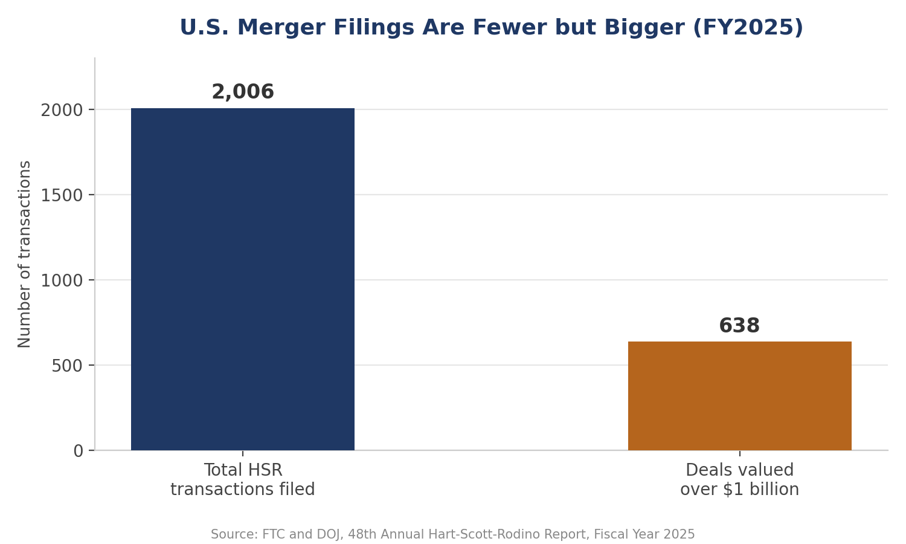
Porter treated rivalry as a function of how many firms compete and how they choose to consolidate. The FTC and Department of Justice's 48th Annual Hart-Scott-Rodino Report shows that pattern shifting rather than disappearing. Companies notified the agencies of 2,006 transactions in fiscal year 2025, and roughly 31.8 percent of them were valued above $1 billion, while the agencies pursued only 18 merger enforcement actions across the entire year. Deal volume held roughly flat year over year, but the mix skewed toward fewer, larger transactions, which means rivalry today is increasingly settled by a small number of mega-deals rather than a steady churn of mid-sized acquisitions. That concentrates competitive intensity into the handful of sectors, healthcare, technology, and energy among them, where the largest deals are landing.
Threat of New Entrants: A Barrier That Keeps Falling
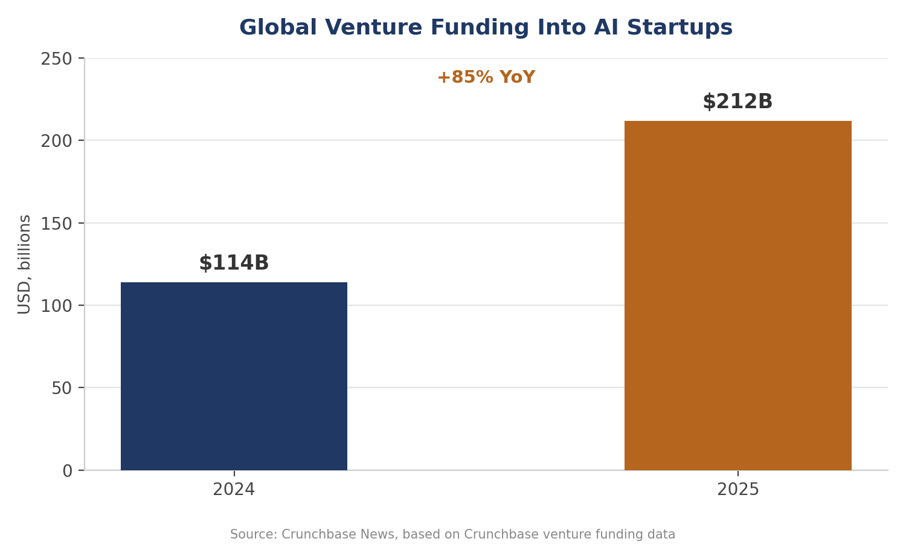
This is the force Porter's original model most underestimates for 2026. Entry barriers were traditionally built from capital intensity, distribution access, and regulatory approval, all slow-moving variables. Crunchbase News reports that global venture funding into AI-related startups reached $212 billion in 2025, an 85 percent increase from $114 billion the year before, with AI-related companies capturing nearly half of all global venture dollars. That volume of capital is compressing the time and money a new entrant needs to build a credible, technically capable competitor from years to months in software-adjacent categories. Incumbents can no longer assume that scale or tenure alone will keep new challengers out.
Bargaining Power of Suppliers: Concentrated at the Chip Layer
Supplier power in Porter's framework rises when few suppliers serve many buyers with no easy substitute. The Semiconductor Industry Association's 2026 State of the Industry report puts global semiconductor sales at a record $795.6 billion in 2025, with the World Semiconductor Trade Statistics organisation projecting the market will reach $1.5 trillion in 2026. Nearly every AI-dependent industry, from cloud computing to automotive to defence electronics, now draws on the same narrow layer of advanced chip suppliers, and that dependency has turned semiconductor capacity into one of the tightest supplier bottlenecks in the modern economy. A business whose competitive strategy assumes commodity-priced compute is building on a supplier relationship far more concentrated than the framework's authors ever modelled.
Bargaining Power of Buyers: Concentration Cuts Both Ways
Buyer power grows when a small number of customers account for a large share of a supplier's revenue, and 2026 filings show that dynamic playing out even at the top of the technology stack. Nvidia's own quarterly report disclosed that in the second quarter of fiscal year 2027, a single direct customer represented 16 percent of the company's total revenue, concentrated in its Compute and Networking segment. When one buyer commands that much of the world's most in-demand supplier, that buyer holds real leverage over pricing, allocation priority, and product roadmaps, regardless of how dominant the supplier looks from the outside. Porter's model captures this dynamic precisely; what has changed is how quickly buyer concentration can now form around a single breakout product category.
Threat of Substitutes: Moving Faster Than the Framework Assumes
Substitutes traditionally took years to mature into a credible replacement for an existing product or service. McKinsey's State of AI 2025 Global Survey found that a majority of organisations are already experimenting with or scaling AI agents, with 23 percent reporting they are scaling agentic AI in at least one business function and a further 39 percent actively experimenting. Agentic systems capable of executing multistep tasks are emerging as substitutes for entire categories of professional services and software subscriptions, not just individual features. For strategists, the practical implication is that substitute analysis can no longer be an annual exercise; the pace of AI-driven substitution now demands the same continuous monitoring that pricing and rivalry have always received.
Where the Framework Still Holds, and Where It Needs Help
Porter's five forces still correctly identify where competitive pressure originates. What the 2026 data shows is that the relative speed of each force has changed: rivalry now resolves through scale rather than volume, entry barriers are falling faster than incumbents can rebuild them, and substitution is compressing from a multi-year threat into a quarterly one. The framework remains a sound map of where to look. Strategists in 2026 simply need to check that map far more often than Porter's original model ever assumed necessary.