
Where the Smart Money Is Going in Food Plant Automation
Deciding to automate a food processing line is only half the decision. The other half, where to put that investment, matters just as much, because labor market conditions, regulatory stringency, and how close you are to a mature automation supply chain all shape how fast a project pays for itself. Some geographies make the automation business case obvious; others require a much more careful, project-by-project evaluation. Get the location decision wrong, and even well-chosen equipment can underperform for reasons unrelated to the technology itself, from slow parts availability to a shortage of local integrators who understand the equipment.
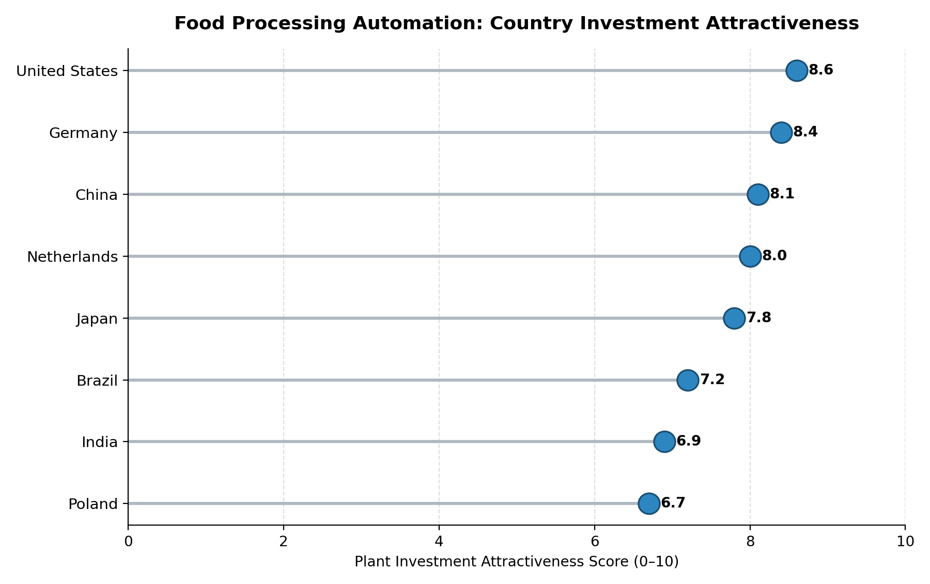
Based on a combined view of labor tightness, regulatory pressure, supply chain proximity, and existing food manufacturing density, the United States and Germany currently score highest in plant investment attractiveness, followed by China, the Netherlands, Japan, Brazil, India, and Poland. Processors comparing sites often begin with a broader analysis of food-processing automation investments before narrowing to specific plant locations.
Why the U.S. and Germany Lead
The United States and Germany top the list for related but distinct reasons. In the U.S., acute labor shortages, driven by an aging manufacturing workforce and stiff competition from warehousing and logistics for entry-level workers, make the business case for automation almost self-evident in many plants. Germany brings a distinct strength: a deep, mature robotics and controls supply chain that shortens project lead times and materially reduces integration risk, on top of its own labor-cost and availability pressures. Both markets combine urgent need with the infrastructure to actually execute quickly, which is exactly the combination that turns a strong attractiveness score into a project that stays on schedule and on budget once construction begins.
The Fast Followers
China scores strongly on manufacturing scale and a rapidly expanding domestic robotics supply base. However, foreign processors still need to weigh intellectual property and technology transfer considerations carefully before committing capital there. The Netherlands benefits from dense food and agri-processing clusters and strong automation engineering talent, a legacy of its position as a major European food and horticulture hub. Japan, despite already having some of the highest robot density in the world, still offers deep integration expertise, even though its overall market growth is more moderate than in less-penetrated geographies simply because so much automation is already in place.
Brazil, India and Poland round out the list as earlier-stage but fast-growing opportunities, propelled by rising packaged food consumption and expanding processing capacity. The catch is that plant-level attractiveness in these markets depends much more heavily on individual project scale and access to financing than it does in the more mature economies above them, so a strong national growth story doesn't automatically translate into an easy investment case at the plant level. Processors evaluating these markets typically need a more conservative payback assumption and a clearer view of local financing options before greenlighting a project, since equipment financing terms and import costs can vary substantially by country.
Where That Investment Is Actually Going
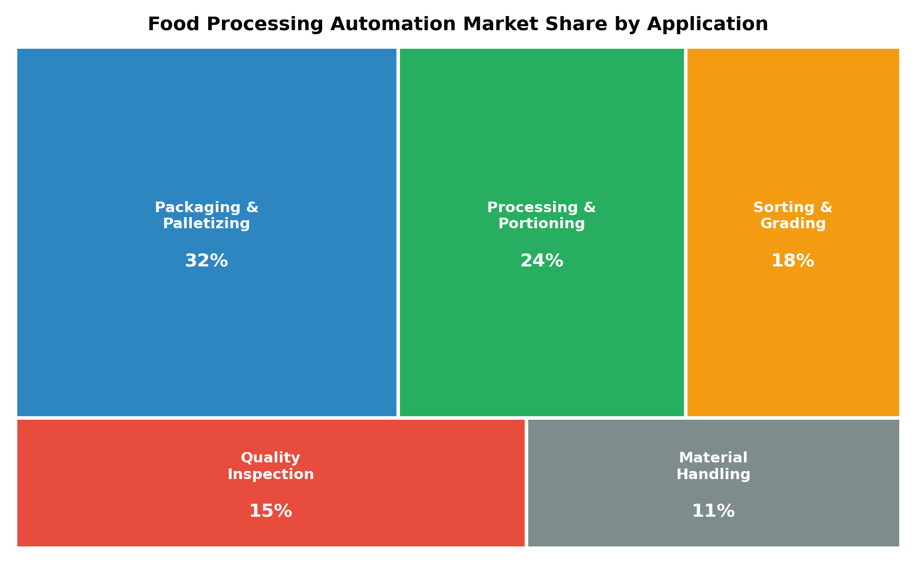
It also helps to know which parts of the plant are absorbing most of this investment once a location is chosen. Packaging and palletizing remains the largest application category by installed value, simply because repetitive end-of-line tasks are found in nearly every food category. Processing and portioning is the second-largest and fastest-maturing category as robotic cutting and portioning systems improve. At the same time, quality inspection and material handling represent smaller but quickly growing shares as vision-guided systems and autonomous mobile robots push automation further upstream and into in-plant logistics.
Putting It Together
For a processor scoping a new or expanded automated line, country attractiveness and application mix should be read together, not separately. A high-scoring country with a mature packaging and palletizing base gives you speed and low integration risk but less headroom for differentiation. A fast-growing but earlier-stage market may require more patience and a larger financing buffer. Still, it can offer a stronger long-term position as automation penetration there catches up to the leaders. Either way, the decision is best made with current cost, risk, and segment data in hand rather than relying on general assumptions about where "automation happens," and revisited periodically as scores shift with local labor markets and regulation.
A Practical Site-Selection Checklist
Before committing capital to a specific location, it helps to work through a short, consistent set of questions rather than relying on general reputation. How tight is the local labor market for production roles, and is that tightness structural or cyclical? How mature is the regional robotics and controls supply chain, and how far away is the nearest qualified systems integrator, since that distance directly affects both installation timelines and ongoing maintenance response? What does the local regulatory environment require in terms of traceability, hygiene certification and equipment safety documentation, and does the automation vendor already have experience meeting those specific requirements in that market? Finally, what financing structures are actually available locally, since access to Robotics-as-a-Service or vendor financing can matter as much as the country's overall attractiveness score. Running every candidate site through the same checklist makes it far easier to compare genuinely different markets on a like-for-like basis.