
What It Actually Costs to Automate a Food Processing Line
Every food-processing automation conversation eventually lands on the same question: what will this actually cost, and when will it pay for itself? It's a fair question, because the honest answer is "it depends on which layer of the automation stack you're buying," and processors who don't understand that distinction often end up either overspending on the wrong component or underestimating the total project budget. Vendor quotes rarely make this breakdown obvious upfront, which is part of why so many automation budgets run over: a proposal that looks reasonable as a single number can hide a mix of components with wildly different cost drivers and risk profiles.
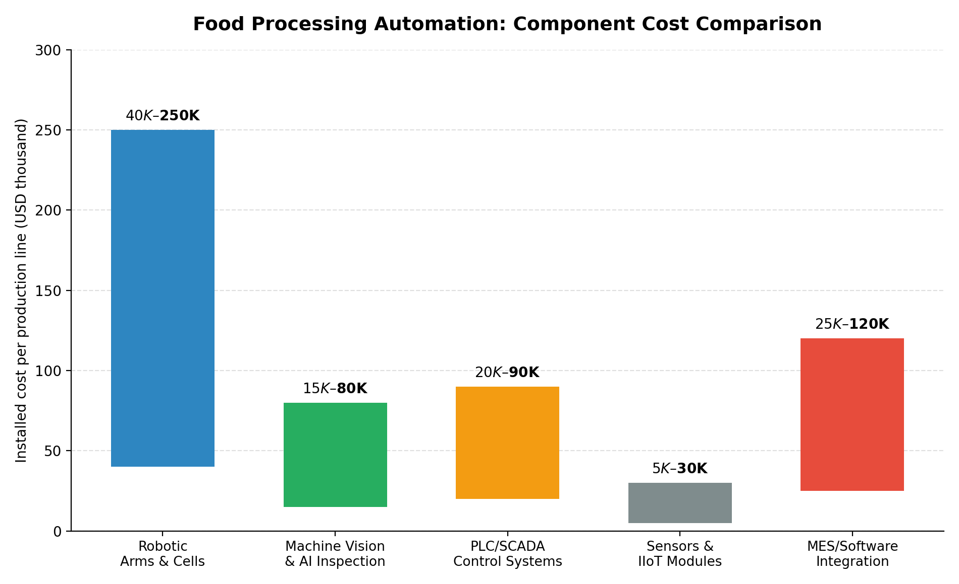
Automation isn't a single purchase; it's a stack of five component categories, each with very different economics: robotic arms and cells, machine vision and AI inspection, PLC and SCADA control systems, sensors and IIoT modules, and MES or software integration. Understanding where the money actually goes is the first step to building a realistic business case.
Robotics Cost the Most, But Cobots Are Changing the Math
Robotic arms and packaging or palletizing cells sit at the top of the cost range, reflecting payload requirements, washdown-rated construction for wet, hygiene-critical environments, and custom end-of-arm tooling. That said, the entry point has dropped dramatically. Collaborative robots, which work safely alongside people without the safety cages traditional industrial robots require, now start around USD 25,000 to 40,000 installed, and payback is often achieved within about 18 months where labor availability and overtime costs are high. That's a very different calculation than it was even five years ago, and it's the single biggest reason automation has spread beyond large multinational processors into mid-size plants.
Vision and Sensors: Cheaper Than You'd Think
Machine vision and AI inspection sit in a middle-cost tier but are seeing the fastest price decline of any category, as camera hardware commoditizes and inspection algorithms shift toward shared, cloud-trained models rather than bespoke line-by-line programming. Sensors and IIoT modules are the lowest-cost, highest-volume category, and their falling prices make plant-wide condition monitoring and predictive maintenance realistic even for smaller operations. If your budget is tight, this is often where the highest return per dollar lies: a modest investment in sensors and software can surface the exact bottlenecks worth automating next, rather than guessing. Control systems, PLCs, and SCADA layers sit in between on cost but are non-negotiable: they are the layers that actually coordinate robots, vision systems, and sensors into a working line, so skimping here to fund a flashier robotic cell tends to backfire with commissioning delays and unreliable performance later.
Where the Real Risk Sits
Cost is only half the picture. The other half is what can go wrong once the equipment is installed, and food processing automation carries some risks that don't show up on a generic manufacturing project.

High upfront capital expenditure remains the single most consequential risk, particularly for full-line retrofits, because financing terms and utilization assumptions drive the economics more than any individual technology choice. Close behind is a shortage of skilled controls technicians and automation engineers, which is both high-probability and high-impact: a well-specified robotic line that sits idle for two days waiting on a qualified technician loses its economic edge fast. Food-contact hygiene compliance, meaning washdown-rated construction, sanitary design and validated cleaning cycles, carries high impact too, since a single hygiene failure can shut a line down entirely. Cybersecurity of increasingly networked control and vision systems is a newer but fast-growing risk as more equipment connects to central MES and cloud analytics platforms.
Building a Realistic Business Case
The strongest automation proposals don't lean on labor savings alone. They combine reduced changeover time between SKUs, lower product giveaway from more precise portioning and filling, higher first-pass quality yield from vision-guided inspection, and reduced compliance and recall risk from automated documentation. A processor that models automation purely as a headcount-reduction exercise will consistently underestimate the achievable return compared to one that accounts for yield, quality, and compliance benefits together. Before signing off on a project, map your line against the cost tiers above, price in the technician and hygiene risks realistically, and structure financing, whether outright purchase or a Robotics-as-a-Service arrangement, around the payback horizon that actually matches your cash flow.
How to Sequence the Investment
Given the cost spread across components, the order in which you spend matters almost as much as the total budget. A sensible sequence starts with sensors and a basic historian, since that layer is cheap relative to the rest of the stack and immediately shows you where downtime, giveaway, and quality losses are actually occurring, rather than where you assume they are. From there, machine vision and inspection typically deliver the next-fastest payback because catching defects earlier reduces scrap and rework costs that compound further down the line. Robotics, the largest single line item, is best deployed once data from the first two phases have identified the specific station where labor cost, injury risk, or throughput constraints justify the investment. MES and software integration should run in parallel throughout, since it's what turns each automation purchase into a connected system rather than a collection of isolated upgrades. Processors who follow this sequence generally report a shorter overall payback period than those who start with the most expensive component first.