
THE ETHICS OF COMPETITIVE INTELLIGENCE
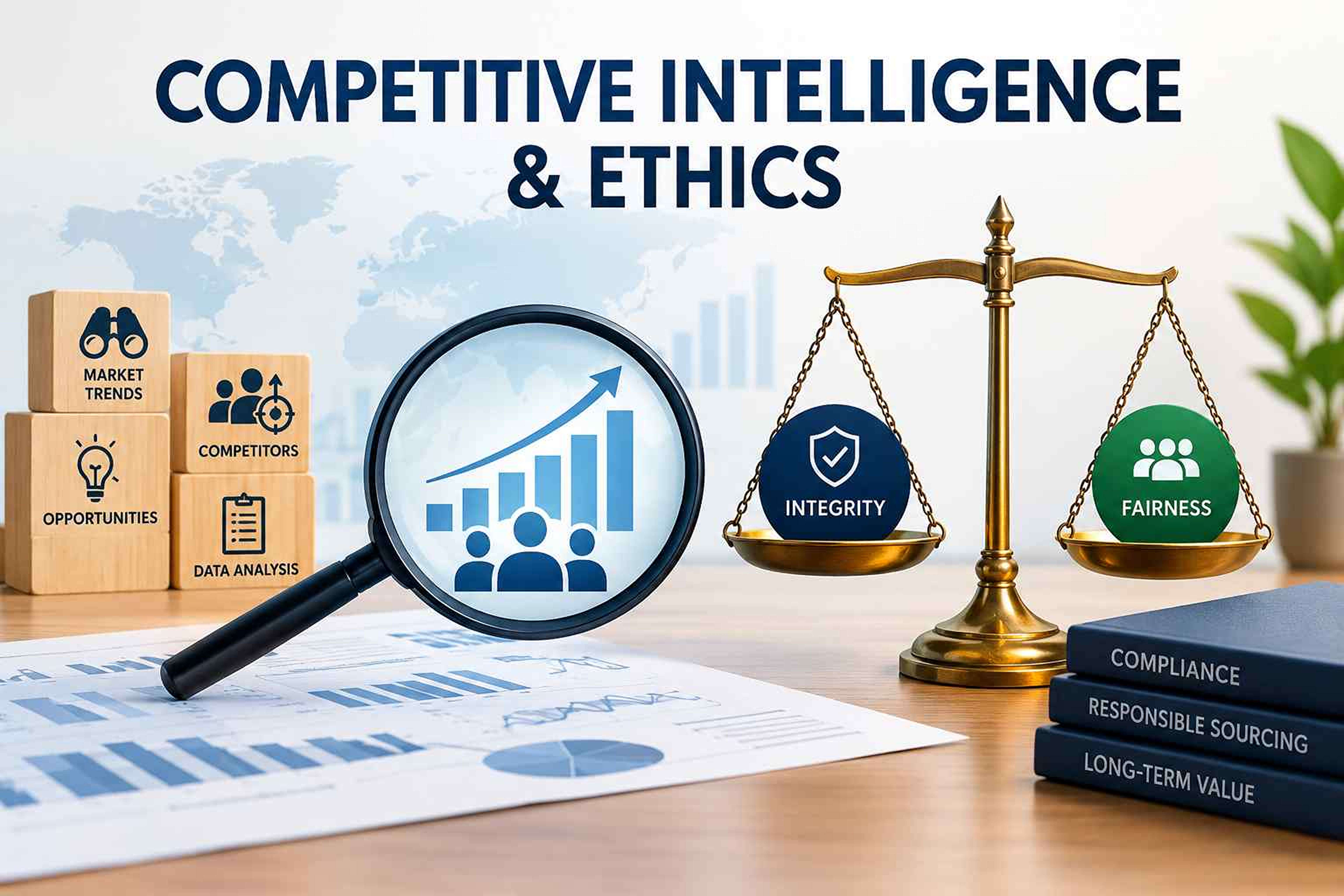
Competitive intelligence has quietly become one of the most contested disciplines in corporate strategy. Every serious organisation now tracks rivals' pricing, product roadmaps, and hiring patterns, and most of that work is entirely legal. The trouble starts at the margins, where curiosity about a competitor's next move slides into acquiring information no outsider was ever meant to have. Recent litigation, prosecutorial data, and industry surveys all point to the same conclusion: the line between intelligence and espionage is well defined on paper, but increasingly tested in practice.
What Separates Intelligence From Espionage
The Strategic and Competitive Intelligence Professionals association, the field's oldest global body, anchors its Code of Ethics in a single distinction: information gathered through public, observable, or voluntarily disclosed channels is intelligence, while information obtained through deception, coercion, or unauthorised access is theft, regardless of how it is later used. That code explicitly instructs members to identify themselves and their employer honestly when requesting information and to never knowingly violate the law. It is not a regulation with penalties attached; it is a professional norm that thousands of practitioners have voluntarily adopted because the alternative, unregulated data-gathering, invites exactly the legal exposure companies are now experiencing.
When Curiosity Becomes a Crime
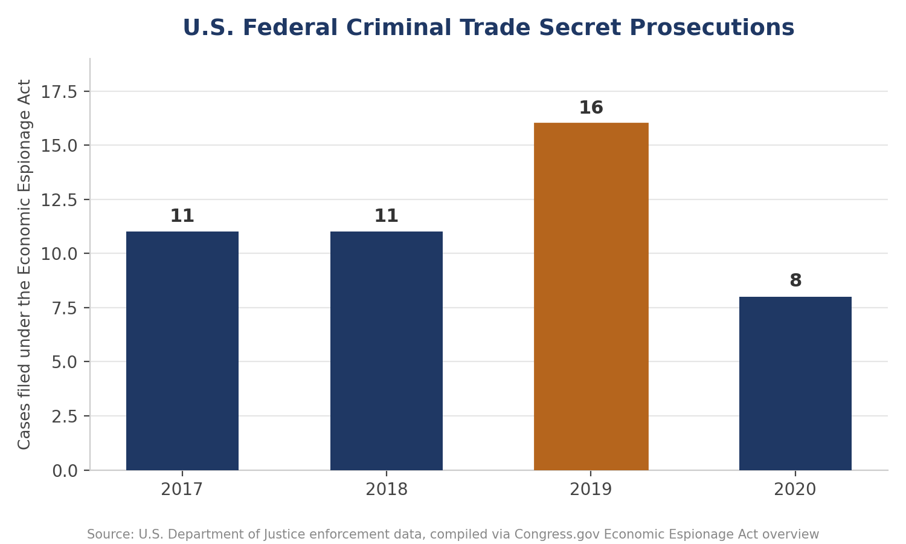
U.S. federal prosecutors have steadily formalised the boundary that industry codes only describe. Under the Economic Espionage Act, the Department of Justice pursued eleven criminal trade secret cases in 2017, eleven again in 2018, and sixteen in 2019, before recorded filings dipped to eight in 2020, according to enforcement figures compiled through the Congressional Research Service's overview of the statute. That is a small number of cases relative to the volume of competitive research conducted every year, which is precisely the point: criminal referral is reserved for conduct that has clearly crossed from analysis into theft, such as copying source code, downloading pricing algorithms, or paying an employee for confidential files. The rarity of prosecution does not signal low risk. It signals that when the line is crossed, the consequences are severe and disproportionate to the short-term competitive gain.
The Corporate Cost of Crossing the Line
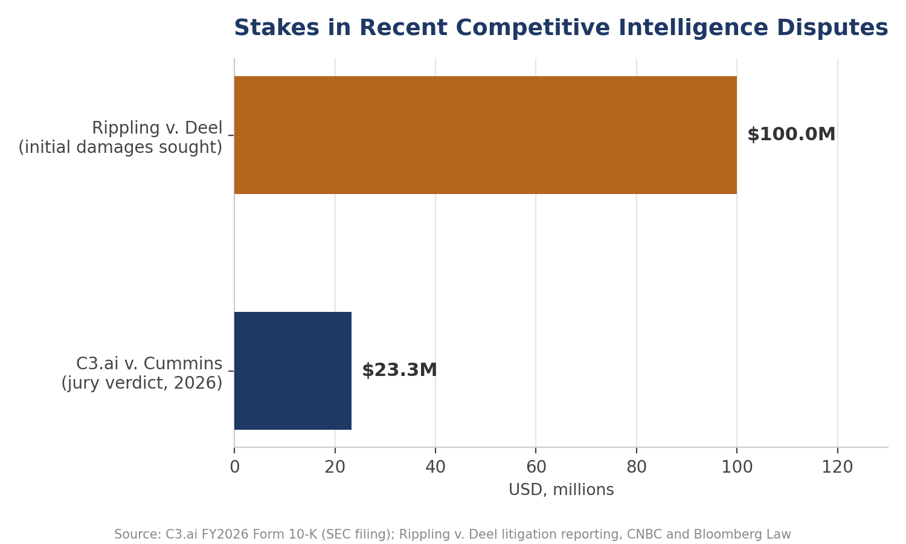
Civil litigation tells the same story at a larger scale. In May 2026, a jury in the Delaware Superior Court found that Cummins Inc. had misappropriated trade secrets belonging to C3.ai and awarded $23.3 million in damages, a verdict disclosed in C3.ai's own annual filing with the Securities and Exchange Commission. A separate and far larger dispute has unfolded between HR software rivals Rippling and Deel, where Rippling's original complaint, reported by CNBC, alleged that a Deel-recruited employee ran systematic searches inside Rippling's own systems to harvest competitor intelligence on Deel's behalf, with Rippling seeking damages reported to exceed $100 million. A California federal judge allowed the case to proceed past a motion to dismiss in February 2026, according to Bloomberg Law's litigation coverage, and the matter has since drawn a reported Department of Justice inquiry. Two verdicts, two industries, one shared lesson: the financial exposure from crossing the ethical line now dwarfs whatever competitive edge the information briefly provided.
Why Ethical Practice Is Becoming a Competitive Advantage
None of this has slowed demand for intelligence itself. In Gartner's 2023 Tech Marketer Role Survey, 74 percent of respondents said they would need to address competitive and market intelligence challenges within the next twelve months to keep their teams effective, a figure Gartner's technology marketing research continues to cite as evidence that structured, well-governed intelligence functions are becoming a baseline expectation rather than an optional capability. The organisations best positioned to meet that demand are the ones building intelligence functions around disclosed sourcing, documented collection methods, and clear internal sign-off before any competitor-facing outreach, rather than functions that quietly reward whoever brings back the most detailed information regardless of how it was obtained.
Building the Guardrails
Three practices recur across the organisations that treat competitive intelligence as a durable capability rather than a legal liability waiting to surface. First, every analyst identifies their employer honestly in primary research calls, matching the SCIP code rather than working around it. Second, legal and compliance teams review any intelligence project that touches a departing competitor employee, since hiring alone is not the risk, but debriefing a new hire on a former employer's confidential systems is. Third, sourcing is documented well enough that, if challenged in litigation, a company can show every fact came from a public filing, a licensed database, an industry event, or a voluntary interview. None of these guardrails slow down legitimate research meaningfully. What they prevent is the far more expensive scenario now playing out in Delaware and California courtrooms, where a single overreaching search history became the centrepiece of a nine-figure lawsuit.