
Policy, Contracts and Risk: How Government Program Structures Are Reshaping the Space Robotics Market

Why Program Structure Now Sets the Investment Agenda
Across the space robotics sector, how a program is funded and contracted increasingly matters as much as what the hardware does. Fixed-price task orders shift technical risk onto suppliers, multi-year appropriations cycles create planning uncertainty, and export control regimes shape who can partner with whom. This analysis traces how those structural forces are reshaping investment, risk, and competitive positioning across lunar, orbital-servicing, and humanoid robotics programs.
Fixed-Price Contracting Redistributes Technical Risk
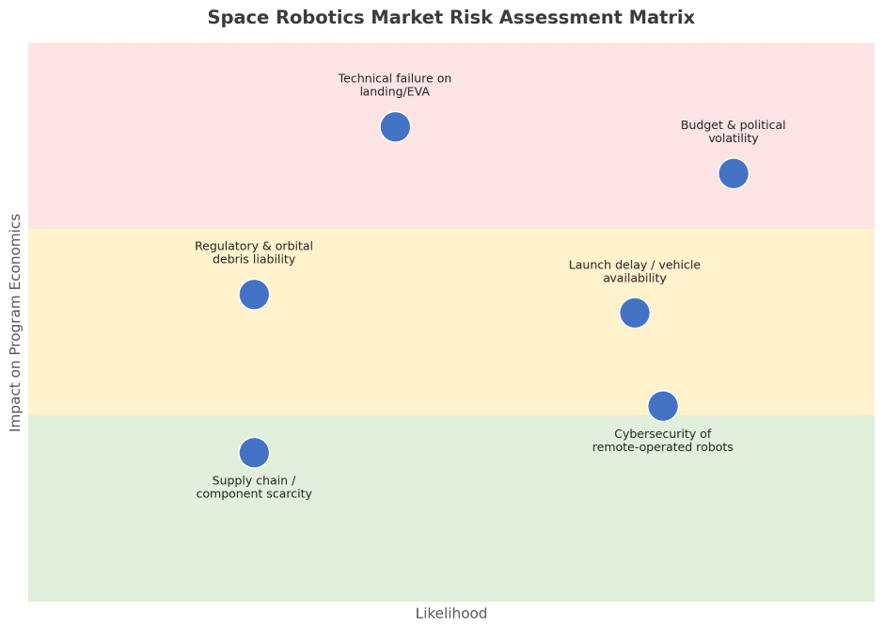
NASA's CLPS task orders are awarded as fixed-price contracts, meaning providers, not the government, absorb cost overruns from technical setbacks. That structure has consequences: a 2024 NASA Office of Inspector General audit found average cost growth of 26 percent and schedule slippage of 14 months across the CLPS portfolio, costs that landed squarely on contractors such as Astrobotic, whose Peregrine Mission One award grew from $226.5 million to $320.4 million after added testing requirements. The same fixed-price logic now extends to larger opportunities, including Intuitive Machines' pending Lunar Terrain Vehicle Services award, worth up to $4.6 billion over its life.
Appropriations Volatility Is a Policy Risk, Not Just a Budget Risk
NASA's FY2026 cycle illustrates how quickly policy assumptions can shift. The administration's initial budget request proposed cutting the agency to $18.8 billion and canceling the Space Launch System, Orion, and Lunar Gateway programs outright. Congress ultimately enacted $24.4 billion in funding, restoring most of the contested programs. Still, the intervening months of uncertainty forced contractors and suppliers to plan against multiple, materially different funding scenarios simultaneously, a pattern likely to recur every budget cycle for the remainder of the decade.
Export Controls and Program Access Diverge by Region
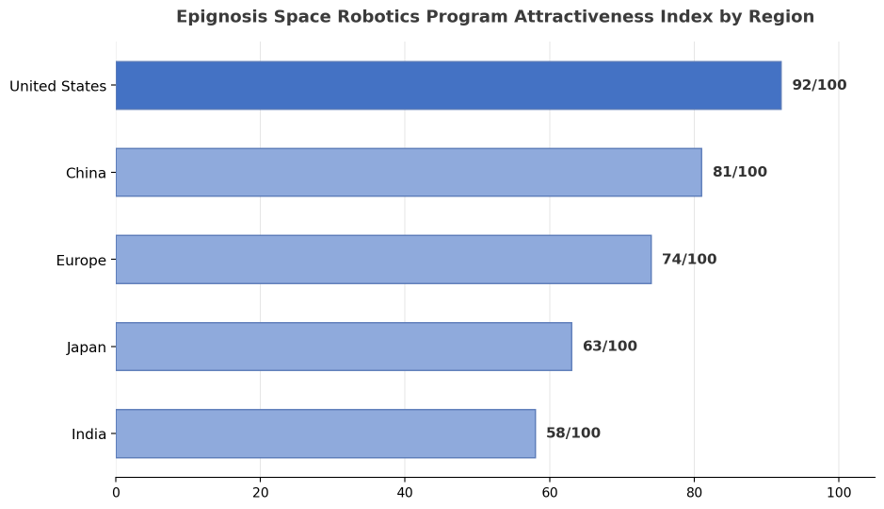
Regulatory alignment varies sharply by region and directly affects which suppliers can compete for which contracts. U.S. robotics programs, including CLPS and DARPA's RSGS servicing initiative, operate under technology transfer restrictions that limit foreign participation in sensitive subsystems. China's International Lunar Research Station has taken the opposite approach on paper, formally inviting international partners, including Egypt, Pakistan, Italy, and Switzerland, onto its Chang'e-7 payload manifest, even as the opacity of China's civil-military budget integration complicates independent assessment of the program's true openness.
ESA's Governance Model Trades Speed for Durability
Europe's approach illustrates a third contracting model. ESA's record €22.3 billion 2026-2028 commitment was negotiated across 23 member states, a consensus process that moves more slowly than single-agency budgeting but produces multi-year funding considered more durable once agreed. The roughly €2.98 billion earmarked for human and robotic exploration, including continued backing for the ExoMars Rosalind Franklin rover, reflects this trade-off: slower to commit, but harder to unwind once approved than a single-country appropriations line.
What Suppliers Should Watch Next
Contractors and investors evaluating space robotics programs should weigh three structural questions alongside technical merit: whether a contract is fixed-price or cost-reimbursable, how exposed the funding agency's budget cycle is to political revision, and whether export controls or international partner rules constrain the supplier's addressable customer base. Programs scoring well on all three, alongside genuine flight heritage, are the ones most likely to convert current government investment into a durable commercial business rather than a single successful demonstration.