
Labor Market Slack: What's Really Happening Beneath Headline Employment Numbers

The headline unemployment rate fell to 4.1% in July 2026, the kind of number that reads as good news in any news ticker. But it fell because 264,000 people left the labor force, not because more people found jobs and the labor force participation rate dropped to its lowest level since 1976 outside the COVID era, according to the U.S. Bureau of Labor Statistics. That gap between what the headline number says and what is actually happening underneath it is the story of the 2026 labor market.
The Headline Number Hides a Shrinking Labor Force
BLS data for June 2026 already showed the pattern taking shape: nonfarm payrolls rose by just 57,000, well below consensus, while the unemployment rate dropped to 4.2% from 4.3% not because hiring picked up, but because the labor force shrank by 720,000 people in a single month. The labor force participation rate fell to 61.5%, and household employment, a separate measure from the payroll survey, actually declined by 507,000. By July, participation fell further to 61.4%, and the employment-population ratio slipped to 58.9%, its lowest reading since May 2014. “May's larger gain briefly suggested the tide might be turning; June makes clear it was the exception, not the new rule,” Indeed Hiring Lab economist Laura Ullrich wrote in commentary on the June report.
The Broader U-6 Measure Tells a Different Story
The BLS publishes six measures of labor underutilization, and the broadest, U-6, captures unemployed workers, discouraged workers, and people working part-time purely because they cannot find full-time hours. U-6 stood at 8.1% in May 2026 and eased only slightly to 7.9% in June, nearly double the headline rate the same month. In July, the number of people employed part-time for economic reasons held at 4.8 million, and long-term unemployment people jobless for 27 weeks or more accounted for 25.5% of all unemployed workers, evidence that slack is concentrated among people who are struggling to find their way back into full-time work rather than cycling through short spells of joblessness.
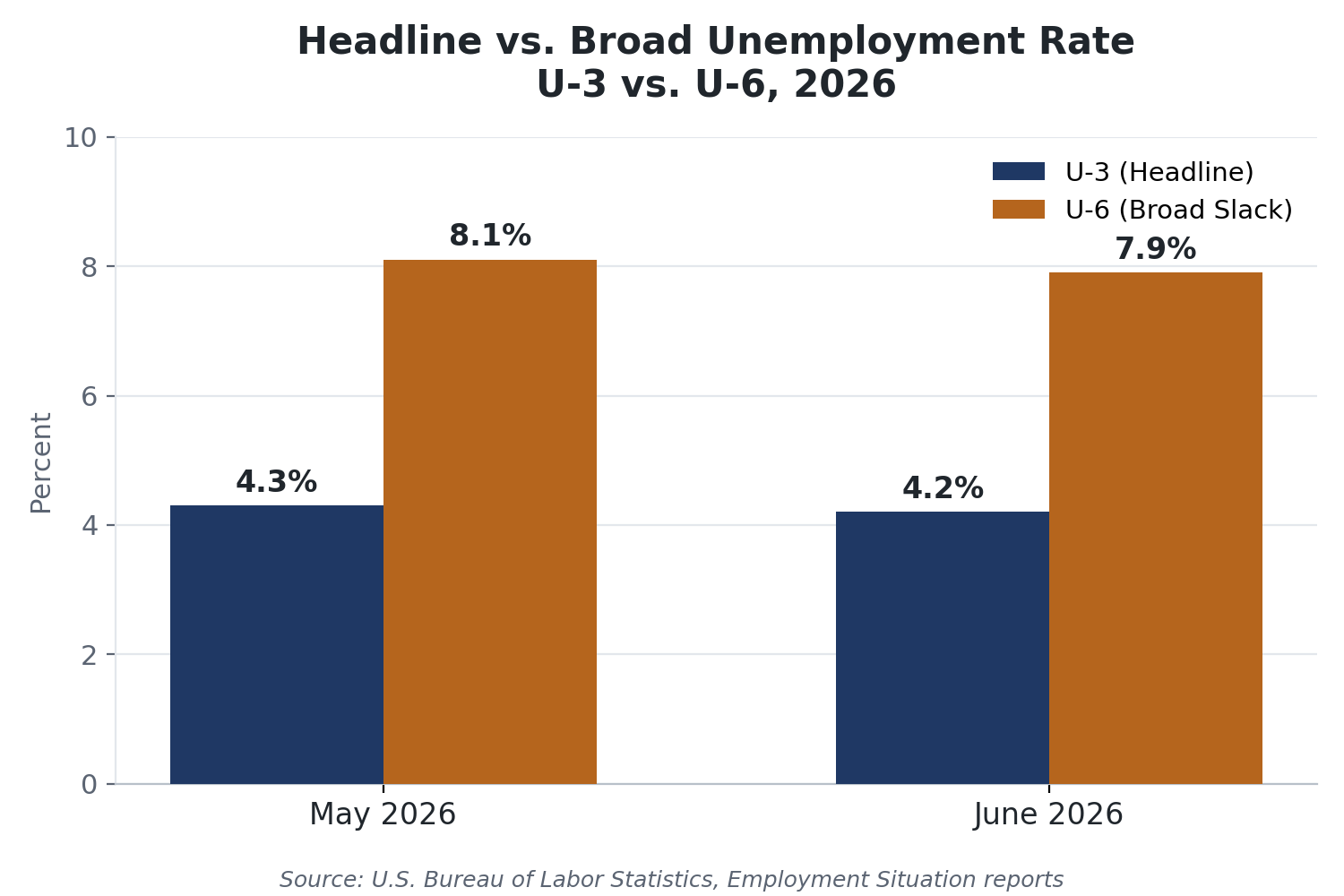
Figure 1: Headline (U-3) vs. broad (U-6) unemployment rate, May–June 2026. Source: U.S. Bureau of Labor Statistics.
JOLTS Data Shows a Cooling, Not a Booming, Market
The Job Openings and Labor Turnover Survey adds another layer to the picture. In June 2026, job openings stood at 7.4 million, hires at 5.3 million, and quits at just 3.2 million, according to BLS JOLTS data. That gap between openings and hires employers posting roughly 2 million more positions than they are actually filling points to longer time-to-fill windows and mismatches between what employers want and what available workers offer. The quits rate, which measures workers' willingness to leave one job for another, has fallen well below its 2021–2022 peak, when quits topped 4.2 million a month; a low quits rate signals workers have lost confidence that a better opportunity is out there, which is itself a form of hidden slack the headline rate cannot capture.
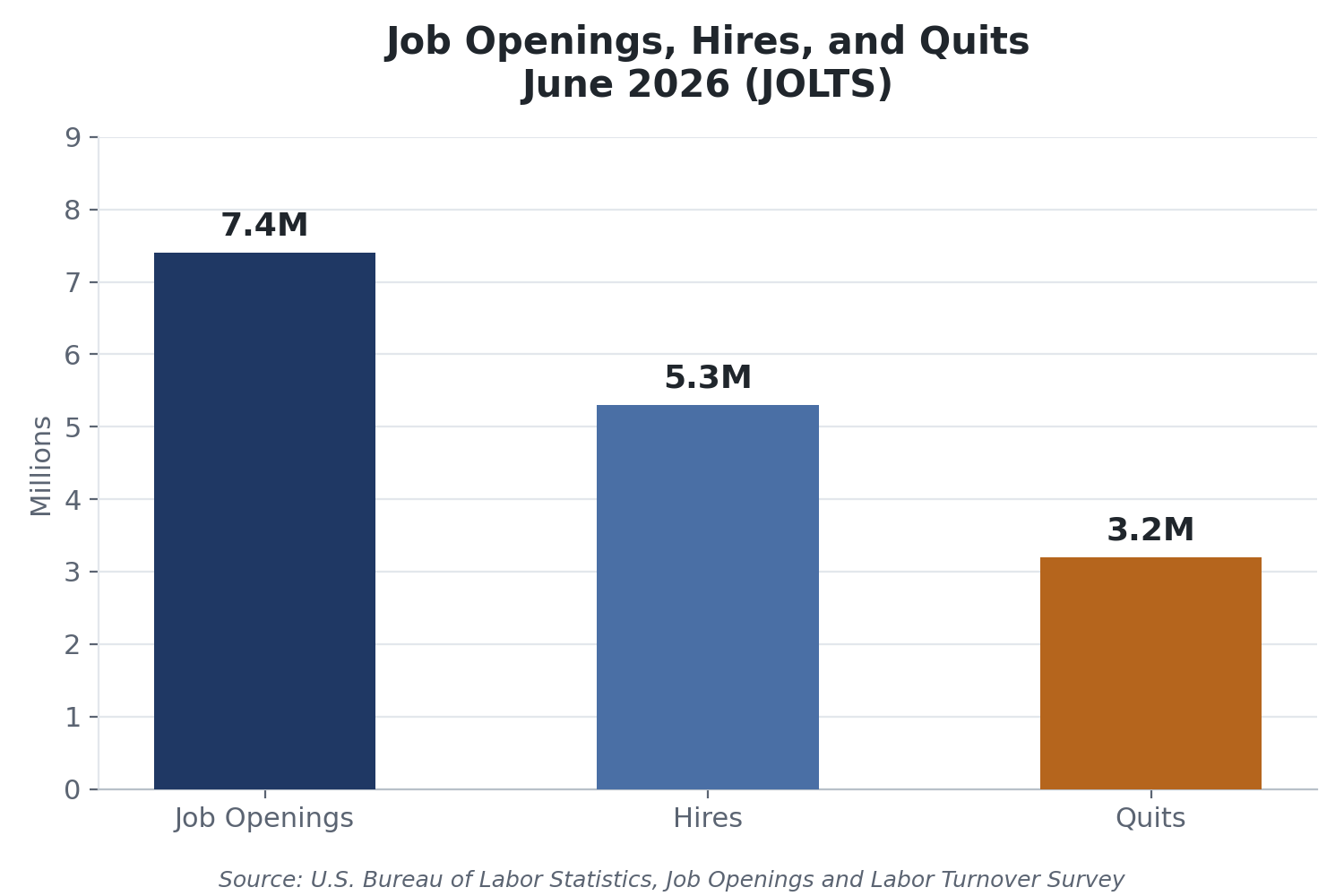
Figure 2: Job openings, hires, and quits, June 2026. Source: U.S. Bureau of Labor Statistics, JOLTS.
Staffing Companies Are Already Feeling It
Corporate earnings are one of the clearest real-time signals of labor demand, since staffing firms get paid only when clients actually hire. ManpowerGroup's first-quarter 2026 investor release disclosed net earnings of just $0.05 per diluted share, down from $0.12 a year earlier, and specifically cited “Talent Solutions headwinds” driven by tempered permanent hiring. The company's own Q1 2026 Employment Outlook Survey of more than 39,000 employers across 41 countries found hiring intentions weakest among the largest organizations, with employers of 5,000 or more workers reporting a net outlook of just 21%, down 25 percentage points year-over-year. Rival staffing and consulting firm Robert Half has seen its stock come under renewed pressure through mid-2026 as investors priced in what one equity research note described as an environment where “professional staffing companies are priced as though the deceleration has already begun.”
Layoffs Are Falling, But the Reason Is Changing
Paradoxically, actual layoffs have been declining even as hiring cools. Challenger, Gray & Christmas reported that U.S. employers announced just 33,429 job cuts in July 2026, the lowest monthly total in two years, and 41% below the same seven-month period in 2025. But the composition of those cuts has shifted: technology companies have announced 149,023 job cuts through July 2026 alone, up 67% from the same period in 2025, with artificial intelligence cited as a factor in roughly 23% of all 2026 job-cut announcements year-to-date. “Hiring has also increased over last year by 25%, so while AI is shifting the labor market, it is not dismantling it,” said Andy Challenger, the firm's chief revenue officer — a reminder that fewer layoffs do not necessarily mean a healthier hiring environment underneath.
What This Means for Reading the Next Jobs Report
Taken together, the BLS's own underutilization measures, JOLTS turnover data, staffing-company earnings, and layoff-tracking data all point toward the same conclusion: the labor market is cooling from the inside out, in ways the monthly unemployment headline is structurally designed not to show. A falling U-3 rate driven by people leaving the labor force, a widening gap between job openings and actual hires, and staffing firms citing tempered permanent hiring are three independent signals converging on one story. For anyone trying to gauge real labor market health, the participation rate, the U-6 rate, and the quits rate deserve at least as much attention as the headline number that leads the evening news.