
Geothermal's Comeback: Why Old Technology Is Getting New Investment
A 100-Year-Old Idea Finds a New Market
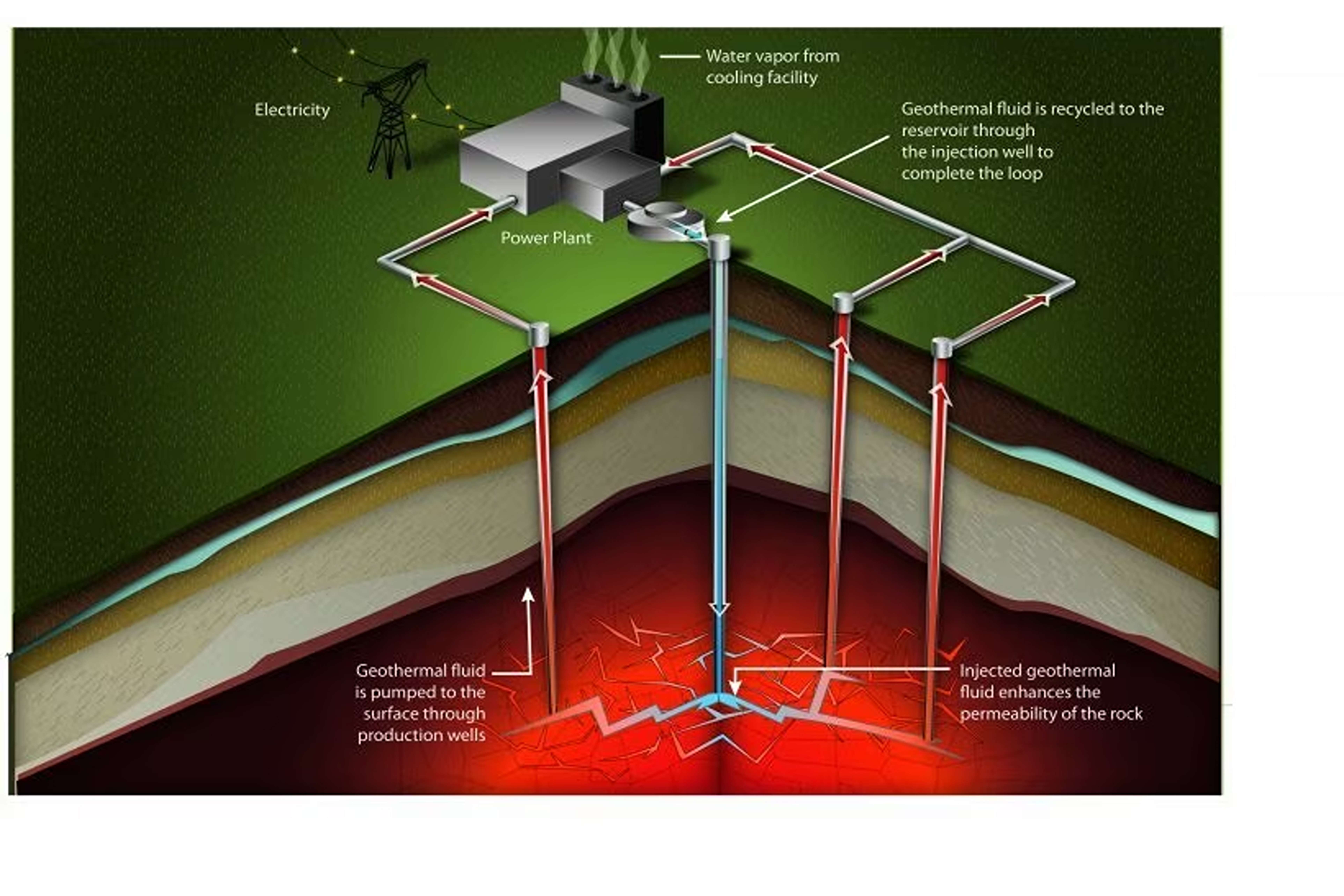
Geothermal power is not new — the first commercial plant opened in Italy in 1913 — but the capital flowing into it today is unlike anything the sector has seen. What changed is not the physics of drilling into hot rock; it's who wants the power and how it is being extracted. Data centers need firm, round-the-clock electricity that solar and wind cannot supply without expensive storage, and drilling techniques borrowed from shale oil and gas are finally making geothermal economical outside the handful of volcanic hotspots that used to define the industry.
Washington Is Betting on Enhanced Geothermal Systems
In February 2026, the US Department of Energy's Office of Geothermal announced up to $171.5 million in funding for next-generation geothermal field tests and exploration drilling — the largest single tranche of federal funding the sector has ever received. The announcement builds on DOE analysis showing the United States currently generates about 4 gigawatts of geothermal electricity but could reliably supply at least 300 gigawatts to the grid by 2050 using enhanced geothermal systems (EGS), a technology that fractures deep rock to access heat where no natural reservoir exists.
Costs Are Falling Faster Than Almost Any Other Clean Technology
The International Energy Agency's most recent geothermal analysis found that investment in next-generation geothermal grew from a negligible base in 2017 to more than $420 million by 2023, and that global geothermal plants already run at a utilization rate above 75%, compared with under 30% for wind and under 15% for solar PV — meaning geothermal produces far more usable electricity per installed megawatt than either. The IEA also estimates that a 300-megawatt EGS project could fall in cost from roughly $4 billion today to between $1 billion and $2 billion by 2035 as drilling techniques scale.
Investors Are Following the Cost Curve Down
Financial analysts are pricing in that cost trajectory now. Rystad Energy projects that global geothermal capital expenditure will climb roughly 20% annually through 2030, pushing total investment from about $1.4 billion in 2020 to nearly $9 billion by 2030 — a more than sixfold increase in a single decade, driven as much by data-center demand as by traditional utility procurement.
A Single Startup Is Absorbing Much of That Capital
Much of that momentum is concentrated in Fervo Energy, the Houston-based EGS developer, which closed an oversubscribed $462 million Series E funding round in December 2025, bringing its total capital raised since 2017 to roughly $1.5 billion. The money is funding Cape Station in Beaver County, Utah, which will deliver its first 100 megawatts of power to the grid in 2026 before scaling to 500 megawatts by 2028 — what Fervo describes as the largest next-generation geothermal development in the world.
Big Tech Is Underwriting the Buildout
The clearest sign that geothermal has moved from pilot project to infrastructure asset class is who is signing the power contracts. Google has agreed to buy 396 megawatts from Fervo's Cape Station project, with an option to expand that to 996 megawatts by June 2030, a Fervo executive confirmed to Reuters — even as the United States' total existing geothermal capacity sits at only around 2.7 gigawatts today, a figure some analysts believe could reach 135 gigawatts with wider adoption of advanced drilling. That a single hyperscaler's contracted capacity is approaching one-seventh of the entire country's current geothermal fleet illustrates how quickly the demand side of this market has shifted.
What the Comeback Means Going Forward
Geothermal's revival is not a story about a single breakthrough technology; it is a story about three trends converging at once — federal cost-sharing for early projects, a credible cost-decline curve that investors are willing to underwrite, and a new category of buyer, hyperscale data centers, that will pay a premium for firm, carbon-free power that other renewables cannot reliably deliver. Developers who can execute on drilling efficiency stand to capture outsized value in the next five years, while those still relying on conventional hydrothermal sites risk being confined to the same limited set of geographies that has capped the industry for a century.