Demand Response Programs: How Utilities Are Managing Peak Load Without New Plants

The Peak Problem Utilities Can No Longer Build Their Way Out Of
For decades, the standard utility answer to a rising peak was simple: build another peaker plant. That math has broken. Wood Mackenzie now expects U.S. gas turbine prices to reach $600 per kilowatt by the end of 2027, a 195% increase since 2019, as global orders of 110 gigawatts collide with manufacturing capacity of just 60 to 70 gigawatts. GridLab's review of recent combined-cycle gas projects found completed plants now cost around $2,000 per kilowatt, well above the $1,116 to $1,427 per kilowatt planners had assumed for units due online in 2026 and 2027. Building new capacity has become slower, scarcer and structurally more expensive at exactly the moment load is accelerating.
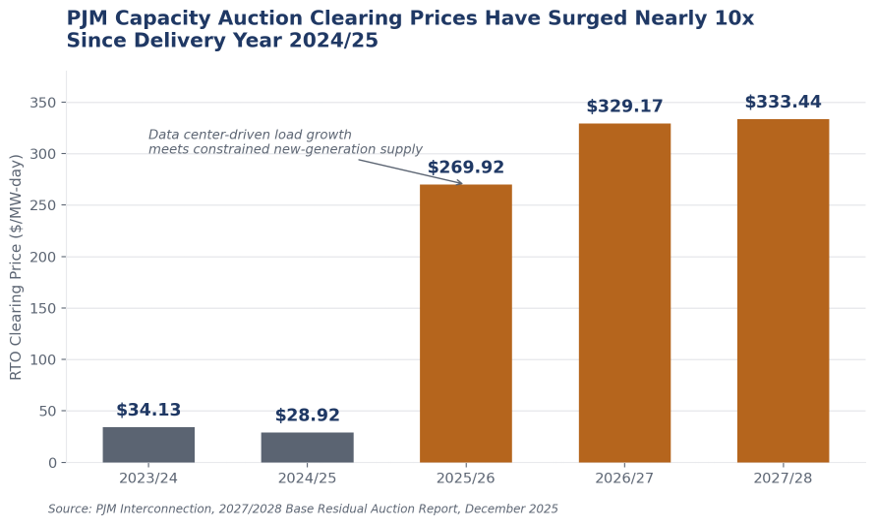
Nowhere is that collision clearer than in PJM, the grid operator serving 67 million people across 13 states and Washington, D.C. Its capacity auction clearing price sat at $28.92 per megawatt-day for the 2024/25 delivery year. One year later, it cleared at $269.92, an almost tenfold jump. It has since climbed further, to $329.17 for 2026/27 and $333.44 for 2027/28, both landing at FERC-approved price caps. PJM attributes more than 5,400 megawatts of the load growth behind the 2026/27 result directly to data center expansion. Utilities within that footprint are now facing rate increases of 1.5% to 5% tied to a single auction result, according to PJM's own estimates.
What Demand Response Actually Buys the Grid
Demand response pays customers, directly or through an aggregator, to reduce or shift electricity use when the grid is under strain, instead of paying to keep a power plant idle for the rest of the year waiting for that same handful of hours. FERC's 2025 Assessment of Demand Response and Advanced Metering, its twentieth annual report to Congress, put potential peak demand savings across the country at 30,542 megawatts in 2023, up from 30,448 megawatts in 2022. Across the nine RTOs and ISOs FERC tracks, demand response could meet roughly 6.5% of a combined non-coincident peak demand of 512 gigawatts in 2023, a share that has held steady rather than eroded even as overall peak demand keeps climbing.
The Economics Are the Real Story
The Department of Energy's 2025 Pathways to Commercial Liftoff report on virtual power plants found that peak capacity delivered through aggregated smart thermostats, managed EV charging and behind-the-meter batteries costs 40% to 60% less than the same capacity from a gas peaker or a utility-scale battery. The Brattle Group, whose modeling underpins much of that DOE analysis, estimates that scaling virtual power plants nationally could save U.S. utilities $15 billion to $35 billion in capacity investment over ten years. DOE separately projects that tripling current VPP capacity to a range of 80 to 160 gigawatts by 2030 could cover 10% to 20% of national peak load and save on the order of $10 billion annually in avoided generation buildout and deferred infrastructure spending.
Utilities and Big Load Are Already Acting on the Math
This isn't theoretical. Google struck a three-year, 100-megawatt virtual power plant agreement with aggregator Voltus to serve load inside the PJM grid, using batteries, smart thermostats, managed EV charging and onsite generation across homes and businesses to absorb strain during peak hours rather than contracting for new dedicated generation. DOE's research separately found that utilities have launched basic VPP programs in under six months, for less than $1 million in upfront cost, and still achieved more than 100 megawatts of peak-shaving benefit over time. That combination of speed and capital efficiency is difficult to match with a multi-year, six-figure-per-megawatt gas turbine order book.
The Regulatory Push Behind the Shift
FERC Order 2222 is the federal rule making this kind of aggregation possible at scale. It requires every RTO and ISO to open wholesale capacity, energy and ancillary services markets to aggregations of distributed energy resources, including demand response, rather than restricting participation to traditional generators bidding individually. PJM has already folded demand response into its capacity auctions directly: 8,009.7 megawatts of demand response capacity (ICAP) were offered into the 2026/27 Base Residual Auction, and the resource's Effective Load Carrying Capability rating for the following delivery year rose from 69% to 92% once PJM required demand response to be available across all hours of the year rather than a narrower peak window. Other RTOs are moving on their own timelines under the same order: ISO-NE by November 2026, PJM's energy and ancillary services markets by February 2028, MISO by June 2029 and SPP by mid-2030.
What This Means for Utility Planning Going Forward
None of this eliminates the need for new generation entirely; DOE and independent analysts are clear that demand-side resources address a portion, not the totality, of load growth from data centers and electrification. What has changed is the sequencing. Where a new gas plant now means a six-year turbine lead time and a per-kilowatt price still climbing, a demand response or virtual power plant program can be stood up in months, priced at a fraction of the capital cost, and scaled incrementally as enrollment grows. For a sector staring at back-to-back record capacity auction prices, that is no longer a sustainability talking point. It is the fastest lever utilities have left to pull before the next auction clears.