
Decoding the Post-Purchase Experience: The Most Overlooked CX Stage

Executive Summary
Most customer experience budgets are still weighted toward the moments before checkout: the ad that sparks interest, the landing page that builds trust, the cart that closes the sale. What happens after the order confirmation email lands gets comparatively little structured attention, even though it is where a first-time buyer decides whether to become a repeat customer, and where a repeat customer decides whether to keep defending the brand to friends or quietly walk away.
This report treats the post-purchase stage as its own connected sub-journey, running from delivery through unboxing, support, and the eventual choice between a return and a renewal, and brings in data from a government postal regulator, a national retail trade association, a global logistics company's own financial disclosures, a leading strategy consultancy's loyalty research, and recent news coverage of the retail returns backlash. The goal is a grounded picture of why this stage is overlooked, what it costs when it is, and what a defensible plan to fix it actually requires.
The case for treating post-purchase as a first-class stage of customer experience management, rather than an operational afterthought handled by logistics and support teams in isolation, rests on a simple asymmetry: acquisition failures are visible immediately, in a missed sale, while post-purchase failures are often invisible until they resurface weeks or months later as a return, a support escalation, or a customer who simply never orders again. Because the second kind of failure is slower and quieter, it tends to be under-measured relative to its actual cost, and under-resourced relative to the acquisition spend it is meant to protect.
There is also an organizational reason this stage gets overlooked that has little to do with data availability and everything to do with how teams are structured. Marketing owns awareness and consideration, sales or e-commerce owns purchase, and post-purchase gets split across logistics, customer support, and returns operations, each reporting through a different chain and measured against a different set of departmental targets. A delivery delay, a confusing support handoff, and a frustrating return process can each look like an isolated, tolerable inefficiency from inside their own department, while together they compound into the exact experience that turns a promoter into a detractor. Fixing the measurement gap requires someone to own the post-purchase stage as a connected whole, the same way a single team typically owns the funnel from awareness through purchase, rather than leaving it to whichever department happens to touch the customer last.
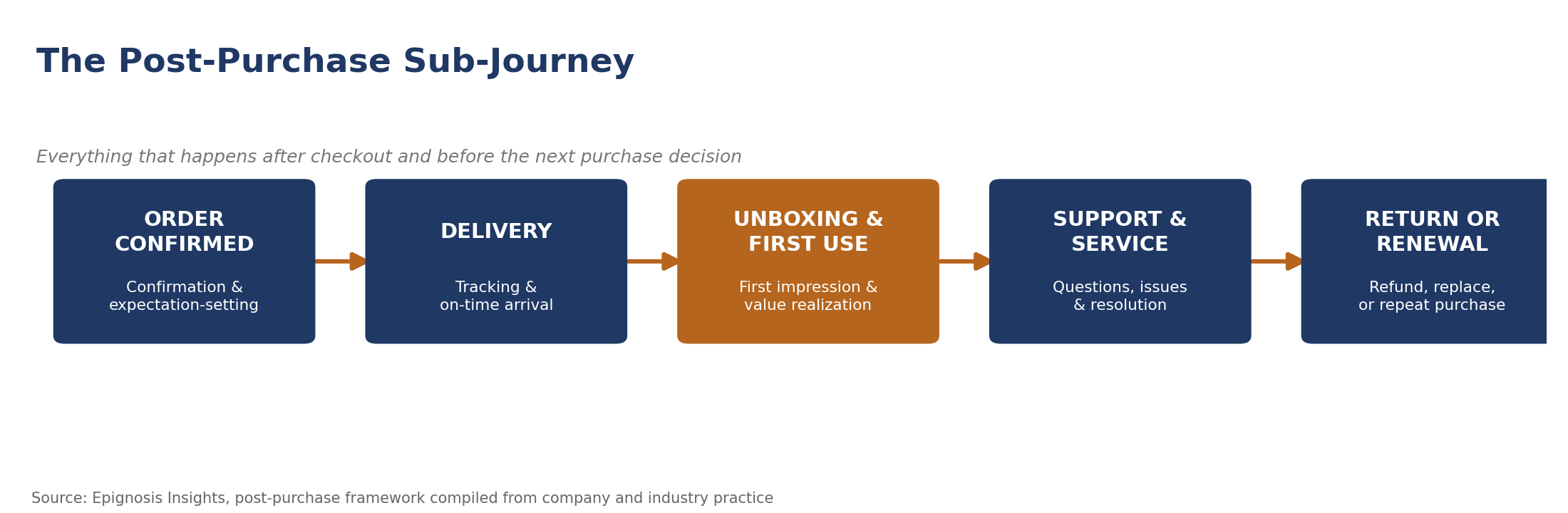
Figure 1: The post-purchase sub-journey, framework compiled by Epignosis Insights.
Delivery: The First Post-Purchase Test
Delivery is the first moment a customer's post-purchase expectations meet reality, and it sets the tone for everything that follows. A late or mishandled delivery does not just create a single bad experience; it retroactively colors how the customer remembers the entire buying process, even if awareness, consideration, and purchase all went smoothly. This is why delivery reliability data matters as a customer experience indicator, not just a logistics one.
The U.S. Postal Service's Office of Inspector General found that on-time delivery performance during the 2025 holiday peak season reached 94.1%, up from 90.4% during the same period the year before, aided by added capacity, revised service standards, and closer coordination between operations leaders and customers.
That improvement matters disproportionately at peak season, because holiday deliveries are disproportionately gifts, first-time purchases, and higher-stakes transactions where a delay is more likely to translate into a lost customer rather than a minor inconvenience. A five-point swing in on-time performance, at the scale of a national postal network, represents millions of individual post-purchase experiences moving from disappointing to acceptable.
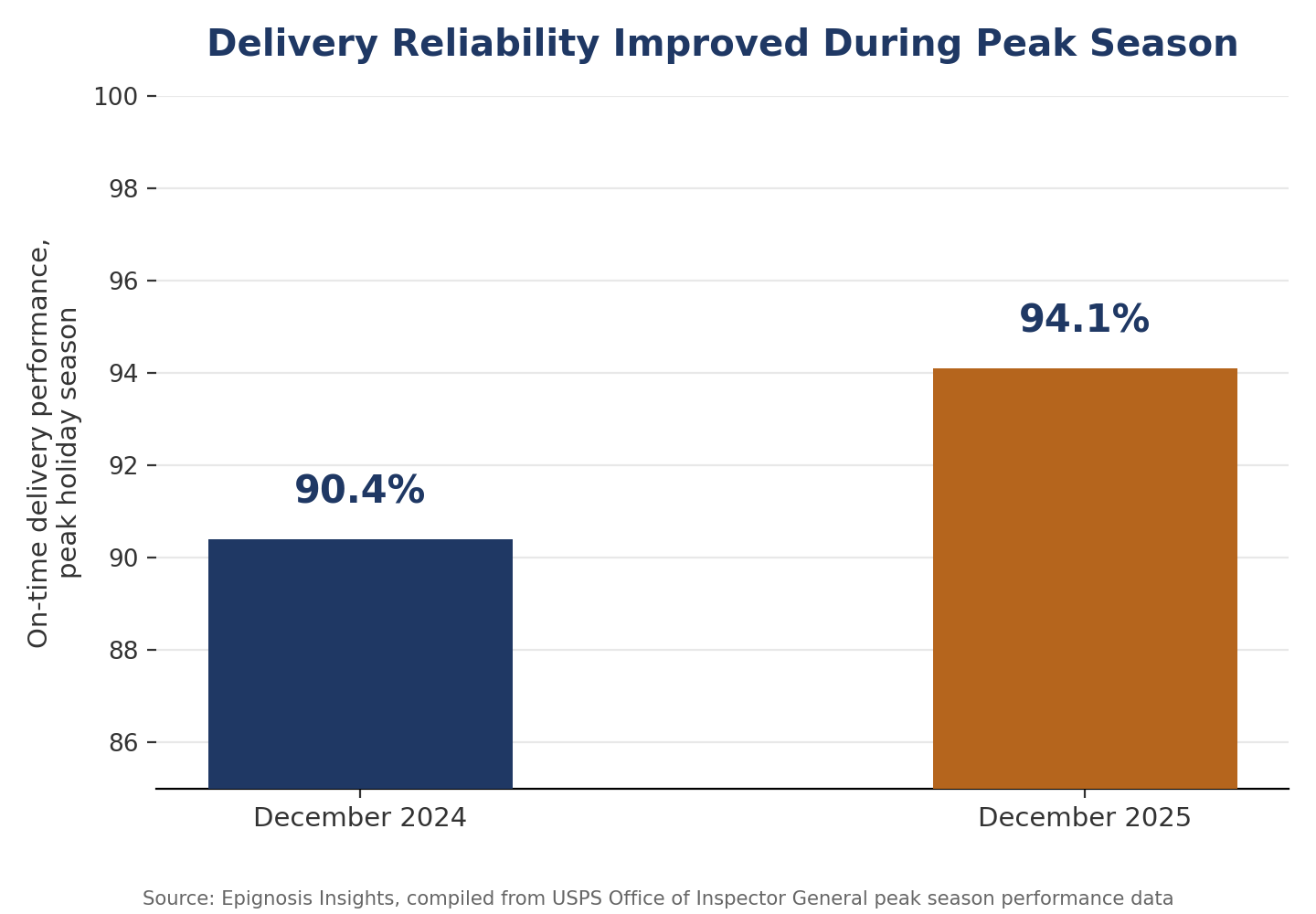
Figure 2: USPS peak season on-time delivery performance, year-over-year, compiled by Epignosis Insights.
What this figure does not capture is the asymmetry in how customers react to delivery performance around the average. A customer whose package arrives exactly on schedule rarely mentions it; a customer whose package arrives late, especially around a gift-giving occasion, is highly likely to mention it, to the retailer and to other people. Delivery reliability metrics that stop at an aggregate on-time percentage miss this asymmetry, which is why post-purchase journey maps need to track late-delivery recovery, meaning what happens after a delivery misses its window, as a distinct and heavily weighted metric rather than folding it into the same average.
Recovery quality after a missed delivery window is arguably a more important predictor of retention than the on-time rate itself. Two retailers with identical 94% on-time performance can produce very different loyalty outcomes depending on how the remaining 6% is handled: one that proactively notifies the customer, offers a clear resolution path, and follows up once the package arrives converts a delay into a demonstration of reliability under pressure, while one that leaves the customer to discover the delay on their own, with no clear escalation path, converts the same delay into confirmation that the brand cannot be trusted. Because most delivery dashboards report only the aggregate on-time figure, this second, arguably more decisive layer of the delivery experience often goes entirely unmeasured.
Returns: Where Policy Meets Emotion
If delivery is the first post-purchase test, returns are where policy design collides most directly with customer emotion, because a return typically means something about the purchase has already gone wrong from the customer's perspective. The National Retail Federation's 2025 Retail Returns Landscape report, produced with Happy Returns, found that retailers expected 15.8% of annual sales, or roughly $849.9 billion, to be returned in 2025, and that 72% of retailers now charge for at least some returns, up from 66% the year before. That shift toward paid returns is a rational response to rising return volume and processing costs, but the same report's data on what happens after retailers start charging tells a more complicated story about the trade-off being made.
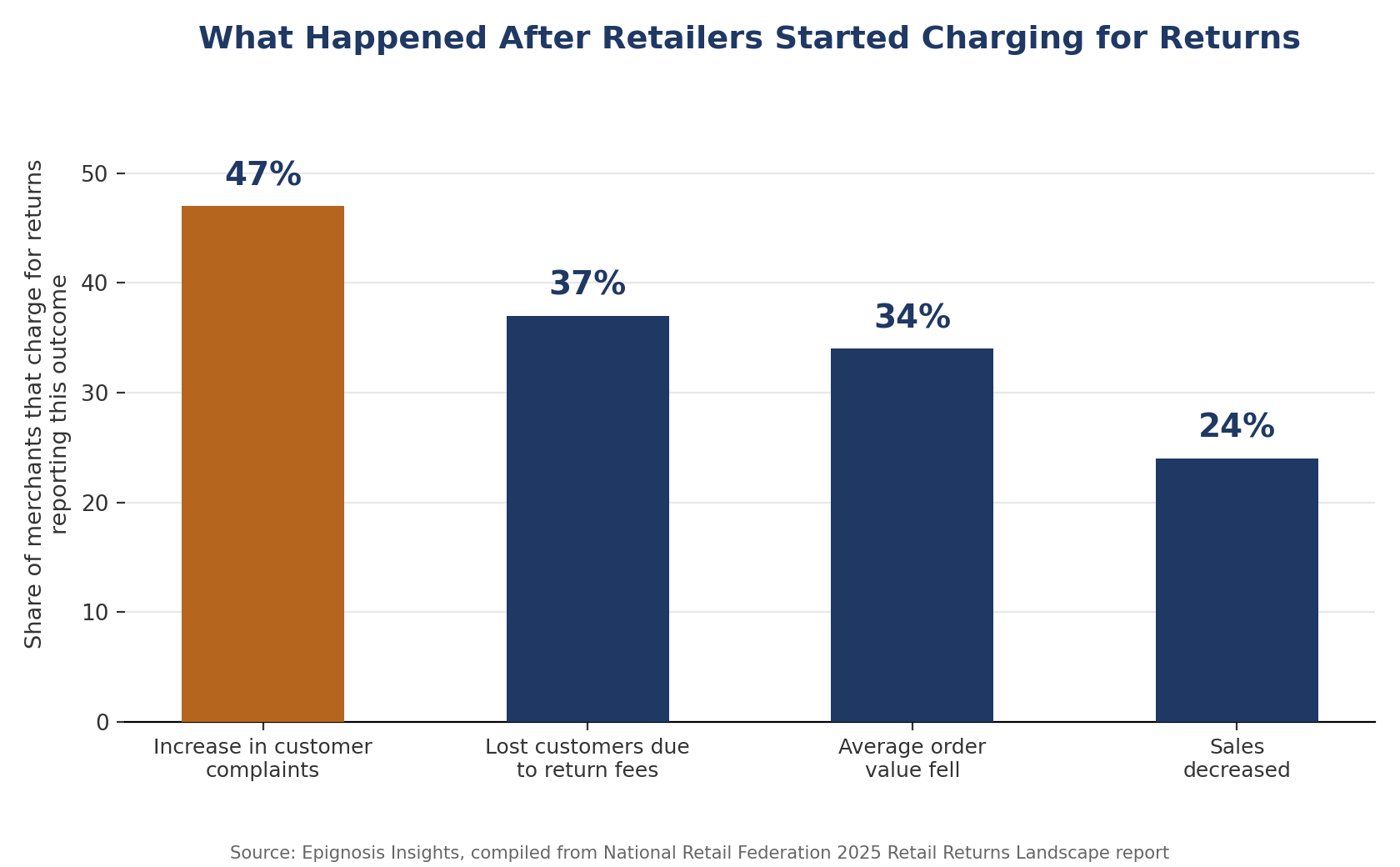
Figure 3: Reported consequences among merchants that began charging for returns, compiled by Epignosis Insights.
Nearly half of merchants that introduced return fees reported an increase in customer complaints, more than a third reported losing customers specifically because of the fee, roughly a third saw average order value fall, and about a quarter saw sales decline outright. None of this means charging for returns is always the wrong call; for some categories and price points, the operational savings clearly outweigh the customer experience cost. But it does mean that a returns-fee decision made purely as a cost-recovery exercise, without modeling the complaint, churn, and order-value effects documented in the same data, is working from an incomplete picture of its own consequences.
The categories where this trade-off is sharpest tend to be the ones where the original purchase decision was already uncertain, apparel and footwear being the clearest examples, where a customer routinely orders multiple sizes with the explicit intent of returning what does not fit. A blanket return fee applied without segmentation penalizes that behavior identically to a customer returning a genuinely defective item, which is precisely the kind of undifferentiated policy that the complaint and churn data above suggests customers react to badly. A more defensible approach segments the fee structure by return reason and customer history, preserving a low-friction path for legitimate defects and exchanges while still addressing the cost pressure that made the fee necessary in the first place.
The Infrastructure Behind the Post-Purchase Promise
Meeting post-purchase expectations at scale requires an enormous amount of physical and operational infrastructure that most customer experience discussions never touch directly. UPS's 2025 annual disclosures describe a delivery network moving an average of 20.8 million packages per day, 5.2 billion for the year, serving roughly 1.6 million shipping customers and 10.7 million delivery recipients across more than 200 countries and territories. That scale is a useful reminder that the post-purchase promise a retailer makes at checkout, whether it is a delivery window, a return policy, or a support response time, is only as credible as the infrastructure standing behind it, and that infrastructure is shared across an enormous number of other retailers' promises at the same time.
This has a direct implication for how a business should think about its own post-purchase commitments: a delivery or returns promise that assumes carrier performance well above what the broader network is actually achieving is a promise being made on borrowed credibility. Businesses that build post-purchase policies around realistic, carrier-verified performance data, rather than aspirational best-case scenarios, are the ones whose promises survive contact with an actual peak season.
The Loyalty Economics of Getting Post-Purchase Right
The financial case for investing in the post-purchase stage is not speculative; it has been quantified repeatedly by Bain & Company, the strategy consultancy that originated the Net Promoter Score. Bain's research finds that the lifetime value gap between promoters, customers who would actively recommend a business, and detractors, customers who would actively warn others away, typically runs from three to eight times, depending on the industry and competitive environment. Separately, Bain has found that companies with sustained, above-average Net Promoter Scores tend to grow at more than double the rate of their industry peers over time.
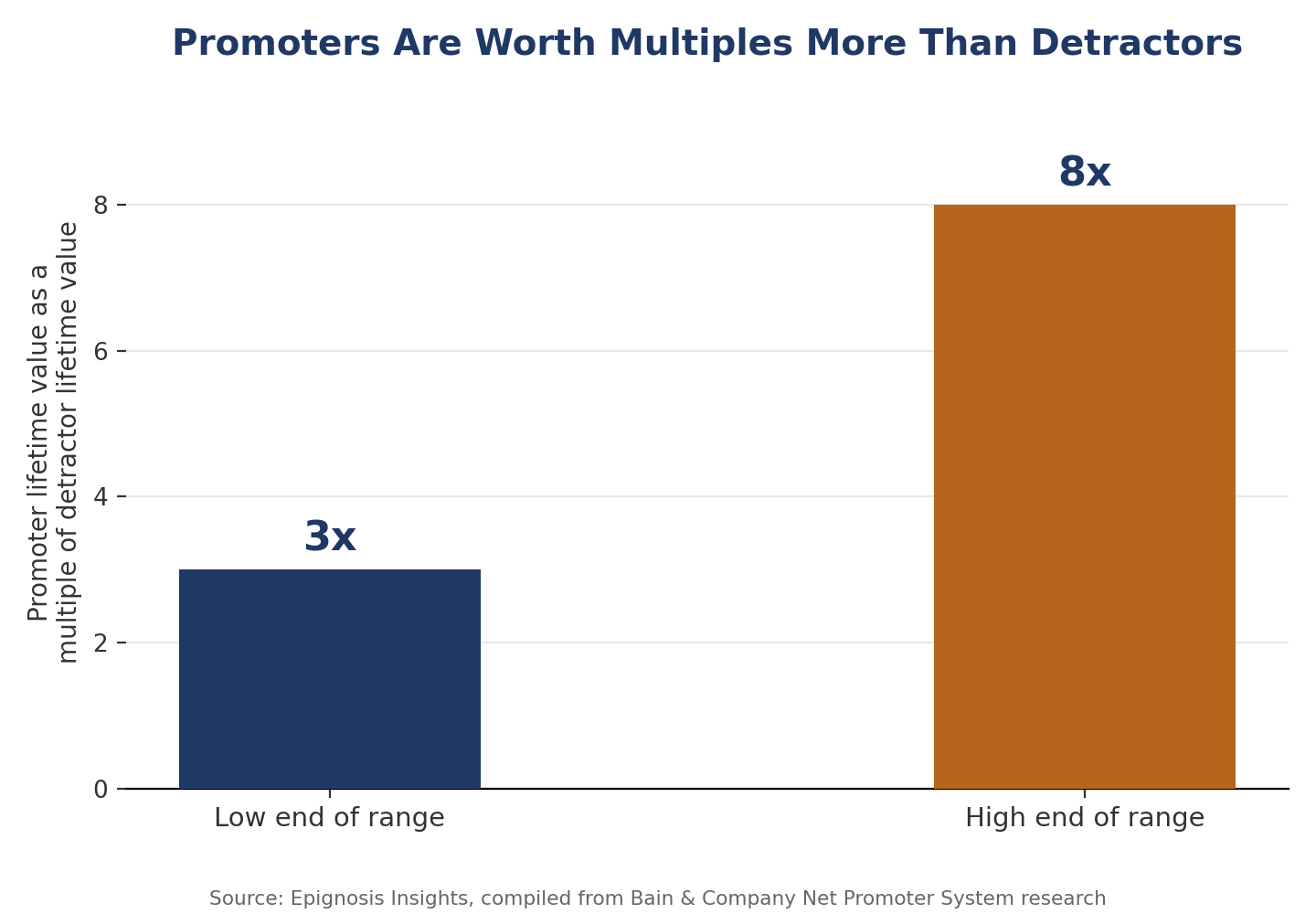
Figure 4: Range of promoter-to-detractor lifetime value multiples, compiled by Epignosis Insights.
The post-purchase stage is where a large share of that promoter-versus-detractor split is actually decided, because it is where a customer's initial purchase decision either gets validated or contradicted by lived experience. A customer delighted at checkout but mishandled at delivery, support, or returns does not remain a promoter on the strength of the original purchase experience alone; loyalty is re-evaluated continuously, and the post-purchase stage supplies most of the continuous evidence a customer uses to make that re-evaluation.
The Returns Backlash Is Becoming a News Story
The tension between cost control and customer goodwill in the post-purchase stage has moved beyond trade publications into mainstream news coverage. A widely syndicated piece distributed by the Detroit News described retail returns as having nearly doubled since 2019, alongside a wave of new return fees, shortened return windows, and stricter verification requirements at major retailers, adding that nearly two out of every three retailers surveyed in an October 2025 industry report named updating their returns process a priority for the following six months. That level of visibility matters strategically: when a policy shift is being covered as a consumer story rather than a retail-industry story, the reputational stakes of getting the post-purchase experience wrong extend well beyond the customers directly affected by any single transaction, because the coverage itself becomes a factor shaping consideration-stage trust for prospective customers who have never made a purchase at all.
A Framework for Managing the Post-Purchase Stage
Closing the gap between how much this stage matters and how little structured attention it typically receives comes down to three operating changes.
Treat Late-Delivery Recovery as a Distinct Metric
Track what happens after a delivery misses its window, not just the aggregate on-time rate, since a small share of failed deliveries drives a disproportionate share of post-purchase dissatisfaction.
Model Fee Decisions Against Their Full Consequence Set
Before introducing or raising a return fee, weigh the projected savings against the complaint, churn, and order-value effects documented across the industry, not just the direct processing-cost offset.
Fund Post-Purchase at the Rate Its Economics Justify
Given the multi-fold lifetime value gap between promoters and detractors, and given that post-purchase experience is where that gap is largely decided, budget allocation for delivery reliability, support quality, and returns experience should be sized to the loyalty economics at stake, not treated as a residual cost center.