
The Quiet Consolidation of the Cybersecurity Vendor Market

Cybersecurity has spent fifteen years fragmenting into ever-narrower point solutions, but 2025 and 2026 mark a sharp reversal. Buyers are tired of managing dozens of disconnected tools, and the largest platform vendors are responding by acquiring rather than building. This is not a slowdown, it is a rewiring of the competitive map, funded by record deal spending and unfolding underneath a security budget that keeps expanding regardless. This analysis draws on Gartner, the European Commission, Palo Alto Networks' own SEC-disclosed transaction filings, Forrester commentary, Solganick's deal-tracking research, and recent news coverage to separate the structural consolidation story from deal-of-the-week noise.
Deal Value Has Gone Vertical
The clearest signal of consolidation is the money behind it. Independent deal-tracking research puts disclosed Global Cybersecurity M&A value at $96 billion across more than 400 transactions in 2025, a 270% increase over the prior year, and 2026 is already running hotter, with $47 billion in disclosed deal value in the first quarter alone and 38 separate transactions closing in March 2026 alone. Separately, deal advisory firm Solganick tracked 105 cybersecurity services transactions in the fourth quarter of 2025 and a further 76 in just the first two months of 2026, concentrated in managed security services and governance, risk and compliance advisory, sub-sectors being rolled up to meet tightening regulatory demand. Unlike prior cybersecurity booms, which were driven by venture-funded startups multiplying, this one is driven by consolidation at the top of the market: strategic buyers absorbing category leaders rather than customers choosing among many small vendors.
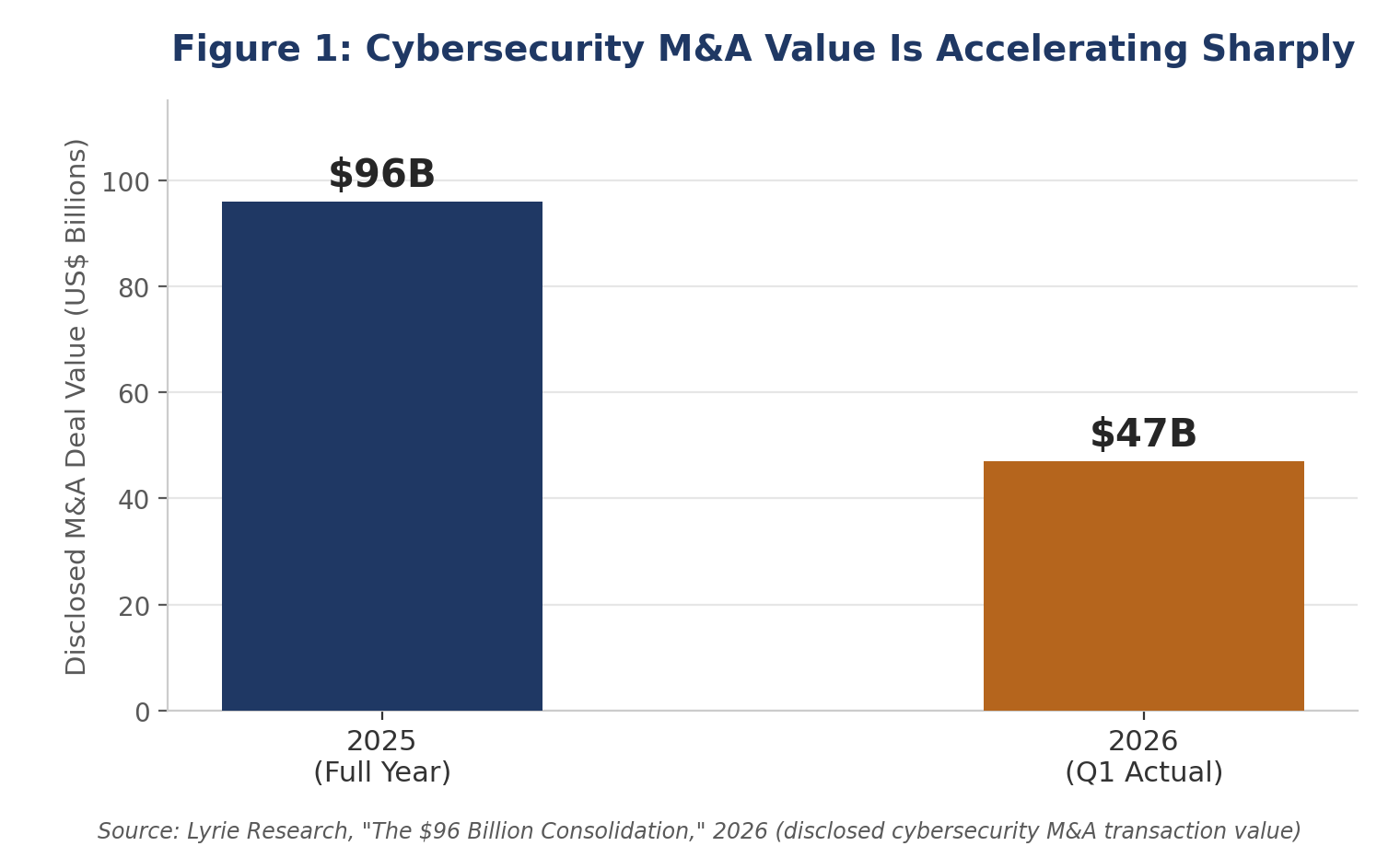
Figure 1: Disclosed global cybersecurity M&A deal value, full-year 2025 versus Q1 2026. Source: Lyrie Research, "The $96 Billion Consolidation," 2026.
Platformization Is the Strategy, Not a Buzzword
The clearest proof point is Palo Alto Networks' agreement, disclosed via SEC filing and press release, to acquire identity-security leader CyberArk for approximately $25 billion in cash and stock, a 26% premium to CyberArk's unaffected trading average, which closed in February 2026 after clearing US, EU, UK and Israeli regulatory review. Forrester principal analyst Geoff Cairns characterized the deal as taking consolidation in the identity and access management market to an entirely new level, one that reshapes the broader cybersecurity industry and not just the IAM category alone. The same quarter saw Google complete its $32 billion acquisition of cloud-security firm Wiz, the largest cybersecurity acquisition on record, after an initial $23 billion offer was rejected in 2024. Enterprise security teams that once managed 60 to 80 separate point tools are the reason these deals pencil out: platform vendors are buying the missing pieces of a unified stack because building them organically takes years buyers no longer want to wait for.
Regulation Is Compressing the Field From Below
Consolidation pressure is not only commercial, it is regulatory. The European Commission's NIS2 Directive, now moving into active enforcement across EU member states in 2026, expands cybersecurity obligations to 18 critical sectors and, even after the Commission's January 2026 simplification proposal, still covers an estimated 28,700 companies including more than 6,200 micro and small enterprises. Meeting these obligations, alongside parallel US frameworks such as CIRCIA incident-reporting rules, is expensive for smaller, single-purpose vendors to satisfy alone, and Solganick's own deal data shows escalating compliance requirements directly driving the roll-up of dedicated governance, risk and compliance advisory firms into larger platforms better equipped to absorb the cost of continuous certification and audit.
Spending Keeps Rising Even as the Vendor Count Falls
Consolidation is happening into a growing market, not a shrinking one, which is precisely why acquirers are willing to pay record premiums. Gartner forecasts worldwide end-user spending on information security to reach $240 billion in 2026, up 12.5% from $213 billion in 2025 and $193 billion in 2024, with cloud security the fastest-growing subsegment. That expanding budget pool is what lets platform vendors justify multi-billion-dollar acquisitions: every enterprise dollar redirected from a niche point tool to a consolidated platform still counts as growth for the acquirer, even as the number of independent vendors competing for that dollar shrinks.
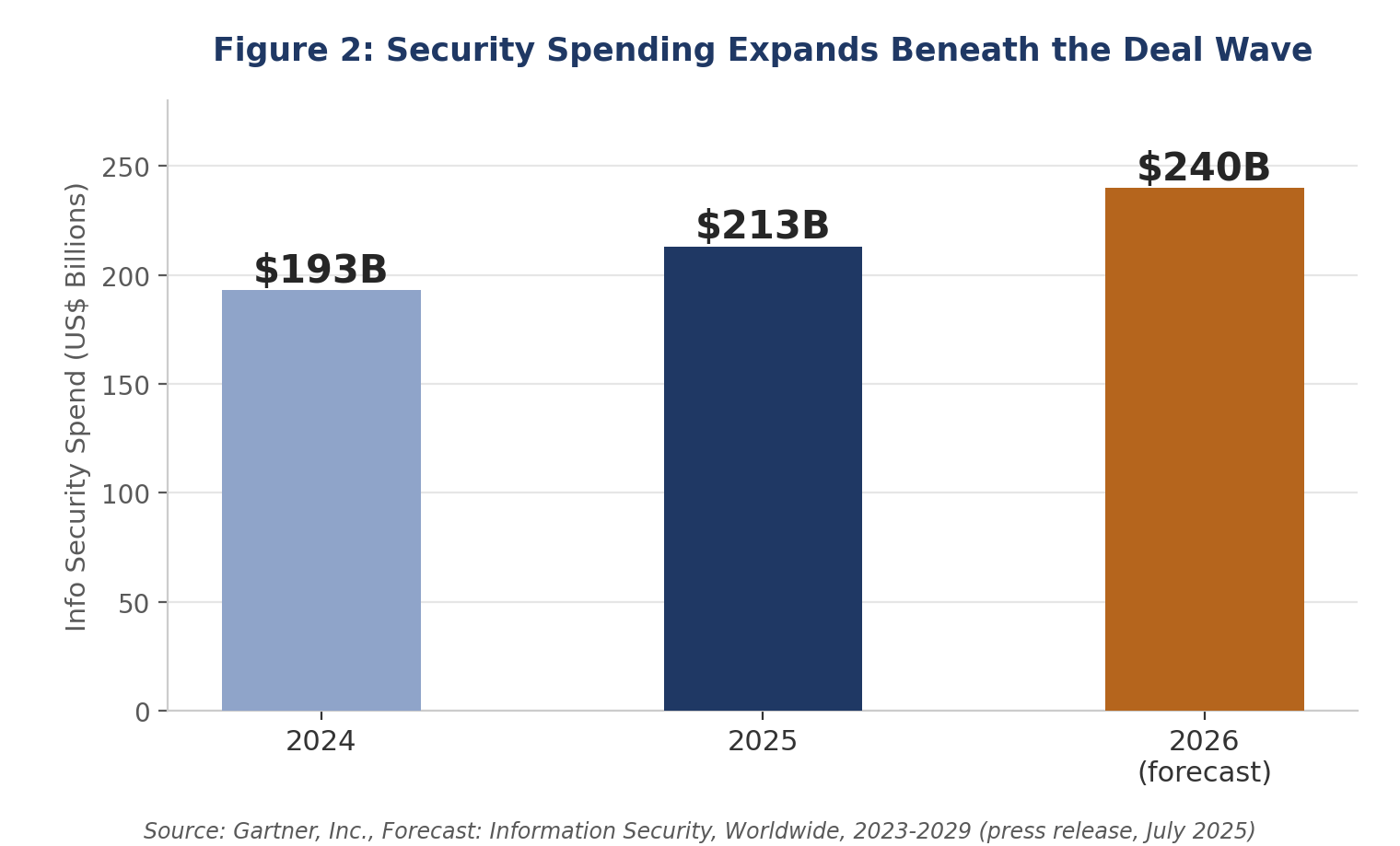
Figure 2: Worldwide end-user spending on information security, 2024-2026. Source: Gartner, Inc., Forecast: Information Security, Worldwide, 2023-2029.
What This Means for Buyers and Challengers
For enterprise security teams, the practical upside is fewer contracts and tighter integration; the risk is concentration, since a security incident or outage at a single mega-platform now has a far larger blast radius than it did when tools were siloed. For smaller, independent vendors, the message is stark: category leadership in a specific niche, such as identity, cloud posture management or OT security, is now the clearest path to an acquisition premium, while undifferentiated point tools risk being squeezed out entirely as the mid-market of the vendor landscape thins. Expect the next eighteen months to bring more billion-dollar-plus transactions concentrated in identity, cloud-native application protection and AI-security governance, the three gaps platform vendors are still racing to close