Biomass and Waste-to-Energy: A Realistic Look at Scalability
A Sector That Has Grown Steadily, Not Explosively
Global bioenergy installed capacity reached 151 gigawatts in 2024, according to the World Bioenergy Association's twelfth annual Global Bioenergy Statistics Report. That is real growth, almost tripling across Asia over the past decade on the strength of China, India and Japan, and France added enough new capacity in 2024 alone to reach 3.35 gigawatts, a 60% year-on-year increase. But the same report records overall capacity growth slowing to just 3% in 2024, after what it calls already weak additions in 2023, a marked deceleration from the roughly 8 gigawatts added annually across the prior five years tracked by the IEA. Bioenergy generated 711 terawatt-hours of electricity in 2024, representing 7% of global renewable output, with Asia responsible for half of that total. The picture is one of a mature, functioning sector rather than a fast-scaling one, and the reasons why are more structural than cyclical.
The Cautionary Tale: China Built More Capacity Than It Has Waste
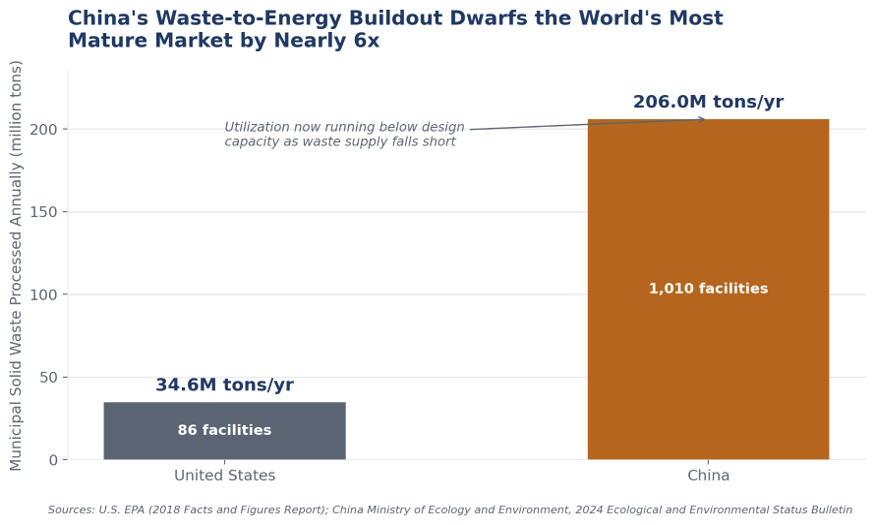
The starkest scalability lesson in this sector right now comes from China, not from a shortage of investment but from too much of it. China's daily household-waste incineration capacity reached 1.16 million tonnes by 2024, according to the country's Ministry of Ecology and Environment, comfortably ahead of the 800,000-tonne-per-day target originally set for 2025. The number of incineration plants grew from 104 in 2010 to roughly 1,010 by October 2024, nearly half the global total on its own. Yet according to reporting from Dialogue Earth and China's own Science and Technology Daily, many of these plants are now running at around 60% of design capacity, and operators are reportedly importing waste from other regions to keep feedstock flowing. Investment outran the underlying resource. That is the risk case study every other market building out waste-to-energy at speed needs to study before replicating the model.
Why the Economics Run Differently From Solar and Wind
Feedstock, Not Capital, Is the Real Ceiling
Solar and wind scale by adding more panels and turbines against an effectively unlimited resource. Biomass and waste-to-energy scale against a finite, geographically fixed supply of combustible material, and that distinction shows up directly in the economics. McKinsey's analysis for the Energy Transitions Commission is explicit that bioenergy use should be limited specifically because of constraints on the sustainable supply of biomass, particularly where alternative low-carbon fuels already exist. BloombergNEF's 2024 feedstock analysis, cited in Macquarie's climate research, found that even waste-based feedstocks positioned as the sustainable alternative to virgin crops are themselves limited and face scalability challenges, with Europe and the U.S. increasingly dependent on imported supply, notably from China, to meet demand — a dependency that adds transport emissions and price volatility to a resource that was supposed to be sourced close to where it's burned. Processing costs compound the constraint: reviewed U.S. gasification systems run $40 to $100 per ton of municipal solid waste in operations and maintenance alone, on top of capital costs of $7,000 to $11,500 per kilowatt for a 15-megawatt facility, figures that make new-build economics far less forgiving than a comparable solar or onshore wind project today.
What Waste-to-Energy Actually Delivers Today
In the United States, the picture has stayed essentially flat for a decade. The EPA counts 75 to 86 operating waste-to-energy facilities processing roughly 34.6 million tons of municipal solid waste annually, generating about 550 kilowatt-hours per ton at typical revenues of $20 to $30 per ton. The Energy Information Administration puts total output at around 14,000 gigawatt-hours a year, consistently under 1% of national electricity generation, valuable as steady baseload but never positioned to scale toward a major supply share. Corporate scale tells a similar story: Reworld, the former Covanta and the largest single U.S. operator, processed 20.8 million tons of waste across 37 facilities in 2024, essentially flat year over year. Veolia, operating around 60 waste-to-energy facilities globally, treated 65 million tonnes of waste and produced 42 million megawatt-hours of energy across its full portfolio in 2024, a business built on operational consistency rather than rapid expansion.
What Would Actually Have to Change for Real Scale
Meaningful expansion depends less on new combustion technology than on solving the feedstock-logistics problem that both McKinsey and BloombergNEF flag: aggregating dispersed, low-density waste and agricultural residue cost-effectively, and doing so without competing against recycling, composting, or food production for the same material. China's experience suggests that permitting and capital are no longer the binding constraint in fast-growing markets — securing a reliable, geographically matched fuel supply is. Where that logistics problem is solved, as in Veolia's and Reworld's long-established, densely populated service territories, waste-to-energy performs as a dependable, low-volatility asset rather than a growth story, generating steady baseload revenue year after year with minimal weather-driven swings. Where it isn't, capacity sits idle regardless of how modern the plant is, and the shortfall shows up as compressed margins rather than an outright plant closure, since most facilities are contracted on long-term municipal tipping-fee agreements that cushion the immediate financial impact.