
The Automotive Chip Shortage Aftermath: Has the Industry Actually Fixed It?

The numbers say the 2021 chip crisis is over. Global light-vehicle production losses tied to semiconductor shortages fell from an estimated 9.5 million units in 2021 to roughly 524,000 units in 2023, according to S&P Global Mobility a 94% reduction that automakers and suppliers have cited as proof the industry built real resilience. Then came October 2025, when a single company dispute nearly halted production lines across three continents, and the answer became far less certain.
What the Recovery Data Actually Shows
S&P Global Mobility's tracking is the most cited benchmark for how severe the original crisis was and how much of it has genuinely resolved. The research firm's analysis puts 2021 losses at 9.5 million vehicles, with the third quarter alone accounting for 3.5 million of that total, followed by another 3 million units lost in 2022 before volumes fell sharply. By 2023, S&P Global Mobility's own reporting describes the shortage as “mostly over,” while cautioning in the same analysis that demand still exceeds supply for several chip categories and that pressure on the automotive supply chain remains. That qualifier turned out to matter more than the headline recovery figure.
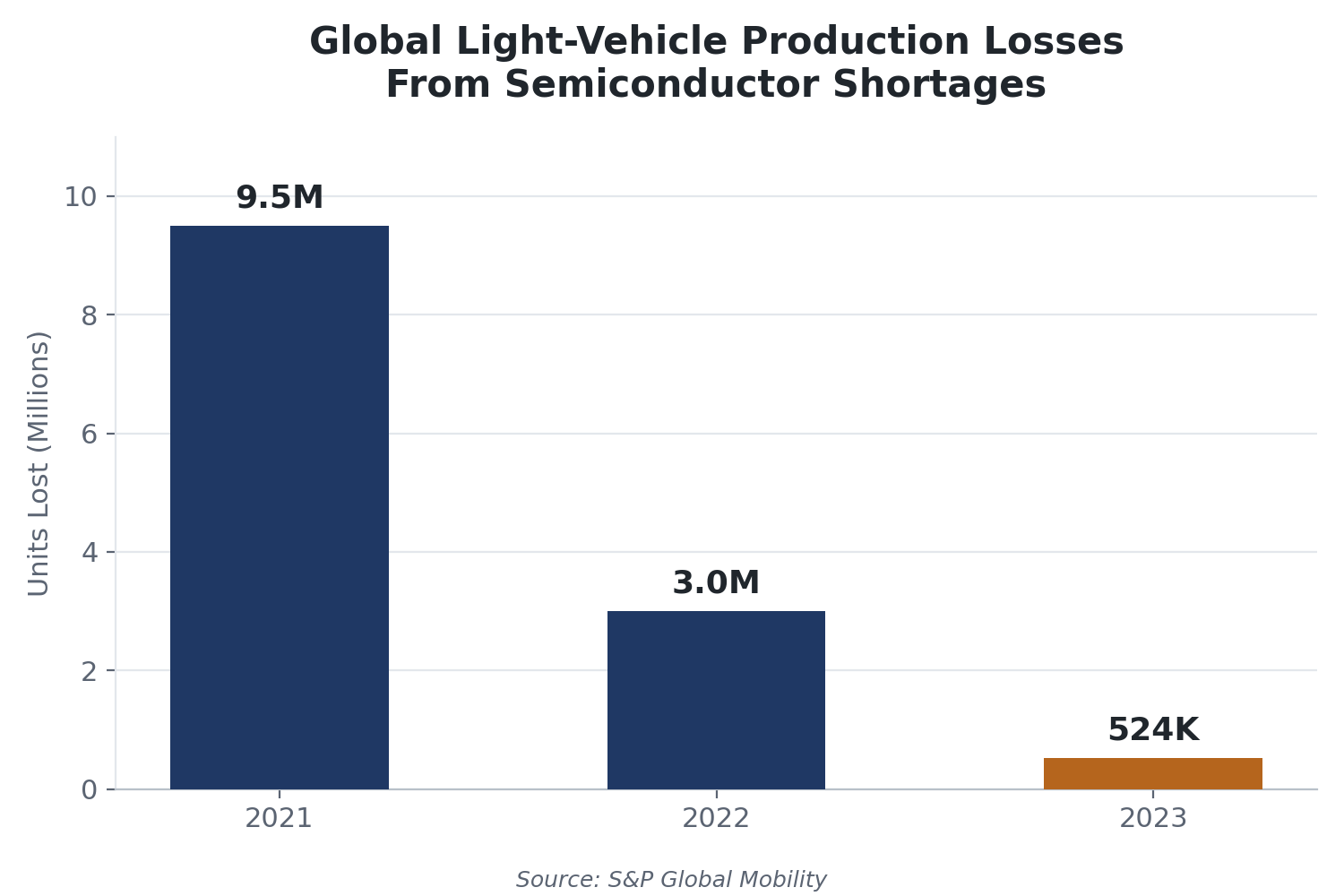
Figure 1: Global light-vehicle production losses from semiconductor shortages, 2021–2023. Source: S&P Global Mobility.
The Nexperia Crisis Exposed the Gap
In late September 2025, the U.S. Department of Commerce's Bureau of Industry and Security expanded its Entity List rules in a way that pulled Nexperia a Netherlands-based chipmaker owned by China's Wingtech Technology into export-control scope. Weeks later, the Dutch government invoked its Goods Availability Act to take direct control of Nexperia over governance concerns, and China's Ministry of Commerce retaliated with export restrictions on Nexperia's China-manufactured components. The dispute cut off supply of foundational chips transistors, diodes, and power-management components that are technologically simple but nearly impossible to requalify on short notice, since automotive-grade parts require lengthy certification cycles that consumer-grade substitutes cannot skip.
Company Disclosures Show the Real Cost
The financial impact showed up directly in earnings. Honda's own investor materials for its first-half fiscal 2025 results disclosed that semiconductor shortages tied to the Nexperia dispute were expected to reduce full-year operating profit by approximately $960 million, with company leadership explicitly citing “restrictions and adjustments” to North American production. Nissan cut output of its top-selling Rogue model in Japan due to limited Nexperia chip supply, according to Reuters reporting, while Germany's automotive industry association warned of “elevated risks to supply, particularly for the first quarter” of 2026 as Volkswagen, BMW, and Mercedes-Benz scrambled to secure alternative components.
A Different Kind of Shortage Is Emerging
Even as the Nexperia dispute has partially eased, a separate and arguably more structural shortage has taken hold in automotive memory chips. Automotive DRAM prices for legacy DDR4 and LPDDR4 types used widely in infotainment and driver-assistance systems rose approximately 70% year-over-year in early 2026, according to S&P Global Mobility's automotive insights research, with roughly 90% of global automotive DRAM production concentrated among Micron, Samsung, and SK Hynix. Unlike the 2021 crisis, this shortage is not a pandemic-driven demand shock; it stems from memory manufacturers prioritizing AI data-center orders, which command far higher margins than automotive contracts.
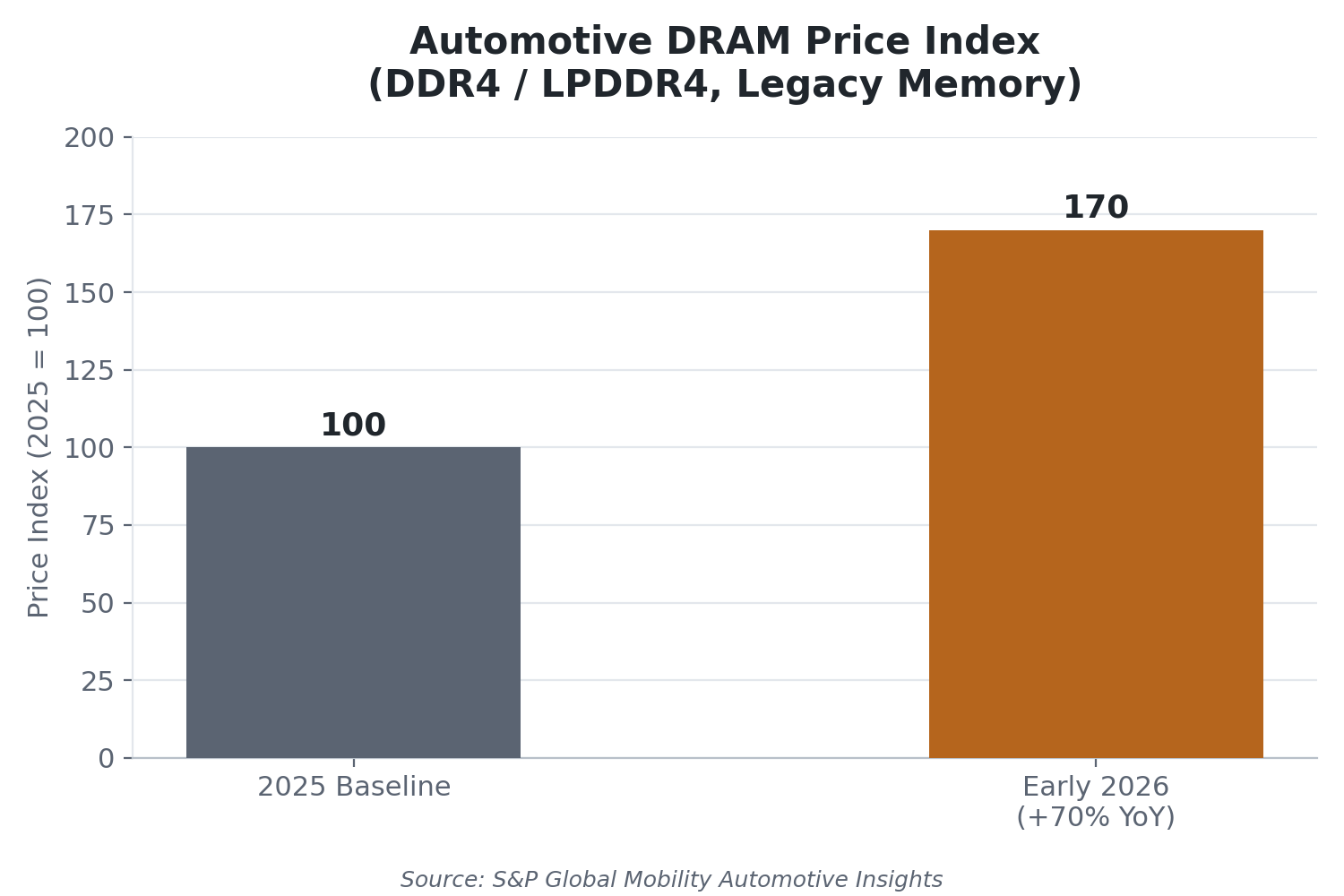
Figure 2: Automotive DRAM price index, legacy memory types, 2025 baseline vs. early 2026. Source: S&P Global Mobility Automotive Insights.
What Consulting Firms Say About Structural Risk
McKinsey's research on semiconductor supply strategy finds that mature-node chips the very category most exposed to the Nexperia-style disruption are projected to account for 67% of automotive wafer demand by 2030, meaning the industry's exposure to concentrated, hard-to-substitute suppliers is growing rather than shrinking. Deloitte's 2026 technology industry outlook describes the chip sector's resilience as facing “an unprecedented test,” pointing to export controls and trade restrictions that now touch a broader footprint of equipment, materials, and components than they did just two or three years ago. AlixPartners' 23rd annual Global Automotive Outlook, released in June 2026, frames the response in structural terms: automakers are pursuing regionalized, “China for China” style supply architectures precisely because global, single-source supply chains proved unable to absorb a geopolitical shock the way they were designed to absorb a demand shock.
So, Has the Industry Actually Fixed It?
The evidence points to a qualified no. Automakers have genuinely solved the 2021 problem: better demand forecasting, deeper supplier visibility, and diversified sourcing cut production losses by roughly 94% between 2021 and 2023. But the Nexperia crisis demonstrated that a single company dispute, layered on top of export-control policy, can still threaten production within weeks — and the emerging DRAM shortage shows that automakers remain price-takers whenever a higher-margin industry like AI data centers competes for the same fabrication capacity. The industry did not eliminate its structural vulnerability to concentrated, geopolitically exposed suppliers; it only got faster at absorbing the specific kind of shock that hit it in 2021.