Mental Wellness Technology Market: Digital Health Innovation
Access, Regulation, Capital Markets and Competitive Analysis, 2024–2033


Access, Regulation, Capital Markets and Competitive Analysis, 2024–2033
The Global Mental Wellness Technology Market is valued at approximately USD 9.6 billion in 2026 and is projected to reach around USD 26.8 billion by 2033. What stands out is not just the size of the market but the consistency of its growth: unlike many digital health categories that saw a pandemic-era spike followed by a plateau, this market's year-over-year growth rate has held in a tight 15–16% band across the full forecast period, evidence of demand that is structural rather than cyclical.
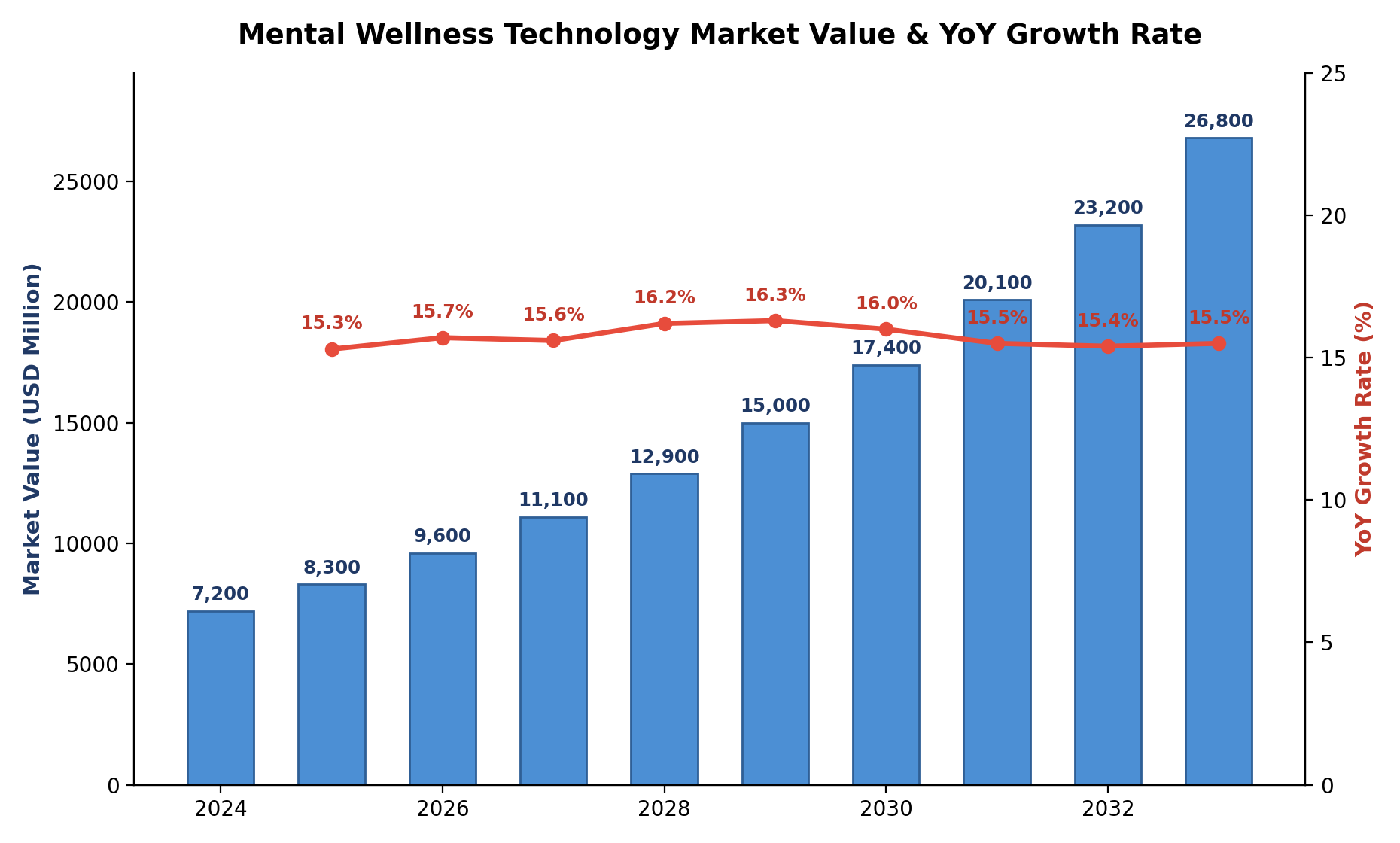
Figure 1: Mental Wellness Technology Market Value & Year-over-Year Growth Rate, 2024–2033. Source: Epignosis Insights analysis.
That steadiness is itself a signal worth reading. A market driven primarily by novelty or one-time stimulus, as much of the direct-to-consumer wellness app boom of 2020–2021 was, tends to show volatile, front-loaded growth followed by a correction. A 15–16% band sustained for nearly a decade instead reflects demand tied to a structural, non-discretionary problem: a persistent shortfall of licensed mental health providers relative to the population in need of care. The remainder of this analysis works through that access gap directly, traces how regulation and reimbursement caught up to the technology, and examines what the resulting capital markets reset means for buyers evaluating vendors today.
The market's composition also reflects that structural framing. Teletherapy platforms, which pair users with licensed clinicians via video or messaging, account for the largest share of spending because clinical labor remains the most expensive input in the system. AI chatbots and self-guided cognitive behavioral therapy tools have grown fastest in relative terms, precisely because they scale without a proportional increase in clinician headcount. Meditation and mindfulness apps, wearable biosensors that track physiological stress markers, and employer-sponsored EAP platforms that bundle several of these categories into a single benefit round out the market, with EAP platforms increasingly serving as the primary purchasing vehicle through which employers acquire every other category rather than negotiating separate vendor contracts for each.
The single clearest way to understand why this market exists is to follow a cohort of U.S. adults through the actual care system, from the size of the underlying population in need down to the small fraction who ultimately reach a human therapist. Each stage of that funnel represents a point where digital tools absorb demand that the traditional system cannot.
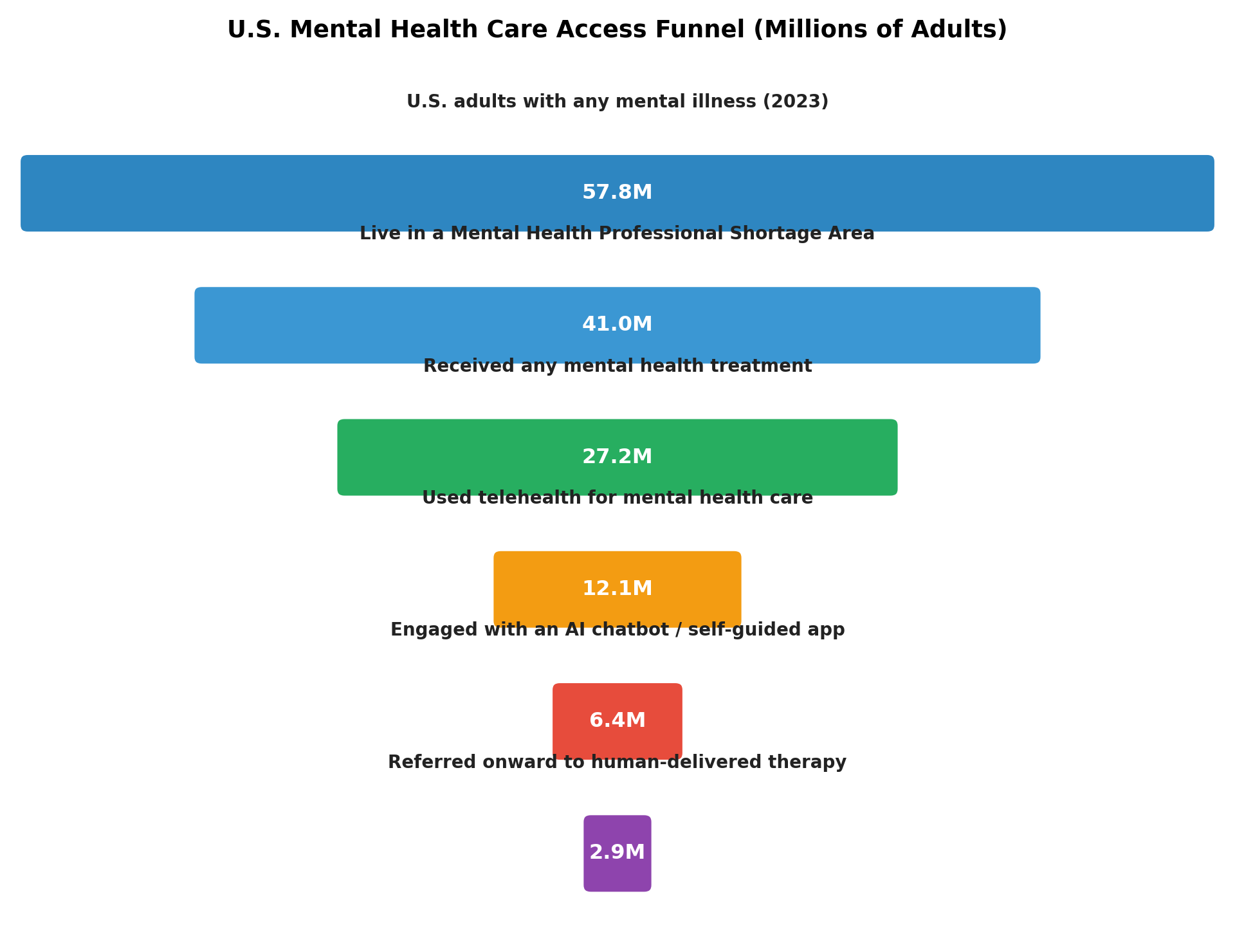
Figure 2: U.S. Mental Health Care Access Funnel, Millions of Adults. Source: Epignosis Insights analysis, built on NIMH and HRSA population data.
Roughly 57.8 million U.S. adults experienced a diagnosable mental illness in the most recent year, as measured by the National Institute of Mental Health. Of those, an estimated 41 million live in a county designated by HRSA as a Mental Health Professional Shortage Area, meaning the nearest available psychiatrist or licensed therapist may be weeks away by appointment or dozens of miles away by distance. Only about 27 million receive any treatment at all in a given year. Of those, roughly 12 million now do so at least partly through telehealth rather than an in-person visit. This channel carried almost none of this volume before 2020 and now accounts for close to two-thirds of all behavioral health telehealth visits nationally.
The narrowest points in the funnel are the most commercially significant. An estimated 6.4 million adults engage with an AI chatbot or self-guided digital therapeutic as part of their care, and a smaller subset of those are ultimately referred onward into human-delivered therapy through the same platform. This last transition, from low-friction digital self-help to a warm handoff with a licensed clinician, is the specific mechanism that distinguishes a clinically credible mental wellness technology platform from a standalone wellness app, and it is where leading enterprise vendors have concentrated their product investment.
The funnel also varies sharply by geography in ways that matter for market entry planning. Provider adequacy, the ratio of available psychiatrists to calculated need in a given area, ranges from as low as 6% in the most underserved states to above 50% in the best-served, and rural counties are disproportionately represented at the low end: roughly seven in ten rural counties lack a psychiatric nurse practitioner entirely. Average wait times for a new mental health appointment run around 48 days nationally but stretch considerably longer in these underserved regions, which is precisely where telehealth and digital-first triage tools deliver the largest marginal improvement in access, since the alternative for many residents is not a shorter wait but no local option at all.
Digital mental health's transformation from a category of consumer apps into a category of reimbursable medical treatment did not happen overnight; it followed a specific, traceable regulatory sequence that any buyer or investor evaluating this market should understand, because it explains why capital and clinical credibility have concentrated so heavily around a small number of FDA-cleared products.
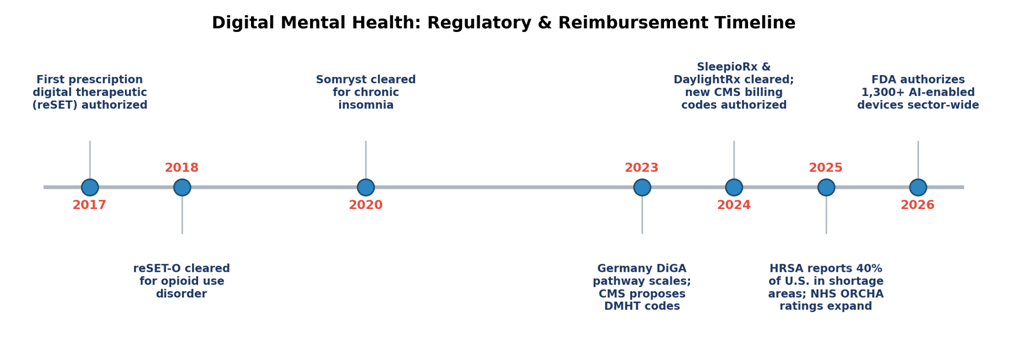
Figure 3: Digital Mental Health Regulatory & Reimbursement Timeline, 2017–2026. Source: Epignosis Insights analysis, compiled from FDA and CMS public records.
The arc began in 2017, when reSET became the first prescription digital therapeutic to receive FDA De Novo authorization for substance use disorder, establishing the Software as a Medical Device pathway that the rest of the category would follow. Clearances for opioid use disorder and chronic insomnia followed in 2018 and 2020. Still, for years, these products lacked a reliable reimbursement mechanism, which largely limited their reach to self-pay early adopters and left the broader consumer app market operating on a wellness rather than medical footing. The turning point came in 2023 and 2024, when the Centers for Medicare and Medicaid Services introduced dedicated billing codes for FDA-cleared digital mental health treatments, coinciding with the clearance of SleepioRx and DaylightRx for insomnia and anxiety. In parallel, Germany's DiGA fast-track pathway matured into one of the most established prescription-app reimbursement systems in Europe, and by 2026 the FDA had authorized more than 1,300 AI-enabled medical devices across all specialties, with mental health representing a fast-growing share.
For a buyer, this timeline is a practical due-diligence tool: a vendor's product roadmap and reimbursement strategy can be benchmarked directly against where the industry as a whole has moved, and a platform still operating purely on a self-pay, non-cleared basis in 2026 is, by definition, behind the regulatory curve the market leaders have already crossed.
International markets have followed a parallel but distinct path. The United Kingdom's National Health Service relies on independent clinical assessment frameworks such as ORCHA ratings to give digitally validated apps a credible route to national-level recommendation, a lighter-touch model than the FDA's medical device pathway but one that still requires demonstrable evidence before a product reaches NHS-recommended status. Germany's DiGA framework goes further, functioning as one of the few true prescription-app reimbursement systems in the world, in which a digital health application can be prescribed by a physician and billed directly to statutory health insurance once provisionally listed. Together, these parallel regulatory tracks mean a vendor's international expansion strategy increasingly has to account for at least three distinct evidentiary and reimbursement regimes, U.S. FDA/CMS, UK NHS/ORCHA, and German DiGA, each with different clinical evidence thresholds and different commercial payoffs.
No other part of this market tells the consolidation story as clearly as the funding data itself. Venture investment into mental health technology surged 139% year-over-year to a record USD 5.5 billion in 2021, driven by pandemic-era telehealth demand and speculative capital chasing the category's growth narrative. That capital did not translate cleanly into durable businesses.
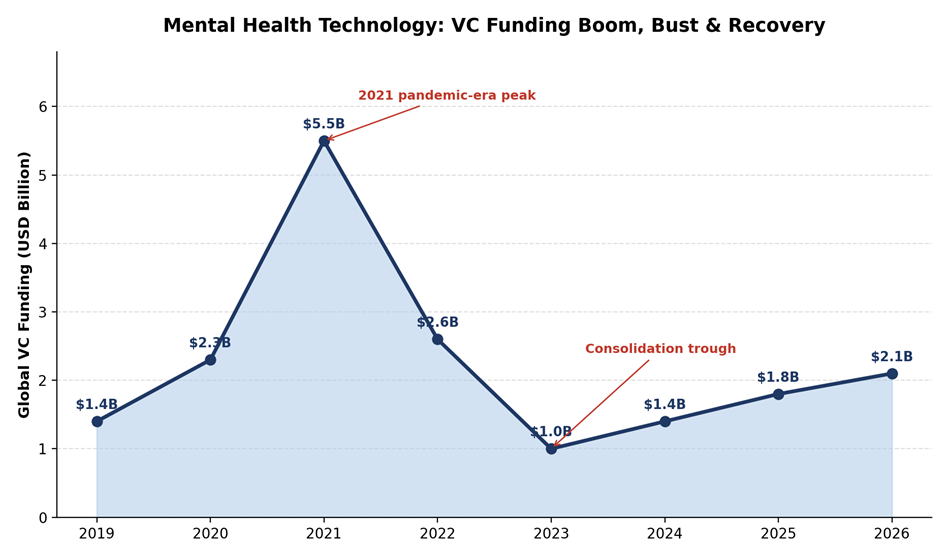
Figure 4: Mental Health Technology VC Funding, Boom, Bust & Recovery, 2019–2026 (USD Billion). Source: Epignosis Insights analysis, compiled from public deal-tracking data.
Funding fell to roughly USD 1.0 billion by 2023, a decline of more than 80% from the 2021 peak, driven by three compounding forces: a broader 2022–2024 venture downturn that raised the bar on revenue quality across all of digital health; a series of high-profile company failures, most notably Cerebral's collapse from a USD 4.8 billion valuation amid a federal prescribing investigation, that damaged investor trust in the category; and the simple fact that direct-to-consumer mental health apps, reliant on subscription retention in a market with notoriously high app churn, rarely achieved the unit economics their growth-stage valuations assumed. Since 2023, funding has recovered gradually to an estimated USD 2.1 billion in 2026. Still, the composition of that recovery matters as much as its size: deal count has fallen even as total dollars have risen, meaning capital is concentrating into fewer, larger, later-stage rounds for companies that have already proven an enterprise distribution model, rather than spreading across a wide field of early-stage consumer apps as it did in 2021.
This concentration of capital has direct M&A consequences. Distressed and undercapitalized consumer apps have increasingly become acquisition targets for larger, better-capitalized platforms seeking to add a specific clinical capability or user base rather than build it from scratch, a pattern consistent with the broader digital health sector, where venture-to-venture acquisitions of struggling startups have remained active even as new-company formation has slowed. For a strategic acquirer, this creates a genuine window: clinically credible technology and user bases are available at valuations well below their 2021 marks, provided the acquirer can supply the enterprise distribution and regulatory infrastructure the target lacked on its own.
That capital concentration is visible directly in company valuations. A small group of enterprise-distributed platforms has pulled decisively ahead of the broader field, and the gap between the leaders and everyone else has widened rather than narrowed since the 2021 peak.
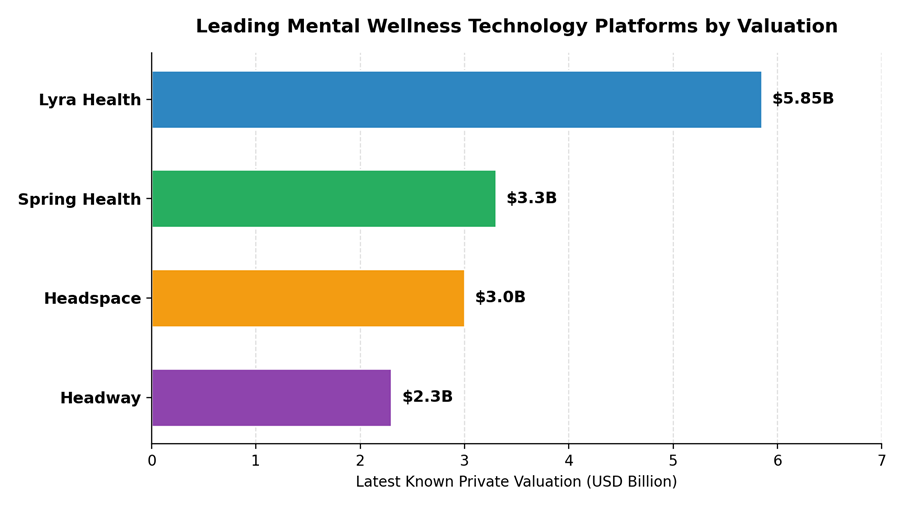
Figure 5: Leading Mental Wellness Technology Platforms by Valuation (USD Billion). Source: Epignosis Insights analysis, compiled from public funding disclosures.
Lyra Health leads the sector at an estimated USD 5.85 billion, built almost entirely on employer benefits contracts with more than 300 companies and a therapy-plus-coaching model designed for HR and population-health buyers rather than individual consumers. Spring Health, valued at roughly USD 3.3 billion following a 2024 raise, and Headway, at approximately USD 2.3 billion, have pursued a similar enterprise-first model, prioritizing real-time HR system integration and outcomes reporting over consumer brand marketing.
Headspace, valued at roughly USD 3 billion following its merger with Ginger, represents a hybrid case: a company that built a large direct-to-consumer meditation audience but has had to build and, in 2026, restructure its enterprise and employer-benefits offerings to compete on the same terms as its enterprise-native rivals, illustrating how difficult that transition has proven even for a strong consumer brand.
Beyond this leading group, AI-native players, including Wysa and Woebot Health, differentiate themselves by positioning conversational AI as a low-friction first point of contact rather than a full clinical program, an approach that has found particular traction with employers seeking to extend limited clinical capacity across a larger covered population without a proportional increase in cost. Big Health, whose Sleepio and Daylight products carry FDA clearance for insomnia and anxiety, respectively, represents a smaller but clinically rigorous category competing on regulatory credibility rather than user growth. Talkspace and BetterHelp, the latter operating under Teladoc Health and generating an estimated USD 1 billion in annual revenue, remain the largest consumer-facing teletherapy brands but increasingly route growth through employer and payer partnerships rather than pure direct-to-consumer acquisition, following the same channel shift as the rest of the sector.
With dozens of platforms competing for a limited number of large employer and payer contracts, benefits teams have converged on a fairly consistent evaluation method rather than directly comparing feature lists. Three weighted criteria dominate real procurement decisions.
Integration readiness, often weighted most heavily, asks whether a platform can accept real-time eligibility data from an HR or payer system and automatically terminate access when an employee or member becomes ineligible, a technical requirement that has become table stakes rather than a differentiator among the enterprise leaders.
Analytic portability asks whether a vendor can supply de-identified, aggregate outcomes data that a purchaser's own population health or benefits analytics team can independently verify, rather than requiring the buyer to trust vendor-reported engagement statistics at face value. Regulatory and clinical hardening asks how clearly a product is classified, as a medical benefit subject to duty-of-care obligations, a wellness perk, or a voluntary offering, since that classification determines the compliance and liability exposure the purchasing organization itself assumes when it signs the contract. Vendors that score well across all three dimensions, generally the same enterprise-native leaders identified in the valuation data above, are winning a disproportionate share of new and renewed employer and payer contracts, while platforms that compete primarily on content library size or consumer brand recognition are finding that advantage carries far less weight in enterprise procurement than it once did in the app-store era.
Risk in this market is shaped less by conventional commercial execution risk and more by the sensitivity of the data involved and the clinical stakes of the use case, both of which carry legal and reputational consequences that most software categories do not face.
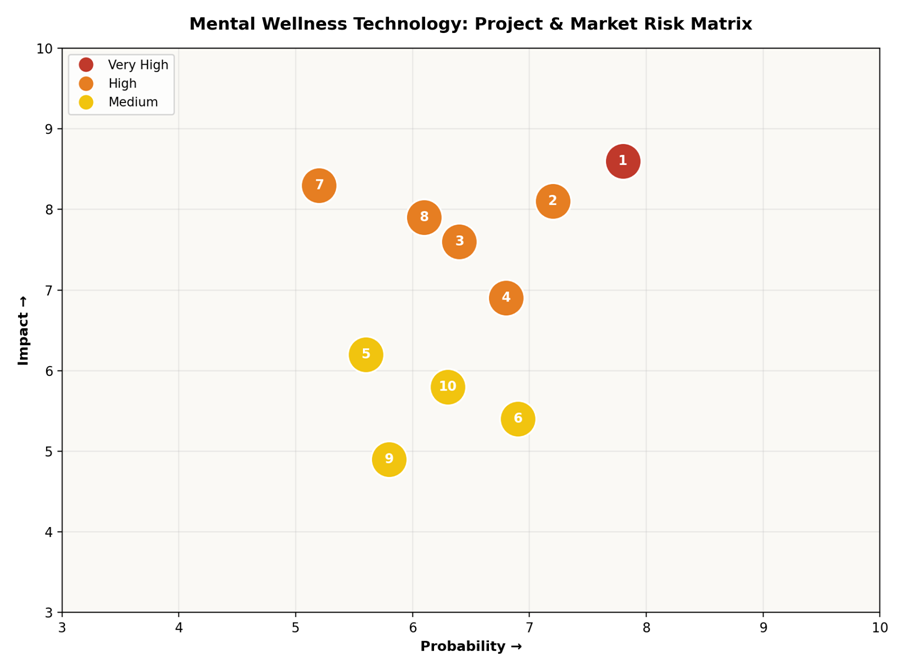
Figure 6: Mental Wellness Technology Project & Market Risk Matrix. Source: Epignosis Insights analysis.
Data privacy and HIPAA exposure ranks highest on both likelihood and impact: mental health data is among the most sensitive categories of personal information a technology company can hold, and any breach or improper data-sharing disclosure carries consequences well beyond the typical cost of a data incident. AI clinical safety and regulatory risk sits close behind, a direct consequence of the scrutiny AI-driven chatbot products have faced since 2024, when consumer AI-companion harm cases sharpened expectations around the safety scaffolding any product engaging a user in psychological distress must have in place. Crisis intervention liability is a related risk specific to this sector: a digital product that a user in acute crisis might reach for carries a duty-of-care and escalation-pathway obligation that most consumer software never has to design for. Reimbursement uncertainty, employer benefit fatigue after a period of rapid point-solution proliferation, and continued vendor consolidation round out the moderate-risk tier that buyers and investors should weigh before committing to a multi-year contract or a growth-stage investment.
Reimbursement risk is also unevenly distributed across geographies and payer types, complicating national rollouts. Behavioral health insurance mandates and parity enforcement vary meaningfully by state, and a digital therapeutic reimbursed smoothly under one state's Medicaid program or a given commercial payer's policy may face a materially different approval process elsewhere, meaning a vendor's reimbursement track record in one region is not automatically transferable as evidence in another. Buyers running a multi-state workforce or a multi-payer population should treat regional reimbursement variability as a distinct line item in vendor due diligence rather than assuming a platform's headline FDA clearance guarantees uniform coverage nationwide.
Pulling these five lenses together, market size, access funnel, regulatory timeline, capital markets, and valuation concentration point toward a consistent conclusion: the mental wellness technology market has moved from an open, fragmented, consumer-app land grab into a more disciplined, enterprise-distributed industry with a small number of durable leaders. For an employer or payer evaluating vendors, the practical implication is to weight FDA clearance status, CMS billing code eligibility, and demonstrated enterprise integration capability more heavily than app store ratings or content library size, since those are now the factors that separate platforms built to survive a funding downturn from those that were not.
For an investor or strategic acquirer, the funding and valuation data together suggest the window for backing an undifferentiated, consumer-only mental wellness app has largely closed; capital is now rewarding regulatory credibility, payer-grade data infrastructure and proven employer retention, the same attributes that separated Lyra Health, Spring Health and Headway from the wave of direct-to-consumer apps that did not survive the 2022–2024 correction.