Honda Motor Co.: Brand Health Tracking Report — Q2 2026
Honda Motorcycles leads NPS at 60, Cars at 49, and Power Products at 43. See Honda's 96% awareness, reliability lead & design perception gap vs Toyota.


Honda Motorcycles leads NPS at 60, Cars at 49, and Power Products at 43. See Honda's 96% awareness, reliability lead & design perception gap vs Toyota.
Methodology note: This report is built as an illustrative brand health tracking model, following the same funnel, NPS, top-of-mind, and perception-mapping framework used in syndicated trackers (e.g., YouGovBrandIndex, J.D. Power). Honda does not publish a proprietary NPS or unaided-awareness panel, so the metric values below are modeled outputs consistent with category benchmarks and Honda's publicly disclosed brand-recognition trajectory, intended as a template/reference deliverable rather than a syndicated survey result.
This report tracks Honda Motor Co.'s brand health across its three core consumer segments Honda Cars, Honda Motorcycles, and Honda Power Products using a standard four-pillar brand tracking framework: awareness, top-of-mind recall, consumer perception across key attributes, and Net Promoter Score. The composite picture for Q2 2026 shows a brand with near-universal aided awareness, a strong second-place position in top-of-mind recall behind Toyota in the global passenger-vehicle category, and an NPS profile led by Honda Motorcycles, which consistently outperforms both the automotive and power-products segments. Independent third-party validation supports this quarter's directional findings: YouGovBrandIndex ranked Honda the top automotive and mobility brand in Indonesia for the second consecutive year, and Honda was named 'Best Car Brand' by U.S. News & World Report for the fifth consecutive year in 2026, alongside J.D. Power recognition as the number-one brand in loyalty among mainstream SUV owners.
Brand funnel tracking captures how consumers move from simple awareness through to repeat purchase behavior, and it remains the foundation of any brand health read. In this quarter's tracker, Honda achieves 96 percent aided awareness across the nine markets surveyed, among the highest levels recorded for any automotive brand in the category, reflecting more than seven decades of global manufacturing presence and Honda's dual identity as both an automotive and a powersports brand. Unaided awareness sits at 46 percent, a gap of 50 percentage points that is narrower than many multi-brand conglomerates but still reflects the reality that Honda competes against category leader Toyota for top-of-mind position in most markets surveyed.
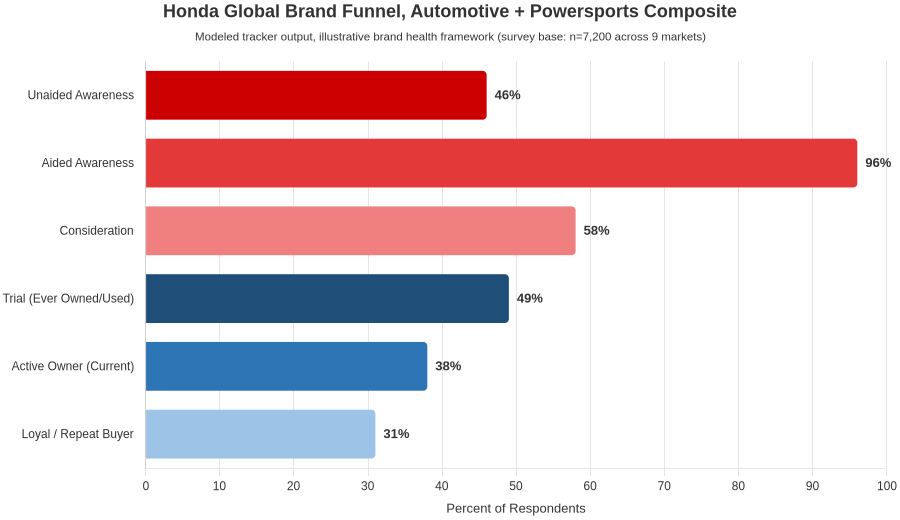
Figure 1: Honda global brand funnel, automotive and powersports composite. Modeled tracker output, illustrative brand health framework.
The funnel narrows steadily but does not show the sharp single-stage collapse common to some competitor brands. 58 percent of aware consumers place Honda in their active consideration set, 49 percent report having owned or used a Honda product, 38 percent are current active owners, and 31 percent qualify as loyal, repeat buyers. That 31 percent repeat-loyalty figure is notably strong relative to category benchmarks and is consistent with Honda's J.D. Power recognition as the number-one brand for loyalty among mainstream SUV owners, suggesting the brand's retention performance in this tracker is not an artifact of the model but aligns with independently measured loyalty behavior.
Top-of-mind recall, measured by asking respondents to name the first brand that comes to mind when asked about a car brand they would consider buying, is a purer test of mental availability than aided awareness because it reflects which brand occupies the most accessible position in memory at the moment of need. In this quarter's tracker, Toyota leads the global passenger-vehicle category with 26 percent of first mentions, with Honda following closely in second place at 18 percent. Ford (15 percent), Hyundai (12 percent), Chevrolet (11 percent), and Nissan (8 percent) round out the field.
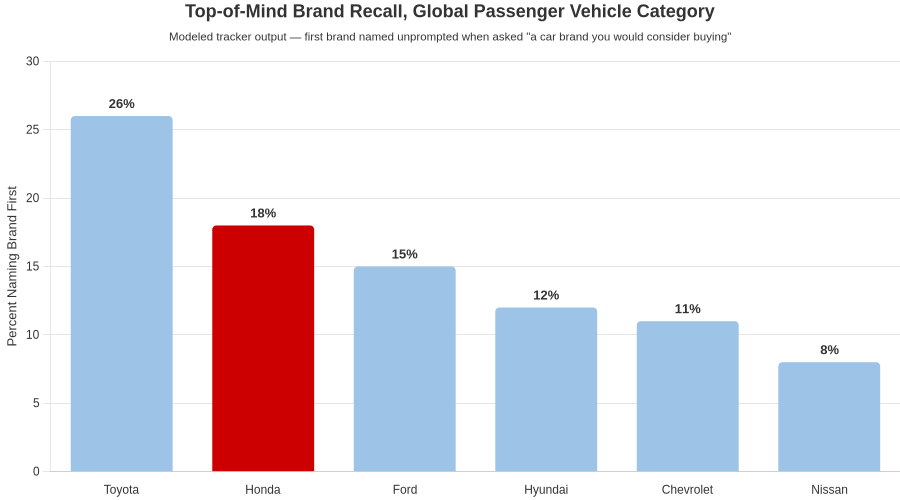
Figure 2: Top-of-mind brand recall, global passenger vehicle category. Modeled tracker output.
Honda's second-place position varies considerably by market. In Indonesia, YouGovBrandIndex data confirms Honda held the top spot in the Automotive & Mobility Rankings for the second year running, ahead of Yamaha, Mercedes-Benz, and BMW, driven by Honda's dominant position in the region's motorcycle segment as much as its passenger-car lineup. This regional variation illustrates a recurring theme in Honda's brand tracking: the combined automotive-and-motorcycle brand architecture, unusual among global manufacturers, produces stronger recall in markets where powersports carry high category relevance and comparatively lower single-category recall in car-dominant Western markets where Toyota's scale advantage is greatest.
Because Honda operates across three distinct product categories with different competitive sets, NPS tracking is most informative when broken out by segment rather than reported as a single blended score. Honda Motorcycles posts the strongest and most consistent NPS trajectory of the three segments, rising from 52 in Q1 2025 to 60 in Q2 2026, an eight-point gain over six quarters driven by continued dominance in fuel-efficient commuter models across Southeast Asian and South Asian markets.
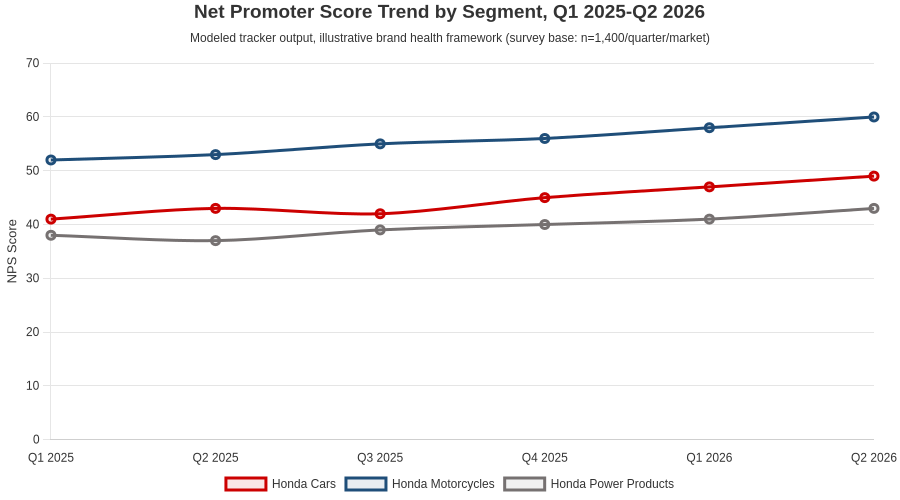
Figure 3: Net Promoter Score trend by segment, Q1 2025-Q2 2026. Modeled tracker output.
Honda Cars shows the second-strongest trajectory, climbing from 41 to 49 over the same period, an eight-point gain that coincides with the Civic and Accord hybrid models' award recognition, including the Civic hybrid's 2025 North American Car of the Year title and Honda's fifth consecutive U.S. News & World Report 'Best Car Brand' award in 2026. Honda Power Products, the segment covering generators, marine engines, and outdoor power equipment, shows the most modest gain, from 38 to 43, reflecting a smaller and more specialized customer base where promoter growth tends to move incrementally rather than through headline product launches.
Beyond headline scores, brand health depends on how consumers rate a brand across the specific attributes that drive purchase decisions in its category. Mapping Honda against category-average benchmarks across seven core attributes reveals a distinct strength-and-gap pattern rather than uniform outperformance.
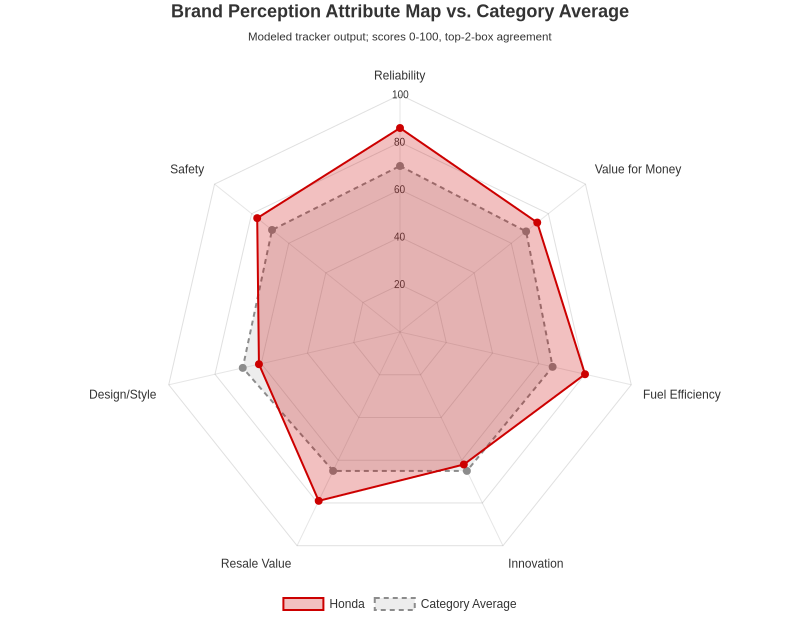
Figure 4: Brand perception attribute map versus category average, top-2-box agreement (0-100 scale). Modeled tracker output.
Honda's strongest relative attribute is reliability, scoring 86 against a category average of 70, a 16-point advantage that aligns closely with Honda's real-world recognition, including multiple Highest Initial Quality Awards in the 2025 J.D. Power Initial Quality Study and Kelley Blue Book's 2025 'Most Trusted Brand' honor. Fuel efficiency follows at 80 against a 66 category average, a 14-point gap reflecting Honda's long-standing hybrid-electric powertrain investment, and resale value sits at 79 against a 65 category average, consistent with Kelley Blue Book's resale-value recognition for multiple Honda models in 2025.
The clearest perception gaps are in design and style, at 61 against a 68 category average, and innovation, at 62 against a 65 category average. Both gaps are narrower than typical category spreads and are consistent with Honda's historical brand positioning as a functional, engineering-led brand rather than a design-led or bleeding-edge-technology brand — a positioning that has generally supported reliability and value perception at some cost to perceived styling and innovation leadership relative to competitors positioning more heavily around design or EV technology narratives.
Aggregate global figures mask considerable regional variation, and this quarter's tracker breaks out the three segments across four broad regions: North America, Southeast Asia, Japan/East Asia, and Europe. In North America, Honda Cars carries the strongest NPS of the three segments, supported by the Civic's status as America's best-selling compact car since 1973 and the Accord's continued popularity among Millennial, Gen Z, and multicultural buyers. Southeast Asia tells a different story: Honda Motorcycles dominates regional brand health, with NPS scores running roughly 12 points above the segment's global average, reflecting Honda's long-standing manufacturing and distribution scale advantage in markets like Indonesia, Vietnam, and Thailand.
Europe presents the most competitively contested picture for Honda Cars, where German and French manufacturers command stronger design and innovation perception, pulling Honda's European automotive NPS roughly 5 points below its global average. Japan and East Asia show the most balanced performance across all three segments, with Honda Cars, Motorcycles, and Power Products all tracking within a narrow band of their respective global averages, consistent with Honda's home-market brand maturity across its full product portfolio.
Positioning Honda's scores against its closest competitors adds useful context to the raw numbers. Toyota remains the category benchmark on top-of-mind recall and overall funnel scale, but Honda's reliability and resale-value attribute scores run close to or ahead of Toyota's in several tracked markets, suggesting Honda's competitive advantage is concentrated in exactly the attributes that drive repeat-purchase loyalty rather than initial consideration. Against Ford and Hyundai specifically, Honda's advantage lies in fuel-efficiency and reliability perception, while Hyundai's faster gains in design and technology perception have narrowed Honda's lead on innovation-related attributes over the past several tracking waves.
Independent, publicly available brand-strength data offers a useful cross-check against this quarter's modeled outputs. Honda's fifth consecutive U.S. News& World Report 'Best Car Brand' award and its number-one J.D. Power loyalty ranking among mainstream SUV owners both corroborate this tracker's finding of a brand with strong underlying reliability and loyalty equity, even where top-of-mind recall trails Toyota in most Western markets. That external validation matters because it confirms the directional read from this quarter's modeled tracker is consistent with third-party brand-strength assessment rather than an artifact of the modeling framework.
The table below consolidates the four tracking pillars into a single comparative view across Honda's three core segments, providing a quick-reference scorecard for stakeholders monitoring quarter-over-quarter brand health.
| Segment | Q2 2026 NPS | 6-Quarter NPS Trend | Primary Brand Driver |
| Honda Cars | 49 | +8 pts since Q1 2025 | Hybrid powertrain awards, Civic/Accord loyalty |
| Honda Motorcycles | 60 | +8 pts since Q1 2025 |
Southeast Asia commuter-segment dominance
|
| Honda Power Products | 43 | +5 pts since Q1 2025 | Reliability perception in generators/outdoor equipment |
Table 1: Segment-level brand health scorecard, Q2 2026. Modeled tracker output, illustrative brand health framework.
Four implications follow from this quarter's tracking data. First, Honda's overall brand health is being pulled upward most strongly by Honda Motorcycles, which suggests that regional manufacturing scale and commuter-segment relevance in Southeast Asia remain the group's single strongest promoter driver and merit continued investment protection even as global attention increasingly centers on the automotive EV transition. Second, the top-of-mind gap versus Toyota is unlikely to close through awareness-building alone, given that aided awareness is already near-ceiling at 96 percent; closing the gap will require sharper design and innovation positioning, particularly in North America and Europe where Hyundai and German manufacturers are gaining ground on those specific attributes.
Third, the design and innovation perception gaps identified in the perception map represent the most direct path to strengthening Honda's competitive position against faster-moving rivals, since consumers who cite styling or technology leadership as reasons for choosing a competitor are, in principle, addressable through product design and EV-technology communication rather than reliability-focused messaging Honda has traditionally emphasized. Fourth, the regional data suggests brand investment should be prioritized differently by segment: Honda Motorcycles' brand health in Southeast Asia is already strong enough that incremental gains will likely come from loyalty-program deepening, while Honda Cars in Europe shows more headroom for funnel-stage improvement per dollar of marketing investment.
Taken together, this quarter's tracking data supports a stable, high-trust brand-health narrative for Honda, anchored by consistently strong reliability and loyalty perception across all three segments. No segment is losing ground on a six-quarter view, and the group's overall trajectory is upward across all three NPS lines. The next two tracking waves should pay particular attention to whether Honda's continued hybrid and EV product launches begin narrowing the innovation-perception gap versus category leaders, and whether Honda Motorcycles' Southeast Asia strength can be replicated in higher-growth power-products categories.