The Experience Gap Between Legacy Brands and Digital-Native Challengers
Epignosis Insights Research Desk — Compiled and analyzed from government, industry association, corporate, consulting, and news sources


Epignosis Insights Research Desk — Compiled and analyzed from government, industry association, corporate, consulting, and news sources
This report, compiled and analyzed by the Epignosis Insights Research Desk, uses U.S. retail banking as a case study to test a common assumption: that digital-native challenger brands categorically outperform legacy incumbents on customer experience. The data does not support that assumption in its simple form. J.D. Power’s 2026 satisfaction research puts legacy retail banks at 657 out of 1,000 points, online-only banks at 674, and neobanksthe fintech apps without their own banking charter at just 622, a full 52 points behind online banks and only marginally ahead of the legacy average.
At the same time, digital-native challenger Chime posted 27% year-over-year revenue growth and added 1.7 million active members in the twelve months to Q2 2026, evidence that commercial momentum and experience quality are not the same thing. Layered against government enforcement data, industry mobile-adoption figures, and company disclosures, the picture that emerges is a genuine experience gap but one that runs between well-executed and poorly-executed digital experiences at least as much as it runs between legacy and challenger brands.
J.D. Power’s parallel 2026 studies of traditional and direct banking provide the clearest apples-to-apples comparison available. The U.S. Retail Banking Satisfaction Study, now in its 21st year and based on more than 107,000 customer responses, put overall satisfaction with traditional retail banks at 657 on a 1,000-point scale in 2026 up just 2 points from the prior year, with the report explicitly noting that customer experience at "key moments of truth" declined even as the headline score inched up. The companion U.S. Direct Banking Satisfaction Study found federally chartered online banks scoring 674 for checking accounts, 17 points ahead of the legacy average, while neobanksfintech apps that partner with a chartered bank for deposit insurance rather than holding their own charter scored just 622, actually below the legacy retail bank average. J.D. Power attributed the online-bank advantage specifically to "strong emotional connections rooted in personalized digital experiences," while identifying neobanks’ weakness as "a higher incidence of problems associated with the debit card and fraud/unauthorized activity, and weaker satisfaction with telephone, online chat and email support" in other words, the digital front-end experience is often excellent, but the operational back-end of problem resolution frequently is not.
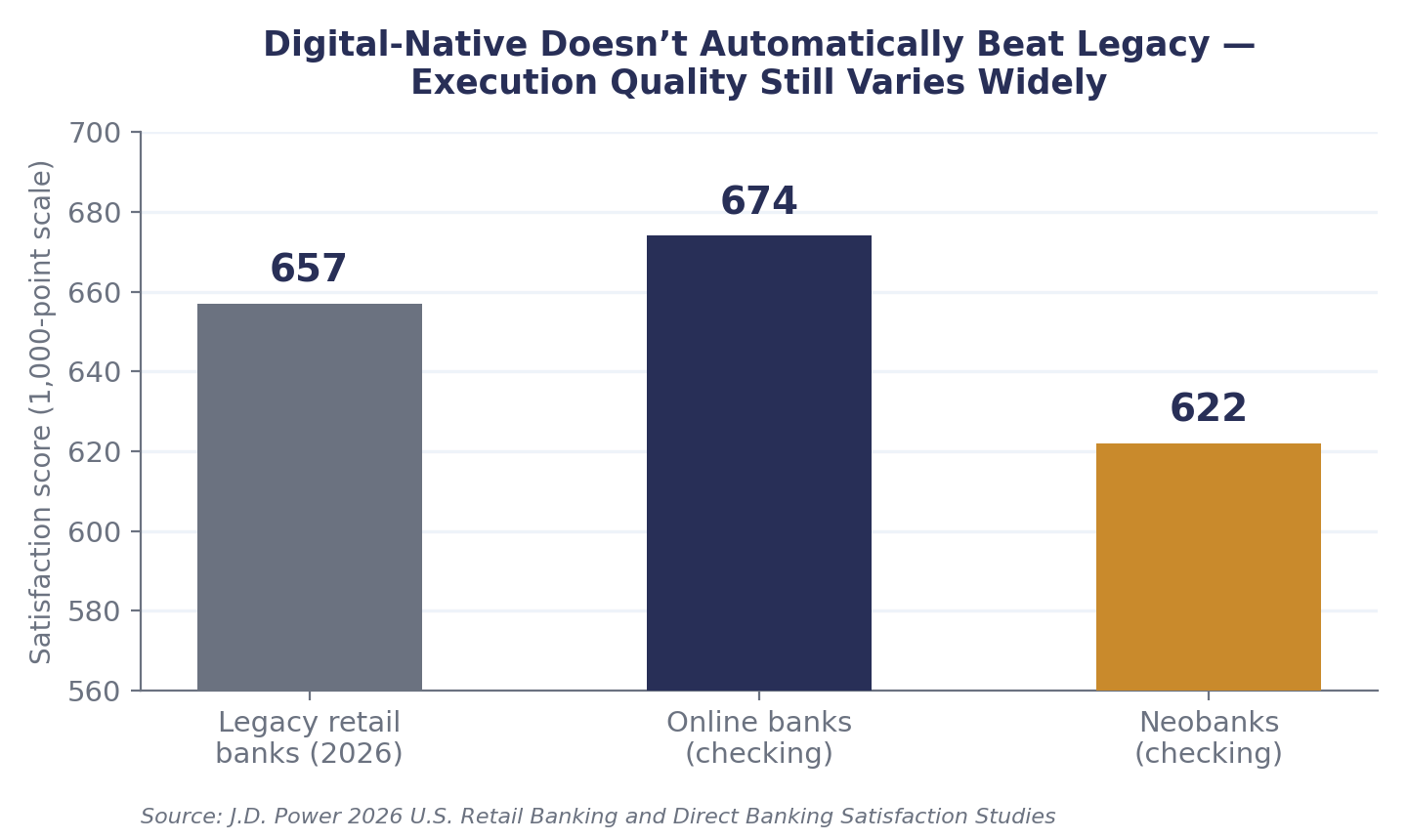
Figure 1: Customer satisfaction scores, legacy retail banks vs. online banks vs. neobanks.
The legacy banking sector’s core problem, per J.D. Power’s own framing, is not acute failure but stagnation: satisfaction "levels off," average customers now maintain three deposit accounts across different institutions rather than one primary relationship, and the banks that retain strongest loyalty are specifically the ones with "less service friction" and "better problem resolution" the same two dimensions where neobanks struggle, suggesting execution quality in these specific areas, not digital sophistication per se, is the actual differentiator. Regional and national incumbents are not standing still on the digital front: Chase led national banks in mobile app satisfaction with a score of 730, ahead of Wells Fargo (728) and Bank of America (727), while Capital One led national banks in online banking satisfaction for a second consecutive year at 725 all comfortably ahead of the leading neobank scores, indicating that the largest incumbents have closed, or in some cases reversed, the digital-experience gap through direct investment in their own platforms rather than ceding that ground to challengers.
Commercial momentum tells a different story from satisfaction scores, and Chime’s own investor disclosures illustrate why digital-native brands continue attracting capital and customers despite an uneven satisfaction record. Chime reported second-quarter 2026 revenue of $669.8 million, up 27% year over year, with active members climbing 20% to 10.4 million and adjusted EBITDA margin expanding to 15% from roughly 3% a year earlier the company’s second consecutive quarter of positive GAAP net income following its June 2025 Nasdaq listing. Management raised full-year 2026 guidance and now expects to add 1.8 million net new active members for the year, describing it as the company’s largest annual cohort ever. Notably, Chime still ranked third among high-yield savings providers in J.D. Power’s 2026 study at 714 points, ahead of most other neobanks and only 25 points behind category leader Marcus by Goldman Sachs evidence that Chime’s specific execution outperforms the neobank category average even as the category overall trails online banks.
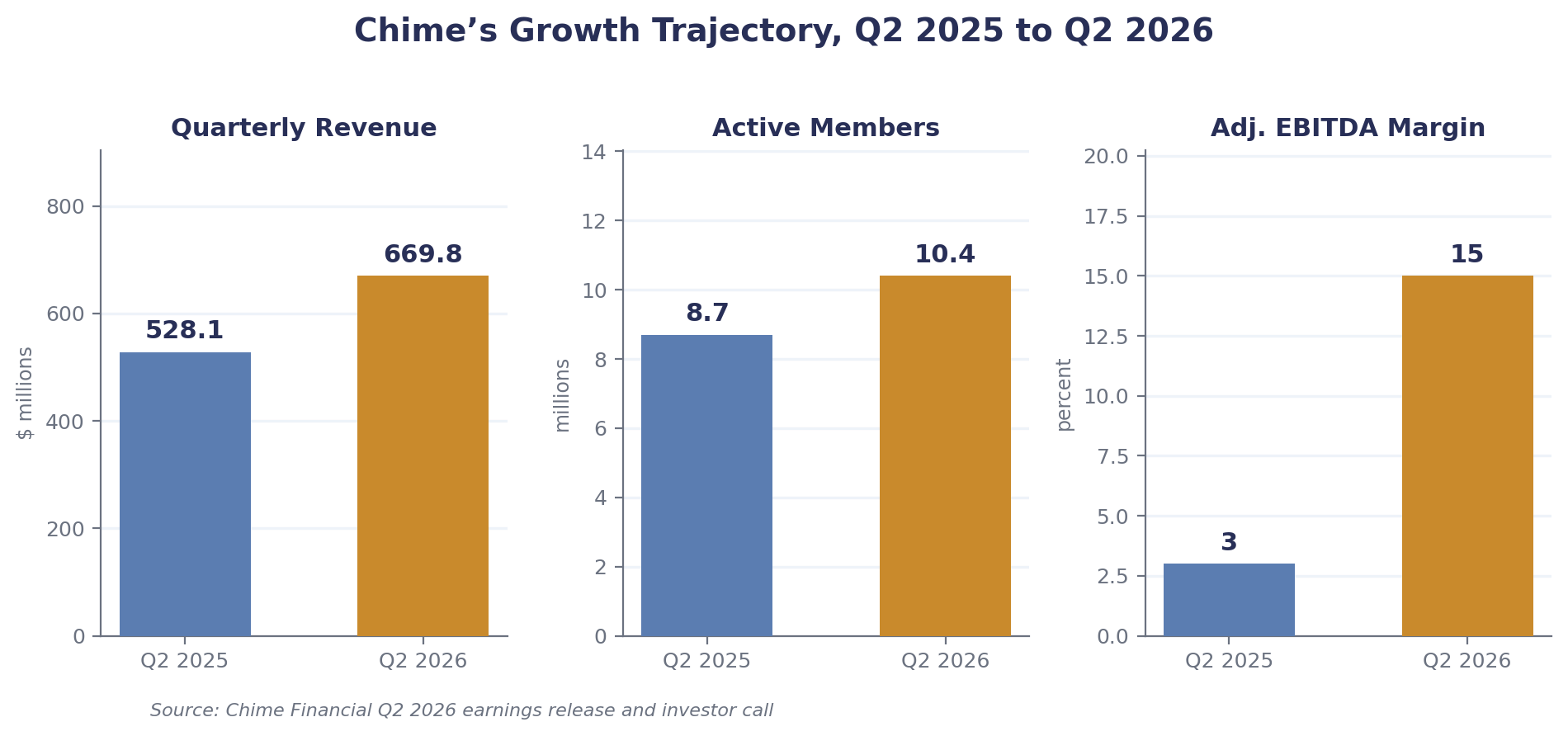
Figure 2: Chime Financial’s growth metrics, year over year.
Government enforcement and complaint data adds a regulatory dimension the satisfaction surveys do not fully capture. The Consumer Financial Protection Bureau issued a formal order against Chime Financial in May 2024 for illegally delaying consumer refunds, with then-CFPB Director Rohit Chopra stating that "Chime’s customers had to wait weeks or months for access to their own money and were forced to use alternative funds to cover their essential expenses." NerdWallet’s 2026 banking review — which named Chime the best overall checking account in the same report nonetheless docked the company half a star specifically because of "a disproportionately high number of complaints" in the CFPB’s public complaint database relative to the asset size of its FDIC partner banks, The Bancorp Bank and Stride Bank. This pattern is not unique to Chime: it reflects a structural feature of the neobank model, where a fintech’s complaint volume is measured against small partner-bank balance sheets rather than against its own much larger customer base, making regulatory complaint ratios a persistently noisy signal across the category. Separate 2026 reporting also disclosed that a data breach traced to an April cyberattack locked roughly 20,000 Chime customers out of their only bank account, underscoring a risk specific to app-only banking relationships: when the single digital channel fails, affected customers have no branch or alternate access point to fall back on.
Independent of any single brand’s performance, the channel preference data compiled from government and industry-association sources shows the entire market, legacy and challenger alike, has moved decisively toward mobile as the default banking relationship. FDIC survey data shows mobile banking grew from roughly 5% of primary channel usage a decade ago to 48.3% of U.S. banked households by 2023 the steepest channel shift the FDIC has recorded since it began tracking access methods while teller-based access was cut by more than half over the same period. The American Bankers Association’s most recent national survey, conducted by Morning Consult in October 2025, found the mobile share had climbed further to 55%, the sixth consecutive year mobile has ranked as the top banking method, with the shift crossing generational lines: over half of Generation X and nearly 40% of Baby Boomers now also rely on mobile apps as their primary tool, not just digitally native younger cohorts. This matters directly for the legacy-versus-challenger debate because it means the channel legacy banks once treated as a challenger-brand differentiator, the mobile app, is now simply table stakes which is precisely why J.D. Power’s data shows the largest incumbents investing directly in mobile app quality rather than conceding that ground.
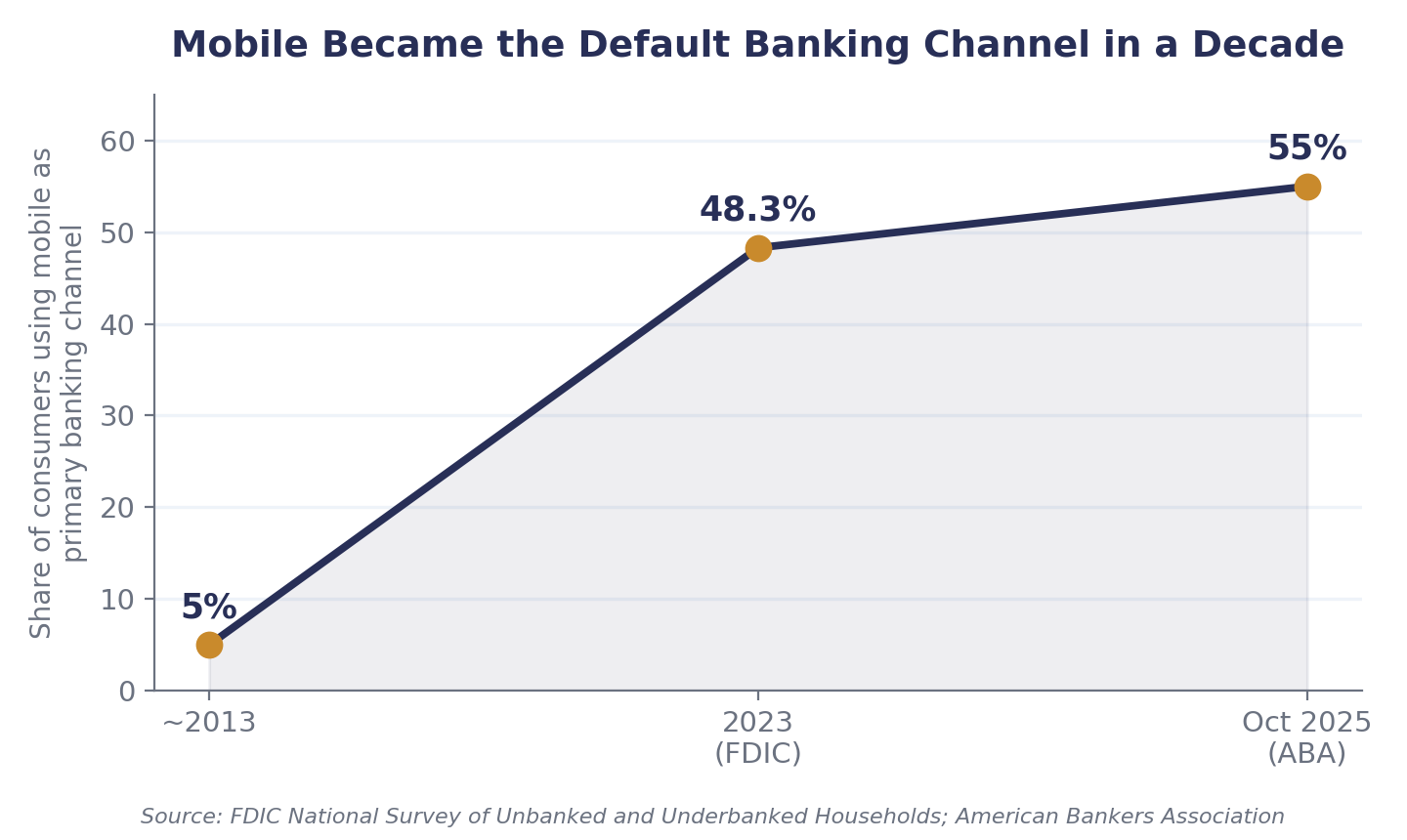
Figure 3: Share of U.S. consumers using mobile as their primary banking channel, ~2013–2025.
Perhaps the most consequential finding in J.D. Power’s 2026 research is the sheer performance spread within the digital-native category itself: a 225-point gap in checking-account satisfaction between the top-performing online bank and the lowest-ranked neobank, and a 186-point gap in the high-yield savings segment spreads larger than the entire gap between the legacy-bank average and the best digital challengers. This means "digital-native" is not a reliable predictor of experience quality on its own; a well-run online bank like Charles Schwab Bank, which ranked highest in checking satisfaction for an eighth consecutive year at 750, delivers a meaningfully better experience than both the legacy retail bank average and many of its fellow digital-native peers, while poorly-run neobanks can underperform legacy incumbents entirely. The operative variable, consistent with J.D. Power’s own diagnosis, is execution on service quality and problem resolution — dimensions that have nothing inherently to do with whether a brand was born digital or migrated to digital, and everything to do with whether the company invested in the unglamorous parts of customer service alongside the interface design.
Part of the variance documented above traces to a structural difference between how legacy banks and neobanks are actually built, not just how they are branded. Federally chartered online banks and large incumbents own their full banking stack the charter, the core banking system, fraud operations, and customer service under a single regulatory and operational roof, which is part of why Charles Schwab Bank and Ally can deliver both strong digital interfaces and strong problem-resolution scores simultaneously. Neobanks, by contrast, operate as technology and marketing layers on top of one or more smaller partner banks that hold the actual charter and deposit insurance, meaning fraud investigation, dispute resolution, and regulatory compliance frequently span two organizations with different incentives and system architectures. This split-responsibility model is a plausible structural explanation for J.D. Power’s finding that neobanks specifically underperform on "high incidence of customer problems and weaker telephone and online chat support when problems occur" even while matching online banks on interface personalization — the parts of the experience that live entirely within the neobank’s own app are strong, while the parts that require coordination with a partner bank’s back office are where satisfaction breaks down.
Legacy banks retain at least one durable structural advantage that no amount of digital investment by a challenger brand can fully replicate in the near term: physical, in-person access, which still matters disproportionately to specific customer segments and specific moments of need. J.D. Power’s retail banking research ranks "trust" as the single most important of the seven satisfaction dimensions it measures, ahead of digital channels and even ahead of resolving problems or complaints, and separate ABA survey data shows that among customers who do not have an online-only account, the two leading reasons are a preference for branch access and, closely behind, a preference for in-person problem resolution reasons that skew heavily toward older customers and toward higher-stakes financial moments such as mortgage applications, estate matters, and large fraud disputes. This is the direct counterpart to the neobank service-quality gap documented above: legacy institutions win specifically at the complex, high-emotional-stakes interactions that are hardest to automate, while digital-native challengers win at the fast, low-friction, high-frequency interactions that make up the majority of day-to-day banking activity. Neither model currently dominates the full range of what a banking relationship requires, which is the core reason the "digital-native wins" narrative oversimplifies what the underlying data actually shows.
The evidence compiled by Epignosis Insights across government, association, corporate, and analytics sources points toward convergence rather than a simple digital-native victory. Legacy banks are closing the mobile-experience gap through direct platform investment, as shown by Chase, Capital One, and Huntington’s leading digital satisfaction scores; digital-native challengers are simultaneously discovering that scale without operational maturity in fraud handling and support responsiveness produces exactly the regulatory and satisfaction problems that J.D. Power and the CFPB have separately documented at Chime. For organizations on either side of this divide, the report’s underlying data argues against treating "digital-native" as a strategy in itself: the brands winning on experience, in both the legacy and challenger categories, are the ones pairing digital convenience with reliable problem resolution — and the brands losing ground, regardless of origin, are the ones that have not yet closed that same gap.
| Metric | Figure |
| Legacy retail bank satisfaction score, 2026 | 657 / 1,000 |
| Online bank checking satisfaction score | 674 / 1,000 |
| Neobank checking satisfaction score | 622 / 1,000 |
| Chime revenue growth, Q2 2025→Q2 2026 | +27% YoY |
| Mobile as primary banking channel, Oct 2025 | 55% |
| CFPB enforcement order against Chime (delayed refunds) | May 2024 |