Global Recycled Cardboard Price Tracker
Epignosis Insights Research Desk — Monthly Report, August 2026


Epignosis Insights Research Desk — Monthly Report, August 2026
Old Corrugated Containers (OCC), the recycled-cardboard feedstock behind most containerboard production, are in the middle of a genuine but incomplete recovery. Epignosis Insights' Global Recycled Cardboard Price Tracker finds U.S. OCC spot prices have climbed from roughly $80 per ton in early 2026 to approximately $100 per ton by mid-year, an incremental monthly rise that has outpaced most market participants' expectations, yet current levels remain well below the five-year average of $140 per ton. Southeast U.S. mills paid roughly 12% more, about $10 per ton, for OCC and other brown grades in June alone, while sorted office paper climbed $11 per ton over the same month, evidence the recovery is broadening beyond a single grade. Behind the price move sits a supply story: containerboard capacity rationalization at International Paper and Smurfit Westrock has tightened domestic OCC demand precisely as several producers signal improving order books. This edition compiles and cross-validates pricing signals from government trade data, industry price-reporting agencies, company disclosures, financial-sector analysis, and trade press into a single monthly view, with Epignosis Insights' own commentary on what the divergence between regions and grades means for buyers and sellers over the next two quarters.
This report is compiled and issued monthly by Epignosis Insights as part of its Recovered Fibre Tracker series. Rather than fielding an independent price survey, Epignosis Insights triangulates and cross-validates pricing signals across multiple public and licensed data sources each month, government trade statistics, industry price-reporting agencies, company earnings disclosures, and specialist trade press, to produce a consolidated view of the recycled-cardboard market that no single source captures alone. Sources referenced in this edition include the U.S. Census Bureau's foreign trade data, Germany's Federal Statistical Office (Destatis), Fastmarkets' PPI Pulp & Paper Week pricing service, price-index firm TTOBMA, financial analysis from Stifel, and company disclosures from Sonoco Products, International Paper, Packaging Corporation of America, and Smurfit Westrock, alongside reporting from Recycling Today, Waste Today, Waste Dive, and Packaging Dive. Because different price-reporting agencies use different sampling methodologies, basis points (FOB seller's dock versus delivered mill), and grade definitions, Epignosis Insights notes the source and basis explicitly wherever a specific figure is cited, and does not average across methodologically incompatible series. Historical annual benchmarks referenced in this edition draw on the City of Seattle's Commercial Recycled Materials Market Report, a municipal data series tracking OCC and related grades since the early 1990s.
The clearest signal in this month's tracker is the sustained, if modest, recovery in U.S. OCC pricing. According to price-index firm TTOBMA, OCC prices have increased incrementally every month in 2026, moving from roughly $80 per ton early in the year to approximately $100 per ton by July, a pace the firm's own director of recovered paper described as outpacing expectations. Financial-sector analysis from Stifel places the turning point in November 2025, when OCC prices bottomed before adding roughly $5 per ton through early March, a view corroborated by Fastmarkets, which reported the second consecutive month of $1-to-$5-per-ton OCC increases across parts of the U.S. in early March, driven by seasonally slowed generation and winter-weather transportation disruptions. Momentum accelerated into early summer: Fastmarkets reported that mills in the U.S. Southeast were paying roughly 12% more, about $10 per ton, for OCC and other brown grades at the start of June compared with May, while sorted office paper climbed to $132 per ton, up $11 from the prior month. Even with this run of consecutive increases, TTOBMA's own benchmark places current pricing well below the five-year OCC average of $140 per ton, underscoring that the market is normalizing from a genuinely depressed 2025 rather than entering a new pricing regime.
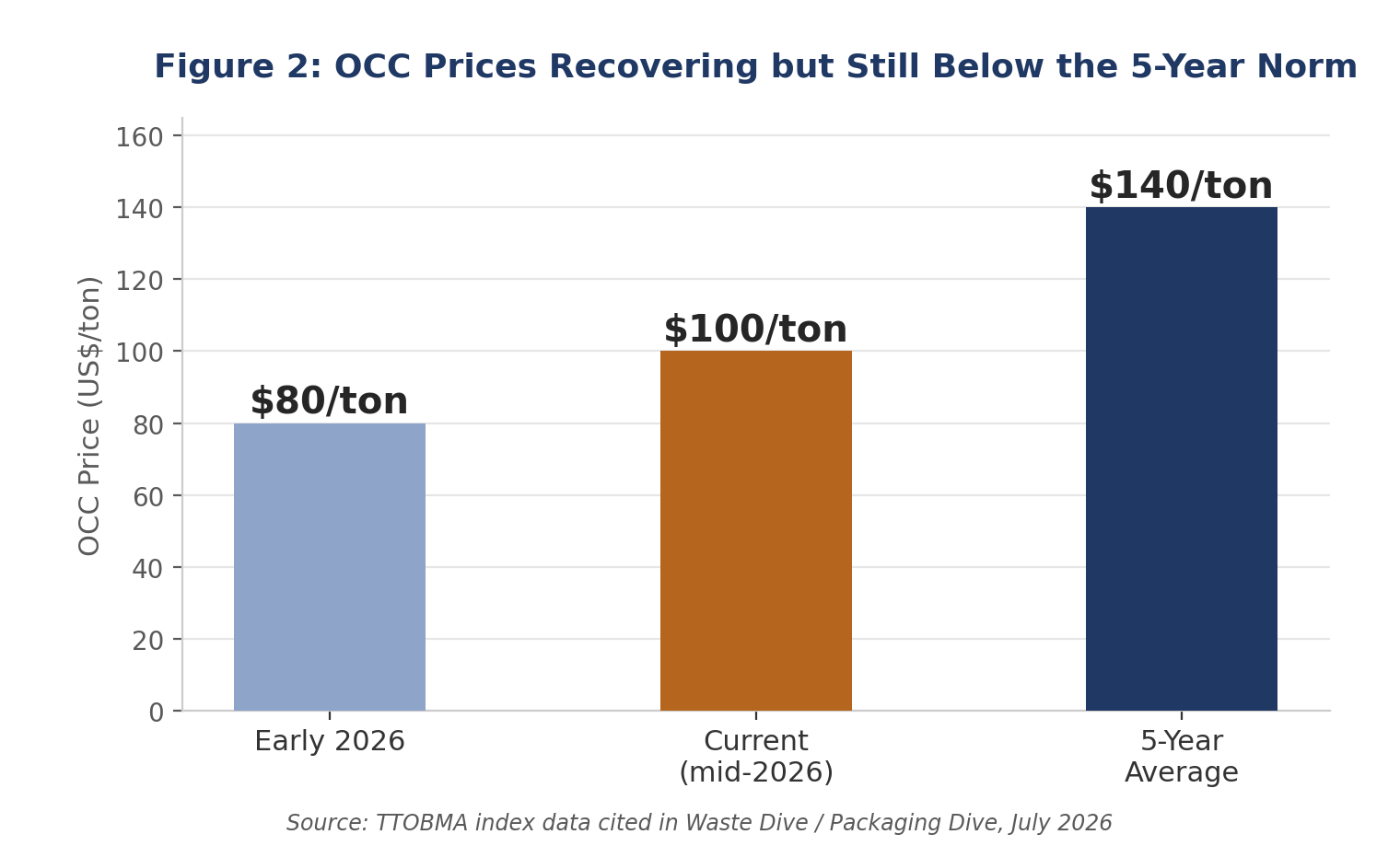
Figure 2: OCC spot price recovery against the five-year average. Source: TTOBMA index data cited in Waste Dive / Packaging Dive, July 2026.
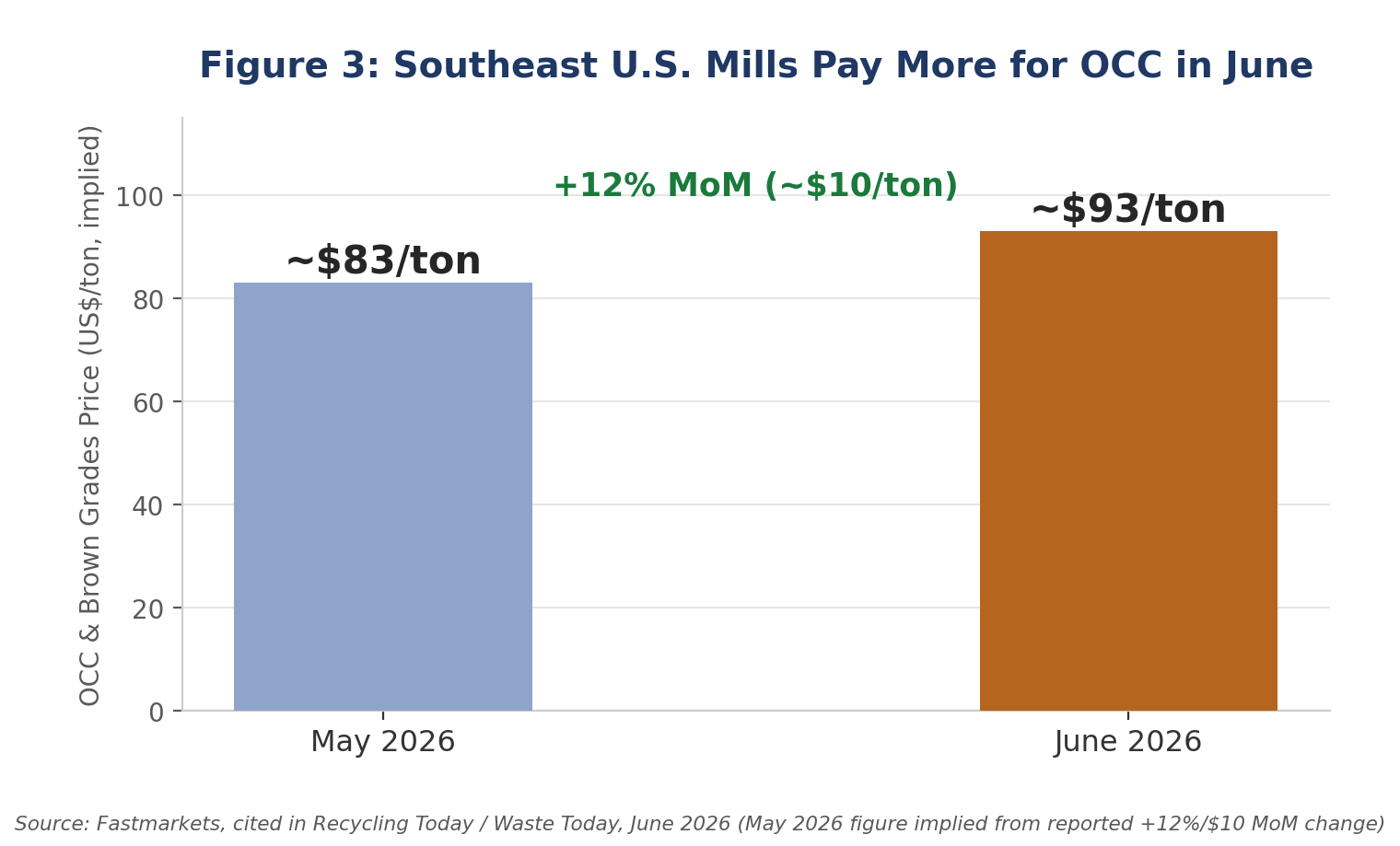
Figure 3: Southeast U.S. mill OCC pricing, May vs. June 2026. Source: Fastmarkets, cited in Recycling Today / Waste Today.
Epignosis Insights' longer-run benchmark data, drawn from the City of Seattle's Commercial Recycled Materials Market Report, shows OCC has never been a stable-priced commodity: annual average prices swung from roughly $28 per ton in 2001 to a peak above $160 per ton in 2017, with two additional distinct cycles in between, driven variously by export demand, economic cycles, and shifts in Asian import policy. This context matters for interpreting the current rebound: a move from $80 to $100 per ton, while meaningful for recyclers' margins month to month, sits well within the band of normal cyclical volatility this commodity has displayed for at least three decades, rather than signaling a structural repricing of the category.
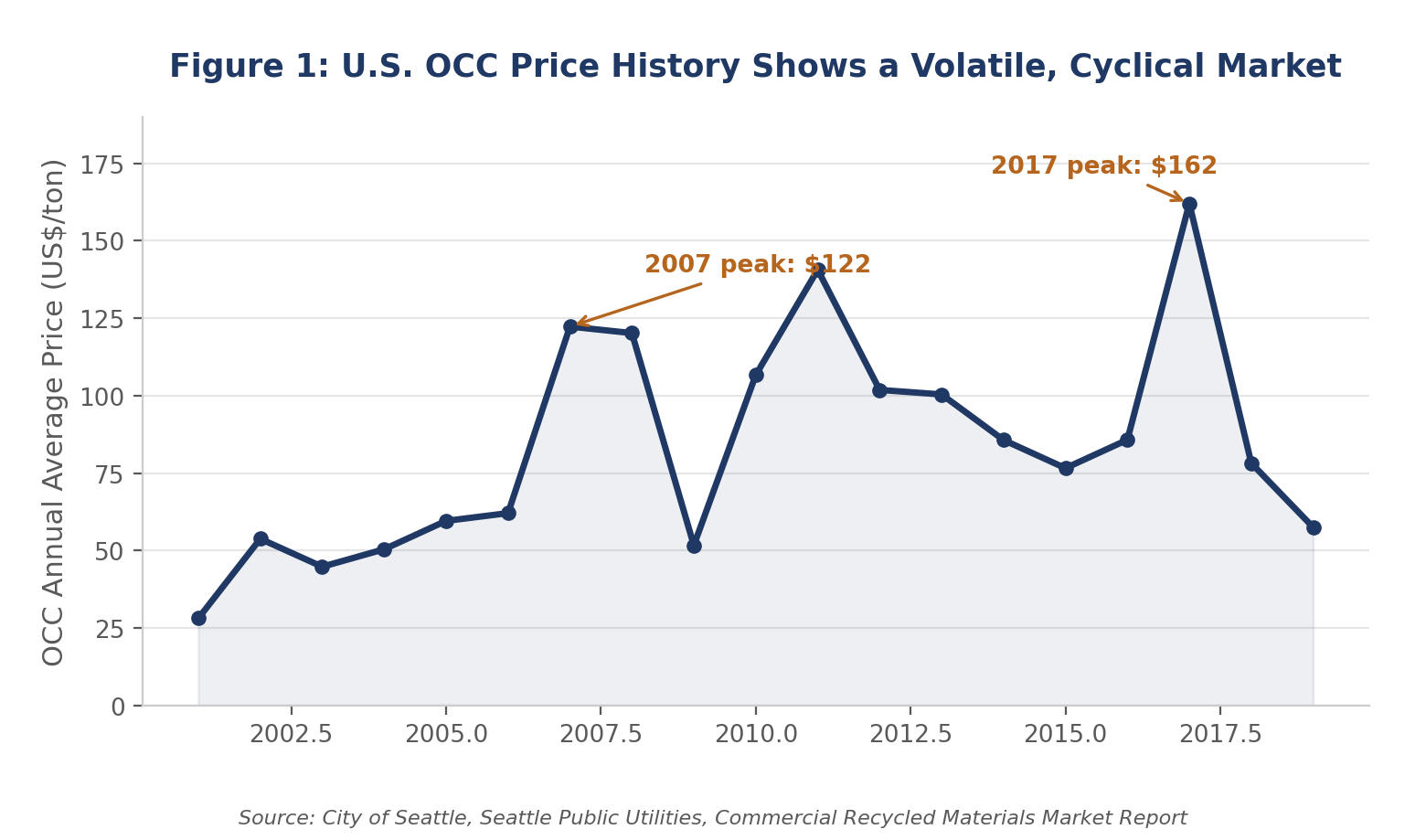
Figure 1: U.S. OCC annual average price history. Source: City of Seattle, Seattle Public Utilities, Commercial Recycled Materials Market Report.
The recovery is not confined to OCC. Sorted office paper (SOP), a higher-grade recovered fibre used in tissue and higher-value paper products, averaged $132 per ton at the start of June, an $11 increase from May, according to Fastmarkets. Epignosis Insights views the parallel movement of OCC and SOP as an important corroborating signal: when only one grade moves, the driver is often grade-specific supply disruption, but when brown packaging grades and higher-grade office paper move together, it more typically reflects broad-based demand strength or a genuine tightening of collection volumes across the recovered-fibre system as a whole.
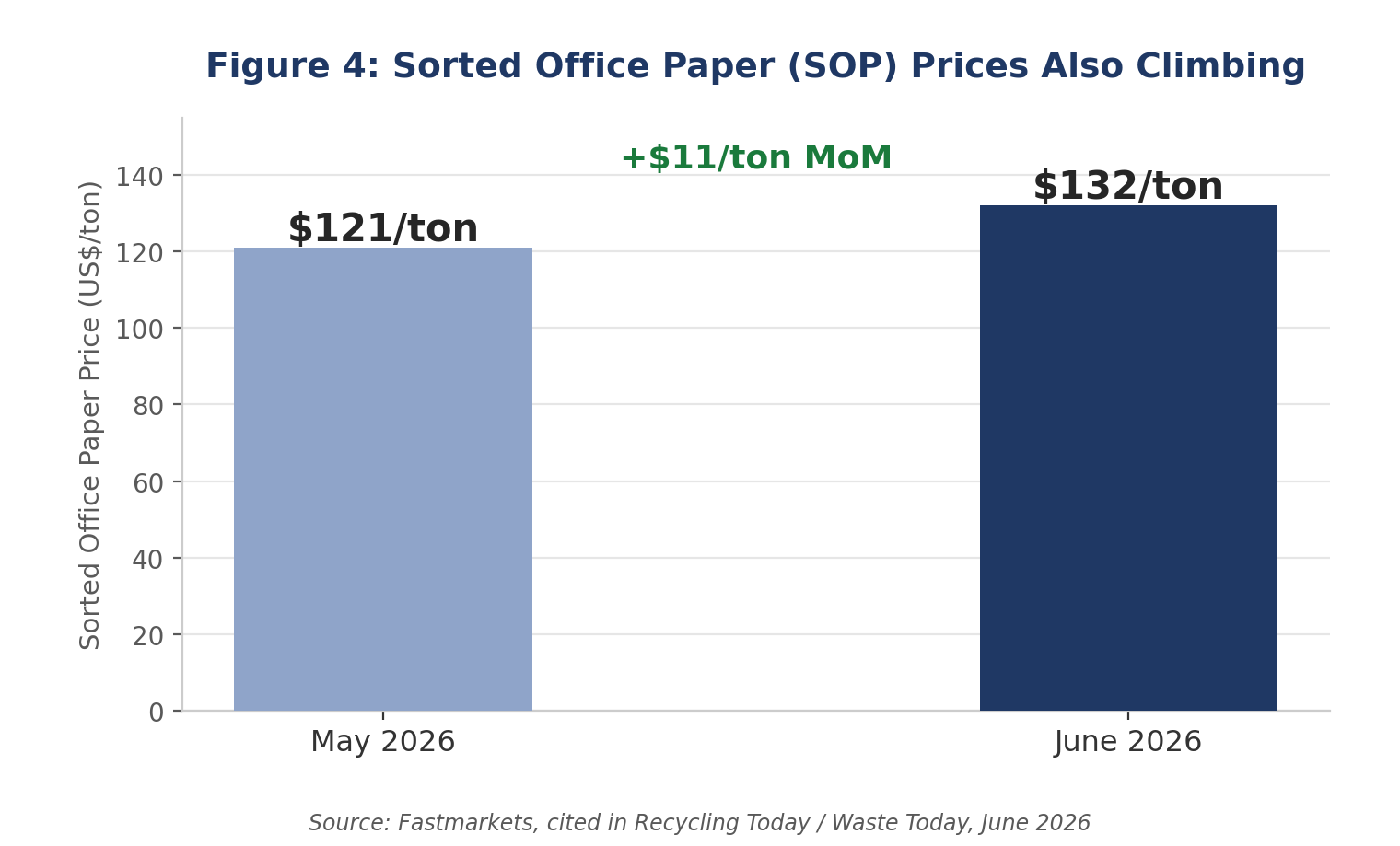
Figure 4: U.S. sorted office paper (SOP) pricing, May vs. June 2026. Source: Fastmarkets, cited in Recycling Today / Waste Today.
Trade data adds an important dimension to the pricing story. According to U.S. Census Bureau figures cited by Fastmarkets, total U.S. recovered paper exports rose 2.3% in the first quarter of 2026, with OCC exports specifically up 6.1% in early 2026, shipments heading to India, Indonesia, Malaysia, South Korea, Taiwan, Thailand and Vietnam. Strong domestic demand has kept a larger share of U.S. tons at home even as exports grew, a combination that has tightened the domestic spot market from both directions simultaneously. On the supply side, containerboard producers have been rationalizing capacity: Smurfit Westrock has moved to cut nearly 450,000 metric tons of recycled containerboard capacity at its St. Paul, Minnesota site, while International Paper has reduced annual containerboard volumes by roughly 900,000 metric tons following the closure of its Riceboro and Savannah, Georgia mills. Germany's Federal Statistical Office (Destatis) reports a parallel European dynamic: recovered paper and board exports fell in the first quarter of 2026 compared with the same period last year, while imports rose, suggesting European mills are also pulling more material inward rather than releasing it to export markets.
Epignosis Insights views the combination of rising exports and rising domestic consumption as the more unusual signal in this month's data. In a typical tightening cycle, mills either compete harder for domestic tons, which shows up as falling exports, or exporters chase stronger overseas pricing, which shows up as falling domestic availability; seeing both rise together points to genuine growth in total recovered-fibre generation and collection volumes, not simply a reallocation between buyers. That distinction matters for the outlook: reallocation-driven tightening tends to reverse quickly once one channel's pricing advantage narrows, whereas generation-driven tightening, if it persists, provides a more durable floor under prices because it reflects the underlying volume of cardboard entering the collection stream, not which buyer captures a given ton.
Rising input costs are beginning to show up in finished-product pricing. South Carolina-based recycled paperboard producer Sonoco Products announced a $70-per-ton price increase across all grades of uncoated recycled paperboard (URB) in the United States and Canada, effective for shipments beginning April 3, an announcement Fastmarkets and Recycling Today linked directly to the OCC price increases feeding into Sonoco's input costs. On recent earnings calls, International Paper executives described the containerboard market as tightening, while Packaging Corporation of America's CEO Mark Kowlzan reiterated during a June conference that the containerboard market remains tight. Epignosis Insights notes this creates a genuinely divergent set of incentives across the value chain: rising OCC prices improve margins for recyclers and collectors, but they compress margins for containerboard and packaging producers who have not yet fully passed the increase through to their own customers, a gap that historically resolves through a combination of price increases, like Sonoco's, and capacity discipline, like the International Paper and Smurfit Westrock cuts already underway.
This divergence is worth watching closely over the coming two quarters because it tends to resolve in one of two ways. Either containerboard and packaging producers successfully pass the higher input cost through to their own corrugated-box customers, in which case Epignosis Insights would expect further finished-product price announcements similar to Sonoco's April move, or producers absorb the margin compression temporarily while betting that OCC prices retreat before the pass-through becomes necessary. The scale of capacity already removed from the market by International Paper and Smurfit Westrock suggests the industry is currently positioning for the former scenario, tightening supply deliberately rather than waiting passively for input costs to fall back.
Epignosis Insights expects the incremental monthly OCC price gains observed since November 2025 to continue through the third quarter of 2026, supported by continued containerboard capacity discipline at International Paper and Smurfit Westrock and by resilient export demand from Southeast and South Asian buyers. However, with current pricing still roughly 30% below the five-year average, we do not expect a return to 2017-style peak pricing within this cycle absent a fresh supply shock. Buyers should expect continued month-on-month volatility in the $5-to-$15-per-ton range rather than a smooth upward trend, and downstream packaging producers should anticipate further finished-product price increases similar to Sonoco's April URB adjustment if OCC costs continue climbing through the back half of the year.