
Chemical Industry Talent Gap: Why Process Engineers Are in Short Supply
Chemical manufacturers are entering a decade in which the people who run their plants are retiring faster than universities can replace them. Even as some majors trim headcount through automation, employers report their hardest hiring problem in years for process engineers, the specialists who keep reactors, distillation columns and control systems running safely. This analysis draws on the U.S. Bureau of Labor Statistics, the American Institute of Chemical Engineers (AIChE), the American Chemistry Council (ACC), Deloitte, and recent company and news disclosures to separate the structural talent gap from cyclical headline noise.
The Graduate Pipeline Is Shrinking Just as Demand Rises
The clearest evidence of a structural gap comes from AIChE's own membership data. Writing in Chemical Engineering Progress in October 2025, AIChE projects that the number of chemical engineering graduates will fall by 38% over the next decade even as industry demand for that talent rises by 10%, a scissors effect with no recent precedent. Unlike past enrollment slumps, which AIChE researchers describe as following a roughly 15-year boom-bust cycle tied to the broader economy, the current downturn is colliding directly with a retirement wave, compounding rather than following the usual pattern. The Bureau of Labor Statistics separately projects chemical engineering employment to grow around 3% through 2034, generating roughly 1,100 openings a year nationally, with a 2024 median annual wage of $121,860, a modest growth rate that nonetheless outpaces the shrinking supply of qualified new graduates entering the field.
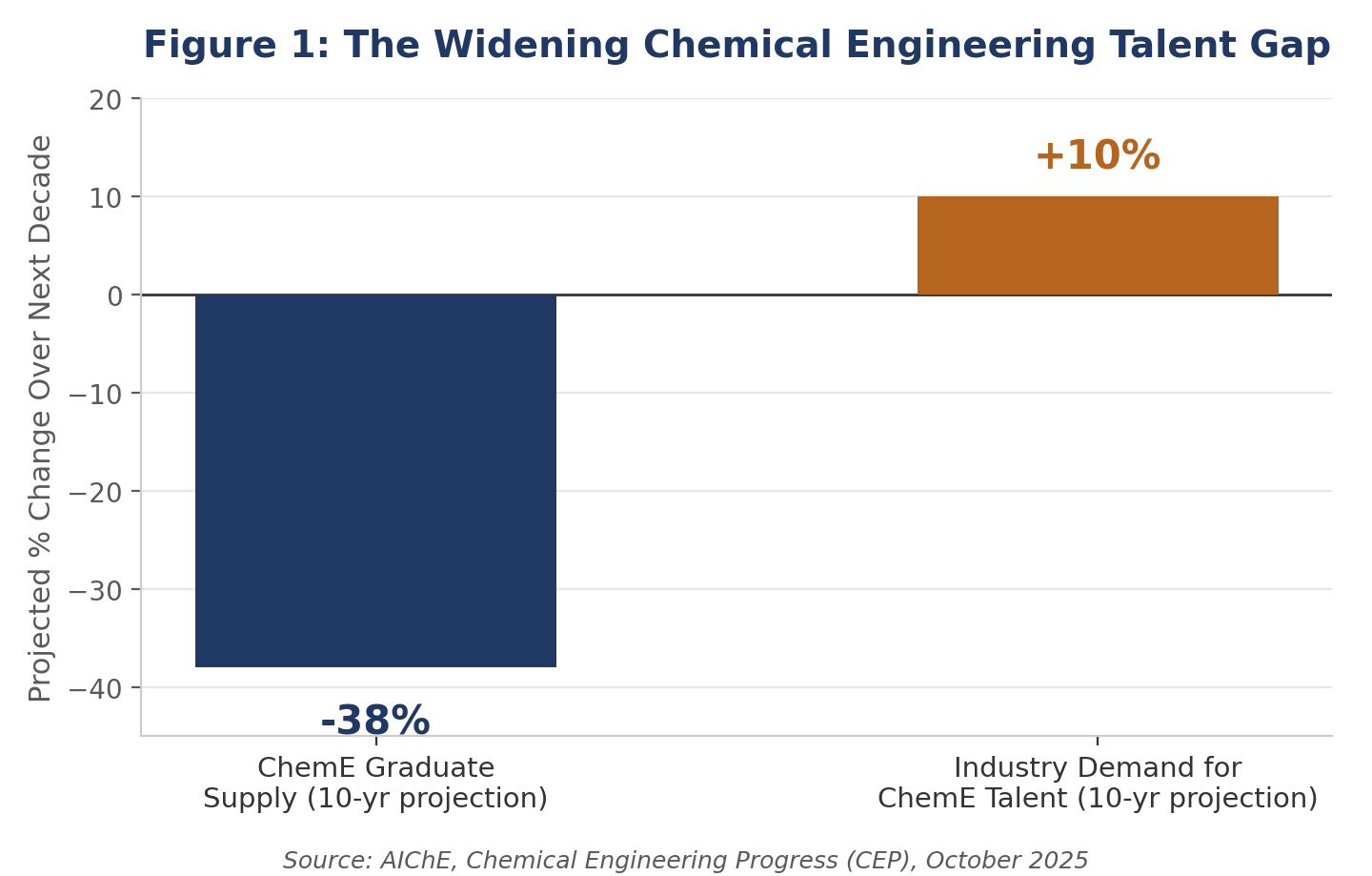
Figure 1: Projected change in chemical engineering graduate supply versus industry demand over the next decade. Source: AIChE, Chemical Engineering Progress, October 2025.
A Retirement Wave Is Draining Institutional Process Knowledge
Behind the graduate shortfall sits a deeper demographic problem. Industry workforce analysis built on 2026 Bureau of Labor Statistics figures shows that roughly a quarter of the U.S. chemical manufacturing workforce is eligible to retire within five years, a cohort whose plant-specific process knowledge is rarely captured in manuals or training documents. The American Chemistry Council puts the scale of what is at stake in context: the industry directly supports 547,000 skilled American jobs at an average annual pay of $104,000, with total employment expected to stay largely flat through 2026 and 2027. Flat headcount growth sounds stable on paper, but it masks the reality that steady attrition from retirements, without a matching wave of new hires, quietly shrinks the pool of experienced process engineers available to run increasingly complex plants.
Compensation Is Climbing, Clear Evidence the Market Is Tight
Pay data offers the sharpest real-time signal of how tight this labor market has become. AIChE's 2025 Salary Survey put the median chemical engineer salary at $160,000, up 6.67% from $150,000 in the 2023 survey, while the median salary for new graduates rose 6.04% to $79,000 over the same period. Time-to-hire is compressing too: engineers who graduated in 2022 through 2024 found their first job in an average of 4.3 months, a full month faster than the previous survey cycle. Employers do not raise compensation and accelerate hiring timelines this consistently unless qualified candidates are genuinely scarce.
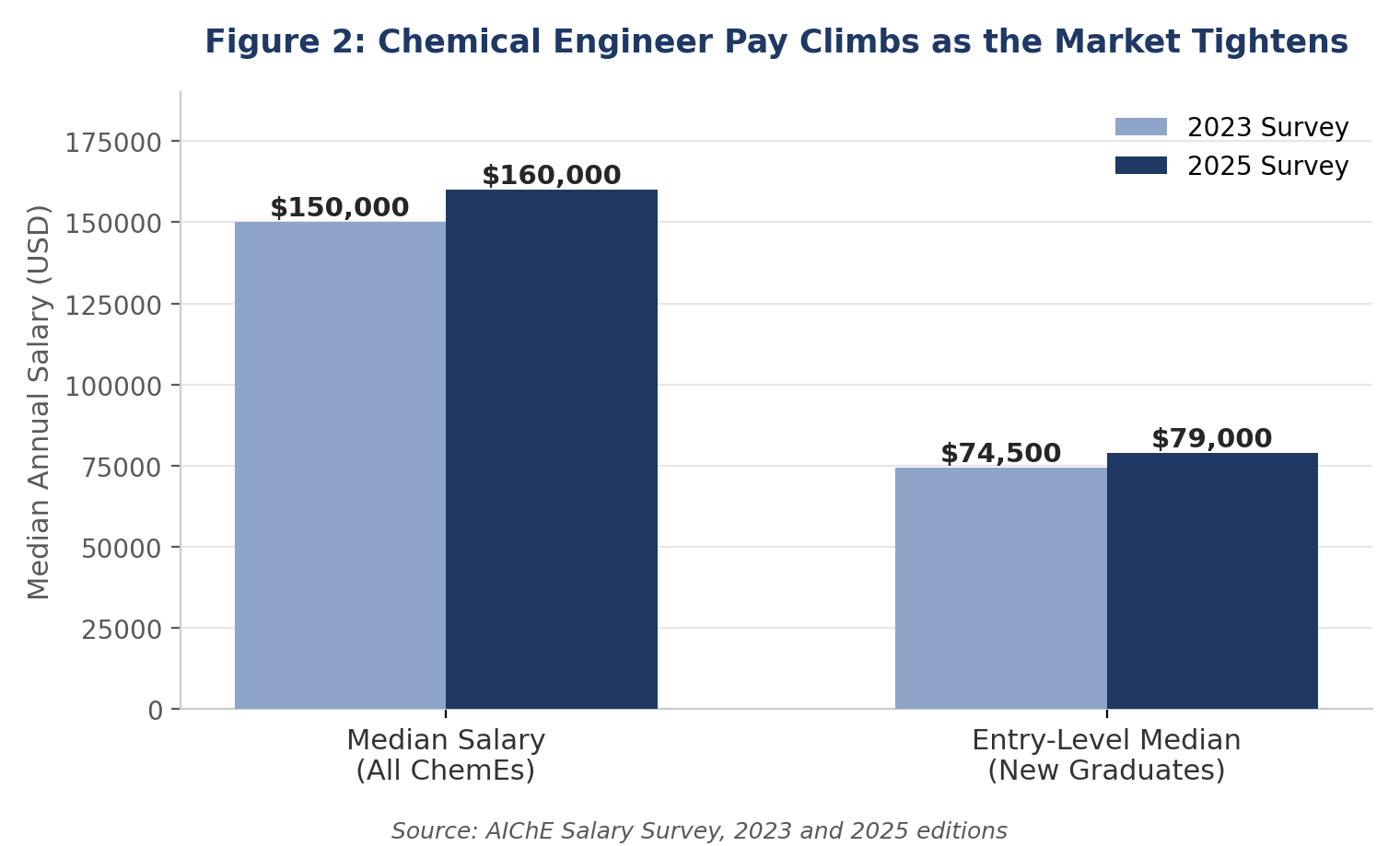
Figure 2: Median chemical engineer compensation, 2023 versus 2025. Source: AIChE Salary Survey, 2023 and 2025 editions.
Restructuring Headlines Mask a Very Specific Skills Shortage
Recent layoff headlines can make the shortage narrative look contradictory. Dow announced in January 2026 that it would cut approximately 4,500 roles, about 13% of its global workforce, as part of a restructuring program that leans more heavily on automation and artificial intelligence, while ExxonMobil confirmed it will close its Fife ethylene plant in Scotland by February 2026, putting more than 400 jobs, including six apprenticeships, at risk. These moves reflect asset rationalization and portfolio restructuring at specific sites, not a surplus of qualified process engineers.
Deloitte's 2026 Chemical Industry Outlook identifies the hybrid technical-digital skill set, engineers who can pair core process knowledge with automation, data analytics and control-systems fluency, as the primary workforce constraint facing the sector, meaning companies are cutting legacy roles in some locations while still struggling to fill specialized process-engineering and digital-control positions elsewhere.
Closing the Gap
The response taking shape across the industry combines three moves: hybrid degree programs, such as the University of Illinois's new Chemical Engineering plus Data Science track, that graduate engineers fluent in both process fundamentals and automation; structured knowledge-transfer and mentorship programs that capture retiring engineers' plant-specific expertise before they leave; and continued upward pressure on compensation to compete for a shrinking pool of qualified candidates. Companies that treat this purely as a hiring problem, rather than a pipeline and knowledge-transfer problem, are likely to fall further behind as the retirement wave accelerates over the next five years.